The 1984 Dodge W150 is a stalwart of the full-size pickup truck segment, produced as part of Dodge's D-series line which ran from 1972 to 1993. This robust ½-ton truck was available as a regular cab with a standard or long bed. Key trims often included the base model and the more upscale Royal SE. While specific pricing varied greatly, these trucks were known for their straightforward, durable construction and availability of powerful V8 engines, making them a popular choice for work and recreational use that continues to appeal to classic truck enthusiasts.
The Good
The 1984 Dodge W150 offers impressive V8 power for its era, coupled with a reputation for rugged reliability, making it a practical workhorse. Its classic, no-nonsense design resonates with enthusiasts, while its utilitarian comfort suits daily tasks. For value buyers, its enduring nature and potential for classic status are significant advantages.

The Bad
Common weaknesses for the 1984 Dodge W150 include potential for rust, especially in the lower body panels and frame. Older electrical systems can be prone to gremlins, and worn suspension components are frequent issues. Carburetor-related problems can also arise, affecting engine performance and fuel efficiency.
1984 Dodge W150: Quick Overview
- Engine Options: The 1984 Dodge W150 was primarily offered with a range of gasoline engines. The standard engine was often a 3.7L Slant-Six inline-six. More commonly chosen for better performance were the V8 options, including a 5.2L (318 cubic inch) V8 and a larger 5.9L (360 cubic inch) V8. Diesel options were also available in some configurations, though less common in the W150 4x4.
- Horsepower: Horsepower varied significantly by engine and year. The 3.7L Slant-Six typically produced around 95-100 horsepower. The 5.2L V8 generally offered in the range of 140-150 horsepower, while the 5.9L V8 could push closer to 170-180 horsepower. These figures are approximate and varied based on specific tuning and emissions equipment.
- Fuel Economy: Fuel economy for the 1984 W150 was not a strong suit, especially with the V8 engines and 4x4 drivetrain. Expect figures in the range of 12-16 miles per gallon combined, with highway mileage potentially reaching up to 18 MPG under ideal conditions. The Slant-Six would be slightly more economical but lacked power.
- 0-60 Times: 0-60 mph times were respectable for a truck of this era, particularly with the V8 engines. Trucks equipped with the 5.2L V8 could achieve 0-60 mph in roughly 10-12 seconds, while the 5.9L V8 might shave a second or so off that time. The Slant-Six would be considerably slower.
- Towing Capacity: Towing capacity for the W150 varied based on configuration, engine, axle ratio, and equipment. When properly equipped, a 1984 Dodge W150 could tow anywhere from 5,000 to over 7,000 pounds. Specific configurations like the long-bed with the 5.9L V8 and towing packages would offer the highest capacities.
- Trim-Level Features:
Base Model: Typically featured a spartan interior with vinyl seats, rubber floor mats, basic instrumentation, and manual windows/locks. Exterior features included chrome bumpers and perhaps a simpler grille. - Royal SE: This trim offered a more comfortable and well-appointed interior, often including upgraded cloth or vinyl seats, carpeting, improved sound insulation, optional power windows and door locks, a better stereo system, and potentially chrome trim accents on the exterior.
1984 Dodge W150 Specifications
No records to be displayed
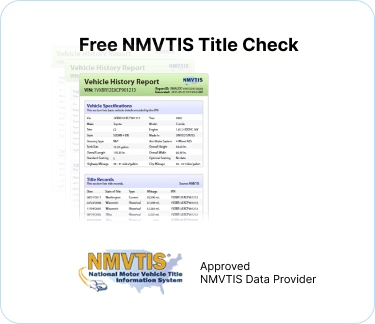
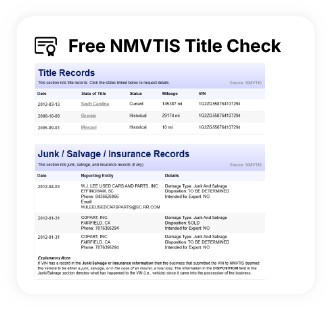
Vehicle History Report
What Problems Does the 1984 Dodge W150 Have?
The 1984 Dodge W150, like many trucks from this era, is susceptible to several common issues that owners frequently report. One of the most prevalent concerns is **rust**. This can manifest in the rocker panels, cab corners, wheel wells, bed floor, and frame. Vehicles driven in areas with harsh winters or exposed to road salt are particularly vulnerable. Thorough inspection of these areas is crucial when considering a purchase.
Electrical system issues are also common. Older wiring harnesses can degrade over time, leading to intermittent problems with lights, gauges, the ignition system, or accessories. Owners may experience issues with the alternator, starter, or battery charging system as well.
The carburetor, especially on V8 models, can require regular maintenance and tuning. Clogged jets, vacuum leaks, or worn components can lead to poor idling, hesitation, and reduced fuel efficiency. Conversion to a more modern fuel injection system is a common modification for those seeking improved reliability and performance.
Suspension components such as ball joints, tie rod ends, and bushings will likely show wear on a truck of this age, leading to clunking noises, poor steering response, and uneven tire wear. The leaf springs in the rear can also sag over time.
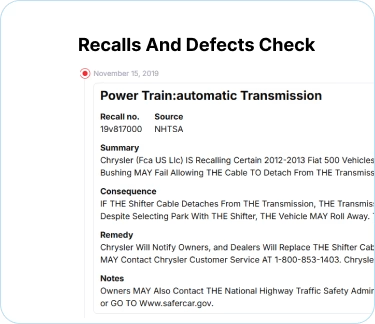
While specific recalls for the 1984 model year might be difficult to pinpoint without a VIN, general long-term reliability hinges heavily on maintenance. Dodge trucks of this generation are known for their robust mechanicals, particularly the V8 engines, but neglect can lead to significant problems. The Slant-Six, while durable, is often underpowered for these trucks. Issues with the automatic transmission (e.g., A727) can occur, often related to fluid leaks, worn clutches, or valve body problems if not properly maintained.
There are no widespread, specific model-year-related major flaws that stand out universally for the 1984 W150, but rather the general wear and tear associated with a vehicle approaching 40 years of age. Prior owners' maintenance habits will dictate much of its current condition and future reliability.
Electrical system issues are also common. Older wiring harnesses can degrade over time, leading to intermittent problems with lights, gauges, the ignition system, or accessories. Owners may experience issues with the alternator, starter, or battery charging system as well.
The carburetor, especially on V8 models, can require regular maintenance and tuning. Clogged jets, vacuum leaks, or worn components can lead to poor idling, hesitation, and reduced fuel efficiency. Conversion to a more modern fuel injection system is a common modification for those seeking improved reliability and performance.
Suspension components such as ball joints, tie rod ends, and bushings will likely show wear on a truck of this age, leading to clunking noises, poor steering response, and uneven tire wear. The leaf springs in the rear can also sag over time.
While specific recalls for the 1984 model year might be difficult to pinpoint without a VIN, general long-term reliability hinges heavily on maintenance. Dodge trucks of this generation are known for their robust mechanicals, particularly the V8 engines, but neglect can lead to significant problems. The Slant-Six, while durable, is often underpowered for these trucks. Issues with the automatic transmission (e.g., A727) can occur, often related to fluid leaks, worn clutches, or valve body problems if not properly maintained.
There are no widespread, specific model-year-related major flaws that stand out universally for the 1984 W150, but rather the general wear and tear associated with a vehicle approaching 40 years of age. Prior owners' maintenance habits will dictate much of its current condition and future reliability.
How long will the 1984 Dodge W150 last?
Based on owner data and typical maintenance habits for vehicles of its era, a well-maintained 1984 Dodge W150 can realistically serve for well over 200,000 miles, with many examples exceeding 300,000 miles. The chassis and core mechanicals, particularly the V8 engines, are known for their longevity. However, this durability is directly tied to consistent oil changes, fluid flushes, and addressing smaller issues before they become major. Over time, weaknesses emerge in areas like rust susceptibility and wear on suspension and electrical components. While the powertrain can endure, body integrity and auxiliary systems will require more attention as the truck ages, making consistent upkeep the key to maximizing its service life.
What Technology & Safety Features are Included?
The 1984 Dodge W150 represents a simpler era of automotive technology, meaning its built-in tech, entertainment, driver-assistance, and safety features are basic by modern standards.
Technology and Entertainment: Standard entertainment was typically a basic AM radio. Optional upgrades included an AM/FM radio, and sometimes an AM/FM radio with a cassette player. Higher trim levels might have offered a more robust speaker system. There were no digital displays, touchscreens, or integrated navigation systems. Instrumentation was analog, consisting of speedometer, fuel gauge, temperature gauge, and warning lights.
Driver-Assistance Features: Driver-assistance features were virtually non-existent. The primary focus was on the driver's direct control. Power steering was common, and power brakes were often available or standard on higher trims, but modern aids like ABS, traction control, or cruise control were either not offered or very rudimentary if present as an option. Some models might have had rear anti-lock brakes as a very early and basic form of stability enhancement, but this was not widespread.
Safety Features: Safety features were minimal. Standard equipment included seat belts (lap and shoulder belts for the driver and passenger). Crumple zones were not as sophisticated as in modern vehicles. The truck's heavy-duty construction provided a significant degree of passive safety, but active safety systems were rudimentary. Airbags were not yet a standard or widely available feature in pickup trucks of this vintage; they began appearing in passenger cars more broadly in the late 1980s and early 1990s.
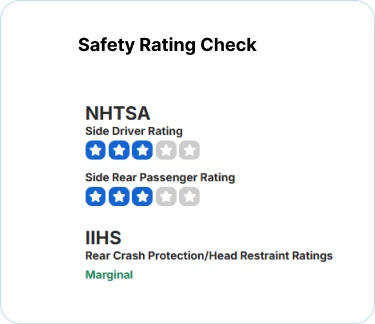
Crash-Test Ratings: Specific crash-test ratings for individual model years of the 1984 Dodge W150 from official bodies like the NHTSA or IIHS are generally not readily available or comparable to modern standards. Trucks from this period were not subjected to the same rigorous and comprehensive testing protocols that are in place today. The general perception of safety for trucks of this era relies on their inherent mass and robust frame construction rather than advanced safety systems or energy-absorbing structures.
Technology and Entertainment: Standard entertainment was typically a basic AM radio. Optional upgrades included an AM/FM radio, and sometimes an AM/FM radio with a cassette player. Higher trim levels might have offered a more robust speaker system. There were no digital displays, touchscreens, or integrated navigation systems. Instrumentation was analog, consisting of speedometer, fuel gauge, temperature gauge, and warning lights.
Driver-Assistance Features: Driver-assistance features were virtually non-existent. The primary focus was on the driver's direct control. Power steering was common, and power brakes were often available or standard on higher trims, but modern aids like ABS, traction control, or cruise control were either not offered or very rudimentary if present as an option. Some models might have had rear anti-lock brakes as a very early and basic form of stability enhancement, but this was not widespread.
Safety Features: Safety features were minimal. Standard equipment included seat belts (lap and shoulder belts for the driver and passenger). Crumple zones were not as sophisticated as in modern vehicles. The truck's heavy-duty construction provided a significant degree of passive safety, but active safety systems were rudimentary. Airbags were not yet a standard or widely available feature in pickup trucks of this vintage; they began appearing in passenger cars more broadly in the late 1980s and early 1990s.
Crash-Test Ratings: Specific crash-test ratings for individual model years of the 1984 Dodge W150 from official bodies like the NHTSA or IIHS are generally not readily available or comparable to modern standards. Trucks from this period were not subjected to the same rigorous and comprehensive testing protocols that are in place today. The general perception of safety for trucks of this era relies on their inherent mass and robust frame construction rather than advanced safety systems or energy-absorbing structures.
What Colors Options are Available?
1984 Dodge W150 Prices and Market Value
When new, the 1984 Dodge W150 had a base price typically ranging from approximately $9,000 to $12,000, with higher trims, engine options, and added features pushing the price closer to $15,000-$18,000. These trucks were not designed for rapid depreciation in their early years due to their utility. Today, the used market prices for a 1984 Dodge W150 vary dramatically. Clean, well-maintained examples, especially those with desirable V8 engines, 4x4 capability, and in good cosmetic condition, can fetch anywhere from $5,000 to $15,000 or even more for exceptionally preserved or restored models. Poor condition examples can be found for under $3,000. Factors significantly affecting resale value include rust, mechanical condition, originality, mileage, and trim level. Classic truck appeal and demand for reliable, vintage workhorses continue to bolster their value.
1984 Dodge W150 Cost of Ownership
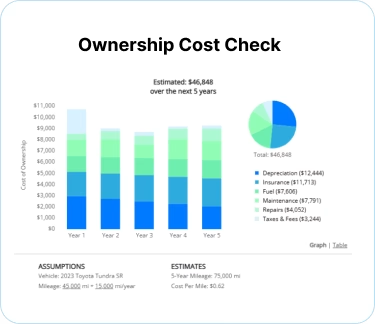
Owning a 1984 Dodge W150 can be economical if you're mechanically inclined or choose a well-maintained example. Insurance costs are generally moderate, especially for liability-only coverage, as classic status can sometimes offer discounts. Fuel costs are a significant consideration, as V8 engines with 4x4 configurations are not fuel-efficient, typically yielding 12-16 MPG. Regular maintenance is essential but can be affordable with readily available parts. Repairs can also be cost-effective due to the truck's simple, robust design, though finding specific vintage parts may sometimes require more effort. Overall, it's a relatively economical truck to own, primarily due to lower purchase prices and simpler repair needs compared to modern vehicles.
1984 Dodge W150 Fuel Efficiency
No records to be displayed
1984 Dodge W150 Insurance
Insurance for a 1984 Dodge W150 is moderately priced, reflecting its status as a Vehicle with strong safety ratings and
reasonable repair costs.
How Does the 1984 Dodge W150 Compare to Other Vehicle?
The 1984 Dodge W150 competed directly with other full-size pickups of its era, most notably the Ford F-150 and Chevrolet C/K 1500 series (including the GMC Sierra equivalent).
Performance: Dodge's V8 engines, particularly the 360, offered competitive power for towing and hauling. Ford and Chevy also had strong V8 offerings, with the 351 Windsor and 305/350 small-blocks respectively, providing similar capabilities. The Dodge W150's 4x4 system was generally considered robust.
Features: In 1984, feature sets were broadly comparable across the brands. Base models were utilitarian, while higher trims like the Dodge Royal SE offered creature comforts like upgraded upholstery and better stereos, matching Ford's XLT or Chevy's Silverado trims. None offered advanced tech by today's standards.
Reliability: All three brands from this era had their strong points and weaknesses. Dodge trucks were often praised for their stout drivetrains, though rust was a common concern for all manufacturers. Ford F-150s were known for their durable chassis, and Chevy C/Ks for their independent front suspension (on 2WD) and generally solid mechanicals. Long-term reliability heavily depends on maintenance history.
Price: New prices were very competitive, with only slight variations between similarly equipped models. Used prices today also show a lot of overlap, driven by condition and originality rather than brand loyalty alone.
Alternatives:
* Ford F-150 (1980-1986): A very similar competitor. Known for strong V8s, good towing, and a solid platform. Often seen as a slightly more refined option than Dodge.
* Chevrolet C1500/GMC Sierra (1973-1987, specifically the 'round body' generation): Also a strong contender with reliable engines and transmissions. Some prefer Chevy's styling or handling.
* Toyota Hilux/Nissan Hardbody: If a smaller, more fuel-efficient, but less powerful truck is desired, these Japanese alternatives offer excellent reliability but lack the heavy-duty capability of the W150.
For a buyer seeking a classic, robust, and capable full-size truck for work or play, the 1984 Dodge W150 remains a strong contender. It offers comparable performance and features to its key rivals, with the primary differentiator often being individual vehicle condition and owner preference for styling or specific mechanical attributes.
Performance: Dodge's V8 engines, particularly the 360, offered competitive power for towing and hauling. Ford and Chevy also had strong V8 offerings, with the 351 Windsor and 305/350 small-blocks respectively, providing similar capabilities. The Dodge W150's 4x4 system was generally considered robust.
Features: In 1984, feature sets were broadly comparable across the brands. Base models were utilitarian, while higher trims like the Dodge Royal SE offered creature comforts like upgraded upholstery and better stereos, matching Ford's XLT or Chevy's Silverado trims. None offered advanced tech by today's standards.
Reliability: All three brands from this era had their strong points and weaknesses. Dodge trucks were often praised for their stout drivetrains, though rust was a common concern for all manufacturers. Ford F-150s were known for their durable chassis, and Chevy C/Ks for their independent front suspension (on 2WD) and generally solid mechanicals. Long-term reliability heavily depends on maintenance history.
Price: New prices were very competitive, with only slight variations between similarly equipped models. Used prices today also show a lot of overlap, driven by condition and originality rather than brand loyalty alone.
Alternatives:
* Ford F-150 (1980-1986): A very similar competitor. Known for strong V8s, good towing, and a solid platform. Often seen as a slightly more refined option than Dodge.
* Chevrolet C1500/GMC Sierra (1973-1987, specifically the 'round body' generation): Also a strong contender with reliable engines and transmissions. Some prefer Chevy's styling or handling.
* Toyota Hilux/Nissan Hardbody: If a smaller, more fuel-efficient, but less powerful truck is desired, these Japanese alternatives offer excellent reliability but lack the heavy-duty capability of the W150.
For a buyer seeking a classic, robust, and capable full-size truck for work or play, the 1984 Dodge W150 remains a strong contender. It offers comparable performance and features to its key rivals, with the primary differentiator often being individual vehicle condition and owner preference for styling or specific mechanical attributes.
Final Verdict: Is the 1984 Dodge W150 a Good Vehicle?
The 1984 Dodge W150 is ideal for classic truck enthusiasts, DIY mechanics, and individuals seeking a rugged, capable workhorse or project vehicle. It's worth buying if you prioritize simplicity, V8 power, and a no-nonsense design over modern amenities. As it is a used vehicle, condition is paramount; prioritize examples with minimal rust and well-documented maintenance. Buying a base model is economical for basic utility, while a Royal SE trim offers a more comfortable experience. It is not suitable for those seeking fuel efficiency or advanced safety features. For the right buyer who appreciates its vintage charm and mechanical robustness, and is prepared for potential maintenance, the W150 offers enduring value and capability.