
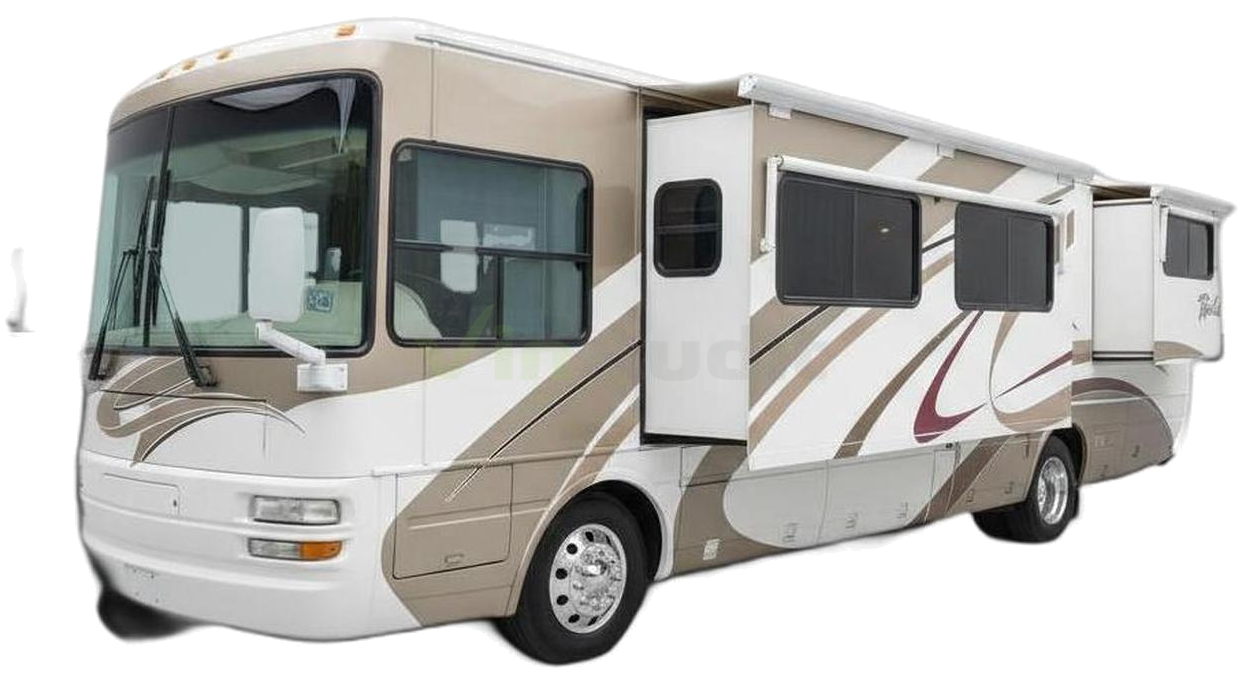
The Good
The 2004 Freightliner XC Chassis offers impressive towing strength and a stable, comfortable ride for long journeys, appealing to practical needs. Its durable construction provides peace of mind, while the smooth handling evokes a sense of freedom and security for emotional enjoyment of RVing.
The Bad
Potential owners should be aware of common issues like air suspension leaks, exhaust manifold cracks, and occasional transmission problems. Regular maintenance is crucial, and a thorough pre-purchase inspection is highly recommended to identify any such weaknesses.
2004 Freightliner XC Chassis: Quick Overview
- Engine Options: The 2004 Freightliner XC Chassis typically came equipped with robust diesel engines designed for RV applications. Common options included the 7.2L Caterpillar C7 and the 5.9L Cummins ISB.
- Horsepower: Horsepower varied depending on the specific engine chosen by the RV manufacturer. The Caterpillar C7 generally offered in the range of 300-350 horsepower, while the Cummins ISB could range from approximately 260-300 horsepower.
- Fuel Economy: Fuel economy for large diesel chassis like the XC is not typically measured in MPG in the same way as passenger vehicles. Owners generally report figures ranging from 6 to 10 miles per gallon, highly dependent on driving conditions, load, and terrain.
- 0-60 Times: Official 0-60 mph times are not readily available or relevant for this type of heavy-duty chassis, as it is designed for steady cruising and not rapid acceleration.
- Towing Capacity: The towing capacity is a significant strength of the Freightliner XC Chassis. It is designed to handle substantial towing loads, typically rated for trailers up to 10,000 to 15,000 pounds or more, depending on the specific configuration and the RV manufacturer's Gross Combined Weight Rating (GCWR). This makes it ideal for towing vehicles or trailers.
- Trim-Level Features: As a chassis, it doesn't have traditional trim levels like a car. Instead, features are determined by the RV manufacturer building on the chassis. However, key integrated features of the chassis itself include:
- Air suspension system for a smoother ride.
- Hydraulic or air brakes for reliable stopping power.
- Integrated fuel tanks.
- Robust frame construction designed to support the weight and stresses of a fully equipped motorhome.
- Power steering for maneuverability.
- Standard instrumentation panels for engine and vehicle monitoring.
- Potential for integrated generator mounts and storage compartments.
2004 Freightliner XC Chassis Specifications
Vehicle Information
| Year | 2004 |
| Make | Freightliner |
| Model | XC Chassis |
| Trim | - |
| Style | - |
| Type | Truck |
| Category | Medium Truck |
Manufacturing Details
| Made In | United States |
| Manufacturing City | GAFFNEY |
Dimensions
| Doors | - |
| Curb Weight | - |
| Gross Vehicle Weight Rating | - |
| Overall Height | - |
| Overall Length | - |
| Overall Width | - |
| Wheelbase Length | - |
| Standard Seating | - |
Engine & Performance
| Engine | 8.3L I6 |
| Engine Size | 8.3L |
| Engine Cylinders | 6 |
| Transmission | - |
| Transmission Type | - |
| Transmission Speeds | - |
| Drivetrain | Rear-Wheel Drive |
Additional Features
| Anti-Brake System | - |
| Steering Type | - |
Pricing
| Manufacturer Suggested Retail Price (MSRP) | - |
| Invoice Price | - |
| Delivery Charges | - |
Vehicle History Report
Specifications
History
Events
History Check
Check
Check
Check
Check
Listings
Recalls
Check
Analysis
What Problems Does the 2004 Freightliner XC Chassis Have?
Engine-related problems can also arise, particularly with the Caterpillar C7 engine, which has had reports of injector issues and occasional turbocharger problems. While the Cummins ISB is generally considered very reliable, like any engine, it can have its own set of age-related wear and tear issues. Transmission problems, though less frequent, have also been reported, sometimes related to cooling system issues or wear on internal components. Brake system components, especially on older units, may require attention, including potential leaks in air brake systems or wear on brake pads and rotors.
Recalls for chassis of this vintage are less common from the chassis manufacturer directly, as many issues are addressed by the RV manufacturer during the build process or as part of routine maintenance. However, it is always advisable to check with Freightliner or a reputable dealer with the chassis's VIN for any outstanding safety recalls. Long-term reliability is largely dependent on how well the chassis has been maintained. A well-maintained 2004 XC chassis with regular oil changes, filter replacements, and attention to the air suspension and brake systems can still provide many more years of service. Conversely, a neglected unit may require significant investment to bring it up to optimal operating condition. Specific model year issues are less defined for the chassis itself, as manufacturers often make running changes, but the general wear and tear on components from the early 2000s is a primary factor.
How long will the 2004 Freightliner XC Chassis last?
What Technology & Safety Features are Included?
Driver-assistance features on the 2004 XC chassis are minimal. You won't find adaptive cruise control, lane departure warnings, or blind-spot monitoring. The primary focus is on the driver's ability to control a large vehicle. Safety features are inherent to the chassis's robust construction, including sturdy frame rails, effective braking systems (often air brakes), and the stability provided by the air suspension.
Optional features that might have been integrated by the RV builder include upgraded sound systems, multi-disc CD changers, and even early forms of satellite radio. Some high-end motorhomes might have offered integrated power inverters and shore power management systems.
Crash-test ratings are not directly applicable to a chassis in the same way they are for a production car. The safety of the overall motorhome is a combination of the chassis's structural integrity and the design and safety features incorporated by the RV manufacturer. Freightliner, as a major commercial vehicle manufacturer, adheres to stringent safety standards in its chassis design, emphasizing durability and stability to protect occupants in the event of an incident. However, specific crash-test data for these RV chassis is not publicly available in the format of typical automotive safety reports.
What Colors Options are Available?
2004 Freightliner XC Chassis Prices and Market Value
2004 Freightliner XC Chassis Cost of Ownership
2004 Freightliner XC Chassis Fuel Efficiency
2004 Freightliner XC Chassis Warranty
Basic
Powertrain
Rust
2004 Freightliner XC Chassis Insurance
reasonable repair costs.
How Does the 2004 Freightliner XC Chassis Compare to Other Truck?
Features on the XC chassis were robust for its time, focusing on a stable and comfortable ride due to its air suspension. Workhorse often provided a similar ride quality, while Spartan also offered advanced suspension systems. Reliability is a point of comparison where all these chassis have their strengths and weaknesses. Freightliner is known for its durable diesel engines and solid construction. Workhorse chassis had some known issues, particularly with certain engine and transmission combinations in specific model years, and Spartan chassis, while generally reliable, could also be costly to repair. Price-wise, the XC chassis was a popular choice due to its competitive pricing relative to its capabilities, often being more affordable than comparable Spartan models.
Alternatives:
- Workhorse W-Series Chassis: A direct competitor, offering a wide range of configurations and often a slightly lower price point. Performance and reliability are comparable, but specific model years and engine choices should be thoroughly researched.
- Spartan Chassis: Often considered a more premium option, potentially offering superior ride comfort and build quality on their higher-end models, but typically at a higher cost, both new and used.
- Newer Used Chassis (e.g., 2010+): If budget allows, stepping up to a chassis from a few years later from any of these manufacturers can offer significant improvements in technology, fuel efficiency, and potentially greater reliability and fewer age-related issues.
For a 2004 model year, the Freightliner XC Chassis offered a strong value proposition with good performance and reliability. It remains a solid choice if found in good condition, comparable to its contemporaries.
Final Verdict: Is the 2004 Freightliner XC Chassis a Good Truck?

Simon A
Simon is a contributor to VinCheck, where he provides articles and reviews on various automotive topics. His work focuses on delivering accurate and up-to-date information about used cars, helping readers make informed decisions.