
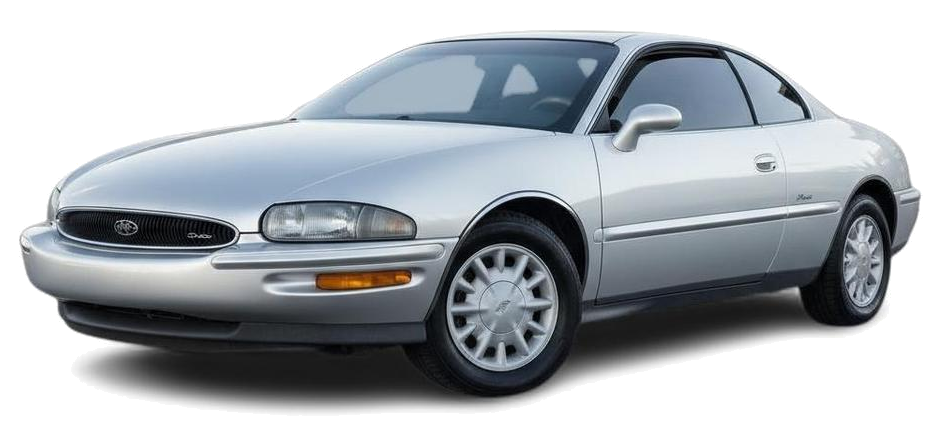
The 1998 Buick Riviera, part of a long-running model line (1963-1999), was a personal luxury coupe that blended distinctive styling with comfortable cruising. For 1998, it featured a sleek, aerodynamic body style. Key trims included the base and the more upscale Gran Sport. When new, pricing typically ranged from the high $20,000s to the low $30,000s. It stood out for its bold, almost polarizing design and a powerful supercharged V6 engine option, appealing to those seeking a statement car with a touch of performance.
The Good
The 1998 Riviera offered a comfortable ride and a stylish, distinctive design that appeals emotionally. Practically, its optional supercharged engine provided good power, and its spacious interior offered comfort for long drives, making it a capable cruiser with a unique character.
The Bad
Potential buyers should watch out for the notorious intake manifold gasket leaks common in GM's 3800 V6 engine, particularly the supercharged variant. Electrical gremlins and occasional transmission issues can also arise. The car's somewhat dated interior design might also be a detractor for some.
1998 Buick Riviera: Quick Overview
- Engine Options: The 1998 Buick Riviera primarily featured two V6 engine options.
- The standard engine was the 3.8L naturally aspirated V6.
- The performance-oriented option was the supercharged 3.8L V6, found in the Gran Sport trim and as an option on the base model.
- The standard engine was the 3.8L naturally aspirated V6.
- Horsepower:
- Naturally Aspirated 3.8L V6: Approximately 205 horsepower.
- Supercharged 3.8L V6: Approximately 240 horsepower.
- Naturally Aspirated 3.8L V6: Approximately 205 horsepower.
- Fuel Economy (EPA Estimated MPG):
- 3.8L Naturally Aspirated V6: Around 18 MPG city / 27 MPG highway.
- 3.8L Supercharged V6: Slightly lower, around 17 MPG city / 25 MPG highway, due to increased performance.
- 3.8L Naturally Aspirated V6: Around 18 MPG city / 27 MPG highway.
- 0-60 Times:
- Naturally Aspirated V6: Approximately 8.0 - 8.5 seconds.
- Supercharged V6: Significantly quicker, around 6.5 - 7.0 seconds, making it competitive for its era.
- Naturally Aspirated V6: Approximately 8.0 - 8.5 seconds.
- Towing Capacity: The Buick Riviera was not designed or marketed as a towing vehicle, and therefore, it does not have a specified towing capacity.
- Trim-Level Features:
- Base Riviera: Typically included power windows, power locks, cruise control, tilt steering wheel, AM/FM stereo with cassette, driver and passenger front airbags, anti-lock brakes (ABS), and 16-inch alloy wheels. Leather seating was often an option.
- Gran Sport (GS): Built upon the base features and added sportier suspension tuning, unique badging, a more aggressive front fascia, dual exhaust, often came standard with leather interior, heated front seats, a premium sound system, and 16-inch polished aluminum wheels. The supercharged engine was a hallmark of the GS.
- Optional Features (available on both trims): Sunroof, premium sound systems, heated seats, remote keyless entry, and traction control were among common options.
- Base Riviera: Typically included power windows, power locks, cruise control, tilt steering wheel, AM/FM stereo with cassette, driver and passenger front airbags, anti-lock brakes (ABS), and 16-inch alloy wheels. Leather seating was often an option.
1998 Buick Riviera Specifications
Vehicle Information
| Year | 1998 |
| Make | Buick |
| Model | Riviera |
| Trim | - |
| Style | Coupe |
| Type | Coupe |
| Category | Mid-Size Car |
Manufacturing Details
| Made In | United States |
| Manufacturing City | ORION |
Dimensions
| Doors | 2-Door |
| Curb Weight | 3699 pounds |
| Gross Vehicle Weight Rating | - |
| Overall Height | 54.60 inches |
| Overall Length | 207.20 inches |
| Overall Width | 75.00 inches |
| Wheelbase Length | 113.80 inches |
| Standard Seating | 5 |
Engine & Performance
| Engine | 3.8L V6 |
| Engine Size | 3.8L |
| Engine Cylinders | 6 |
| Transmission | 4-Speed Automatic |
| Transmission Type | Automatic |
| Transmission Speeds | 4-Speed |
| Drivetrain | Front-Wheel Drive |
Additional Features
| Anti-Brake System | 4-Wheel ABS |
| Steering Type | Rack & Pinion |
Pricing
| Manufacturer Suggested Retail Price (MSRP) | $32,500 |
| Invoice Price | $29,413 |
| Delivery Charges | - |
Vehicle History Report
Vehicle
Specifications
Specifications
Ownership
History
History
All History
Events
Events
NMVTIS Title
History Check
History Check
Salvage/Rebuilt
Check
Check
Accident
Check
Check
Theft
Check
Check
Open Lien
Check
Check
Past Sale
Listings
Listings
Safety
Recalls
Recalls
Odometer
Check
Check
Market Price
Analysis
Analysis
What Problems Does the 1998 Buick Riviera Have?
The 1998 Buick Riviera, like many GM vehicles of its era, has a few commonly reported issues that prospective owners should be aware of. The most prevalent concern revolves around the intake manifold gaskets, especially in the 3800 Series II V6 engines, both naturally aspirated and supercharged. These gaskets are known to degrade over time, leading to coolant leaks into the engine valley, which can cause misfires, rough running, and potentially catastrophic engine damage if not addressed promptly. This issue is not specific to the 1998 model year but affects a broad range of GM vehicles equipped with these engines throughout the late 1990s and early 2000s.
Another area of concern can be the transmission, specifically the 4T65-E automatic transmission. While generally robust, some units may experience issues such as slipping gears, harsh shifting, or outright failure, particularly with higher mileage vehicles or those that have not received regular fluid changes. Electrical gremlins are also a possibility, with reports of issues related to the power windows, door locks, dashboard warning lights, and the climate control system.
The supercharged engine, while offering a significant performance boost, can be more susceptible to certain problems if not maintained diligently. These include potential issues with the supercharger itself, such as bearing wear or seal leaks, and increased strain on other engine components.
Regarding recalls, it's always advisable to check with the National Highway Traffic Safety Administration (NHTSA) for any specific recalls that may have been issued for the 1998 Riviera. However, for this specific model year, there haven't been widespread, highly publicized recalls that overshadow the common mechanical issues.
In terms of long-term reliability, the Riviera can be a decent car if well-maintained. Its overall structure is solid, and many components are durable. However, the aforementioned issues, particularly the intake manifold gasket, require proactive attention. Neglecting these can significantly impact the vehicle's longevity and repair costs. While not inherently unreliable, its reliability is heavily dependent on the quality of previous maintenance and the owner's willingness to address known potential problems.
Another area of concern can be the transmission, specifically the 4T65-E automatic transmission. While generally robust, some units may experience issues such as slipping gears, harsh shifting, or outright failure, particularly with higher mileage vehicles or those that have not received regular fluid changes. Electrical gremlins are also a possibility, with reports of issues related to the power windows, door locks, dashboard warning lights, and the climate control system.
The supercharged engine, while offering a significant performance boost, can be more susceptible to certain problems if not maintained diligently. These include potential issues with the supercharger itself, such as bearing wear or seal leaks, and increased strain on other engine components.
Regarding recalls, it's always advisable to check with the National Highway Traffic Safety Administration (NHTSA) for any specific recalls that may have been issued for the 1998 Riviera. However, for this specific model year, there haven't been widespread, highly publicized recalls that overshadow the common mechanical issues.
In terms of long-term reliability, the Riviera can be a decent car if well-maintained. Its overall structure is solid, and many components are durable. However, the aforementioned issues, particularly the intake manifold gasket, require proactive attention. Neglecting these can significantly impact the vehicle's longevity and repair costs. While not inherently unreliable, its reliability is heavily dependent on the quality of previous maintenance and the owner's willingness to address known potential problems.
How long will the 1998 Buick Riviera last?
Based on owner data and typical maintenance habits, a well-maintained 1998 Buick Riviera can realistically achieve between 150,000 to 200,000 miles, with some examples exceeding 250,000 miles. The long-term durability of the Riviera hinges significantly on the owner's commitment to addressing known weaknesses proactively. The GM 3800 V6 engine, particularly with regular fluid changes and attention to potential coolant leaks (intake manifold gaskets), is quite robust and can last for many miles. The chassis and body are also generally well-built, resisting rust better than some contemporaries if kept in a less humid climate or properly cared for. However, the transmission, while generally reliable, can become a point of failure beyond 150,000 miles if neglected. Electrical components and suspension parts may also require attention as the vehicle ages, typical for any car of this vintage. The weakness lies not in inherent design flaws preventing longevity, but in the common issues that require diligent maintenance to overcome.
What Technology & Safety Features are Included?
The 1998 Buick Riviera offered a reasonable suite of technology and safety features for its time, aiming for comfort and convenience. Standard technology included a tilt steering wheel and cruise control for easier long-distance driving. The entertainment system typically consisted of an AM/FM stereo with a cassette player, and for an upgraded experience, an optional premium sound system with a CD player was available, offering clearer audio reproduction.
Driver-assistance features were relatively basic by today's standards. Anti-lock Braking System (ABS) was standard on all models, providing improved braking control during emergency stops. Traction control was also available, particularly on the Gran Sport models, helping to prevent wheel spin during acceleration on slippery surfaces.
Safety was addressed with standard front airbags for the driver and front passenger. Side-impact door beams were also incorporated for occupant protection. Seatbelt pretensioners were included to further enhance safety in a collision.
Optional features added to the creature comforts and luxury feel. These could include power-adjustable and heated front seats, which were particularly desirable for comfort in colder climates. A power sunroof was another popular option, allowing for an airy cabin experience. Remote keyless entry added a layer of convenience for locking and unlocking doors.
Regarding crash-test ratings, specific official ratings for the 1998 Buick Riviera from organizations like the Insurance Institute for Highway Safety (IIHS) or the National Highway Traffic Safety Administration (NHTSA) for that particular model year can be difficult to find in detailed public databases today. However, vehicles from this era generally performed moderately in frontal and side-impact tests, with safety standards evolving rapidly. It's important for potential buyers to research any available historical safety data, but it's unlikely to match the advanced safety systems and ratings of modern vehicles.
Driver-assistance features were relatively basic by today's standards. Anti-lock Braking System (ABS) was standard on all models, providing improved braking control during emergency stops. Traction control was also available, particularly on the Gran Sport models, helping to prevent wheel spin during acceleration on slippery surfaces.
Safety was addressed with standard front airbags for the driver and front passenger. Side-impact door beams were also incorporated for occupant protection. Seatbelt pretensioners were included to further enhance safety in a collision.
Optional features added to the creature comforts and luxury feel. These could include power-adjustable and heated front seats, which were particularly desirable for comfort in colder climates. A power sunroof was another popular option, allowing for an airy cabin experience. Remote keyless entry added a layer of convenience for locking and unlocking doors.
Regarding crash-test ratings, specific official ratings for the 1998 Buick Riviera from organizations like the Insurance Institute for Highway Safety (IIHS) or the National Highway Traffic Safety Administration (NHTSA) for that particular model year can be difficult to find in detailed public databases today. However, vehicles from this era generally performed moderately in frontal and side-impact tests, with safety standards evolving rapidly. It's important for potential buyers to research any available historical safety data, but it's unlikely to match the advanced safety systems and ratings of modern vehicles.
What Colors Options are Available?
1998 Buick Riviera Prices and Market Value
When new in 1998, the Buick Riviera had a starting MSRP typically in the high $20,000s, with the sportier Gran Sport models often exceeding $30,000 when equipped with optional features. Like most vehicles, the Riviera experienced significant depreciation in its first few years. Currently, used market prices for a 1998 Buick Riviera can range widely, generally from around $2,000 to $6,000, heavily dependent on mileage, condition, trim level (Gran Sport often fetches a bit more), and maintenance history. Factors significantly affecting its resale value include the presence of the supercharged engine, overall condition (especially the absence of major leaks or mechanical issues), interior wear, and body integrity. Well-preserved, low-mileage examples, particularly the Gran Sport, can command higher prices within this range.
1998 Buick Riviera Cost of Ownership
Owning a 1998 Buick Riviera can be moderately economical, but with caveats. Insurance costs are generally reasonable for a vehicle of its age and class, likely comparable to other domestic sedans. Fuel costs will vary depending on the engine; the supercharged V6 is thirstier, while the naturally aspirated version offers better MPG. Maintenance costs can be average, but be prepared for potential repairs like the common intake manifold gasket leak, which can add to the bill. Transmission issues could also be costly if they arise. Overall, if well-maintained and major issues are avoided, it's not an overly expensive car to own. However, neglecting known problems will significantly increase long-term repair costs.
1998 Buick Riviera Fuel Efficiency
Fuel Type
Gasoline
Fuel Capacity
18.50 gallons
City Mileage
18 miles/gallon
Highway Mileage
27 miles/gallon
1998 Buick Riviera Safety Rating
NHTSA
IIHS
1998 Buick Riviera Warranty
Basic
Original warranty
36 months / 36,000 miles
Estimated remaining
Expired
Powertrain
Original warranty
36 months / 36,000 miles
Estimated remaining
Expired
Rust
Original warranty
72 months / 100,000 miles
Estimated remaining
Expired
1998 Buick Riviera Insurance
Insurance for a 1998 Buick Riviera is moderately priced, reflecting its status as a Coupe with strong safety ratings and
reasonable repair costs.
How Does the 1998 Buick Riviera Compare to Other Coupe?
The 1998 Buick Riviera competed in the personal luxury coupe segment, a shrinking but still significant market. Its key rivals included cars like the Ford Thunderbird/Mercury Cougar, Chevrolet Monte Carlo/Lumina Coupe, and potentially entry-level luxury coupes from import brands.
Performance: The Riviera, especially with the supercharged V6 in Gran Sport trim, offered competitive acceleration, often outperforming its American counterparts like the Thunderbird and Monte Carlo. The standard V6 was adequate but less inspiring. Import rivals in a similar price bracket might have offered more refined powertrain options but perhaps less outright power.
Features: Buick traditionally emphasized comfort and a degree of luxury. The Riviera boasted comfortable seating, a quiet cabin, and a good ride quality. Standard features were competitive, with options like leather and premium sound enhancing the luxury feel. Rivals offered similar amenities, though some import brands might have had an edge in terms of advanced electronics or premium materials.
Reliability: This is where the Riviera faces challenges. While the 3800 V6 engine itself is known for durability, common issues like intake manifold gasket leaks and potential transmission problems can detract from its reliability score compared to some Japanese competitors. Ford's offerings from this era had their own sets of issues, and Chevrolet's coupes were generally considered decent but perhaps less premium.
Price: The Riviera was often priced slightly higher than its Chevrolet and Ford counterparts, positioning it as a more premium American option. It offered a good value proposition when new, especially considering the available performance.
Alternatives:
* Similar: The **Ford Thunderbird** and **Mercury Cougar** offered a similar personal luxury coupe experience, though often with less potent engine options and a slightly less refined feel. The **Chevrolet Monte Carlo/Lumina Coupe** was a more budget-friendly alternative, sharing some mechanical components but lacking the Riviera's distinct styling and upscale aspirations.
* Potentially Better: For those prioritizing Japanese reliability, a used **Lexus SC300/SC400** would offer superior build quality and long-term dependability, though likely at a higher used price point. The **Acura CL** or **Honda Prelude** from the same era could also be considered for their reliability and sporty driving dynamics, though they were smaller and less focused on pure luxury.
The 1998 Riviera stands out for its bold styling and the availability of a potent supercharged engine, offering a unique blend of American luxury and performance that its rivals struggled to match directly.
Performance: The Riviera, especially with the supercharged V6 in Gran Sport trim, offered competitive acceleration, often outperforming its American counterparts like the Thunderbird and Monte Carlo. The standard V6 was adequate but less inspiring. Import rivals in a similar price bracket might have offered more refined powertrain options but perhaps less outright power.
Features: Buick traditionally emphasized comfort and a degree of luxury. The Riviera boasted comfortable seating, a quiet cabin, and a good ride quality. Standard features were competitive, with options like leather and premium sound enhancing the luxury feel. Rivals offered similar amenities, though some import brands might have had an edge in terms of advanced electronics or premium materials.
Reliability: This is where the Riviera faces challenges. While the 3800 V6 engine itself is known for durability, common issues like intake manifold gasket leaks and potential transmission problems can detract from its reliability score compared to some Japanese competitors. Ford's offerings from this era had their own sets of issues, and Chevrolet's coupes were generally considered decent but perhaps less premium.
Price: The Riviera was often priced slightly higher than its Chevrolet and Ford counterparts, positioning it as a more premium American option. It offered a good value proposition when new, especially considering the available performance.
Alternatives:
* Similar: The **Ford Thunderbird** and **Mercury Cougar** offered a similar personal luxury coupe experience, though often with less potent engine options and a slightly less refined feel. The **Chevrolet Monte Carlo/Lumina Coupe** was a more budget-friendly alternative, sharing some mechanical components but lacking the Riviera's distinct styling and upscale aspirations.
* Potentially Better: For those prioritizing Japanese reliability, a used **Lexus SC300/SC400** would offer superior build quality and long-term dependability, though likely at a higher used price point. The **Acura CL** or **Honda Prelude** from the same era could also be considered for their reliability and sporty driving dynamics, though they were smaller and less focused on pure luxury.
The 1998 Riviera stands out for its bold styling and the availability of a potent supercharged engine, offering a unique blend of American luxury and performance that its rivals struggled to match directly.
Final Verdict: Is the 1998 Buick Riviera a Good Coupe?
The 1998 Buick Riviera is ideal for buyers seeking a stylish, comfortable personal luxury coupe with a touch of American flair and, in Gran Sport trim, surprisingly potent performance. It appeals to those who appreciate distinctive design over cutting-edge technology and who prioritize a smooth, quiet ride for cruising.
It is worth buying if found in good condition with meticulous maintenance records, especially if addressing potential intake manifold gasket issues proactively. Given its age, buying new is impossible. Focus on well-maintained examples, ideally the Gran Sport trim for its enhanced performance. Be prepared for some potential maintenance, particularly related to the engine and possibly the transmission. For the budget-conscious buyer looking for a unique ride that offers comfort and character, the Riviera can be a solid choice, provided they are aware of and prepared for its known quirks.
