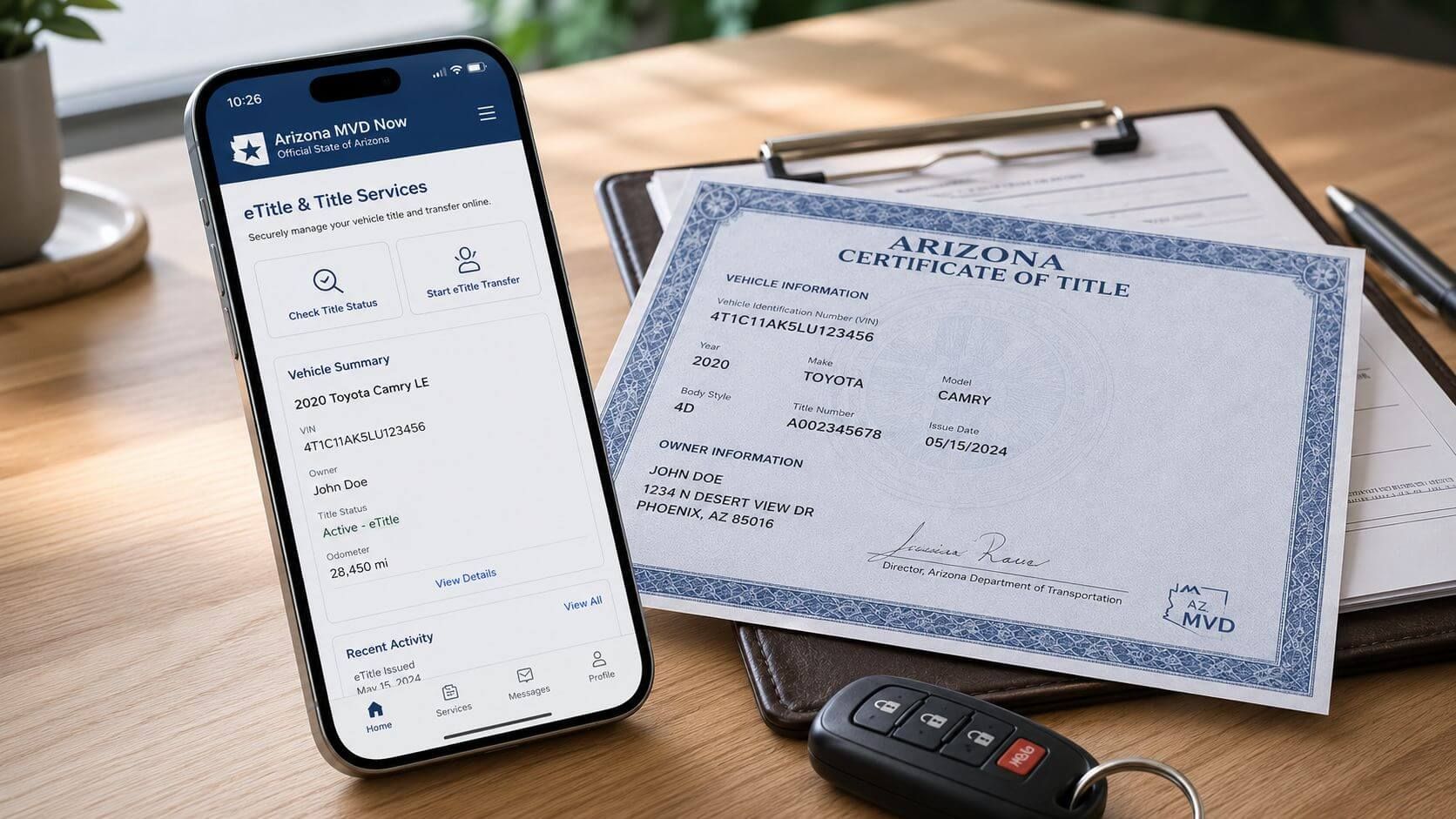
Buying a used car in Arizona should start with two checks: verifying the vehicle by VIN and confirming whether the title can be transferred cleanly. Arizona offers an online eTitle Transfer option for eligible private-party sales, but not every vehicle or buyer-seller situation qualifies.
An Arizona VIN check helps you review available vehicle history records tied to the vehicle’s 17-character identification number. The eTitle Transfer process, when available, helps eligible Arizona buyers and sellers complete ownership transfer electronically through AZ MVD Now. Used together, these steps can help you avoid title surprises, lien problems, mileage issues, undisclosed brands, and registration delays.
Before paying for a used car in Arizona, confirm the VIN, review the title status, check for liens, verify emissions requirements if applicable, ask about recalls, and make sure the seller can complete the transfer properly.
Why an Arizona VIN Check Matters
The VIN is the vehicle’s unique identifier. It connects the car to title events, registration records, mileage readings, theft records, accident clues, recall information, sale history, and vehicle specifications when those records are available.
A VIN check can help you answer important questions before you buy:
- Does the vehicle match the seller’s listing?
- Are the year, make, model, and trim accurate?
- Does the title history show brands or problem records?
- Is there accident or damage history?
- Do the mileage records make sense?
- Are there theft or sale records?
- Does the vehicle appear to have moved through multiple states?
- Are there open recall concerns?
- Does the asking price match the vehicle’s condition and history?
A VIN check is not a substitute for the title, an MVD transfer, or a mechanic inspection. It is an early screening tool that helps you decide whether the vehicle is worth pursuing.
VIN Check vs. Arizona Title Check
A VIN check and title check work together, but they are not the same.
| Check | What It Helps Verify | Why It Matters |
|---|---|---|
| VIN check | Vehicle identity, accident clues, mileage, title history, recalls, theft, and sale records | Helps screen the car before paying or traveling |
| Title check | Ownership, liens, title brands, seller authority, and transfer status | Helps confirm whether the seller can legally transfer the vehicle |
| Plate lookup | Early research when the VIN is not listed | Useful for screening listings before requesting the VIN |
| eTitle eligibility | Whether the vehicle and parties qualify for online transfer | Helps avoid wasted time if an office visit is required |
If the listing only shows a plate number, start with a license plate lookup as an early step. Once the seller provides the VIN, verify the vehicle more deeply.
Where to Find the VIN
Before running any check, make sure the VIN is correct. One wrong character can return the wrong vehicle information.
Check the VIN on:
- Dashboard near the windshield
- Driver-side door jamb label
- Arizona title or out-of-state title
- Registration documents
- Insurance documents, if available
- Seller listing
- Service records
- Dealer paperwork, if applicable
The VIN should match everywhere. If the VIN on the title does not match the vehicle, pause the deal. It could be a typo or clerical issue, but it could also point to title fraud, VIN cloning, theft risk, or a misrepresented vehicle.
What to Check on an Arizona Vehicle Title
The title is the ownership document. Before buying, confirm that the seller has the authority to transfer the vehicle and that the title does not show unresolved problems.
Check for:
- Correct VIN
- Seller’s legal name
- Vehicle year, make, and model
- Odometer information, when required
- Lienholder information
- Title brands
- Legal status of multiple owners, if any
- Signatures required for transfer
- Altered, erased, or crossed-out information
- Whether the title is electronic or paper
If there is a lien, the lien must be released or handled properly before you can receive clear ownership. If the title has a brand, the price and risk should reflect that history.
For title concerns, use a title check by VIN and compare the result with the seller’s actual documents.
What Is Arizona eTitle Transfer?
Arizona eTitle Transfer is an online title-transfer option for eligible private-party vehicle sales through AZ MVD Now. Instead of completing a paper title transfer at an MVD or authorized third-party office, eligible buyers and sellers can transfer ownership electronically.
This can be convenient because the process is handled online, the odometer disclosure is built in, and a Sold Notice is automatically generated for the seller.
However, eTitle Transfer is not available for every vehicle or every transaction. Buyers should confirm eligibility before assuming they can complete the sale online.
Arizona eTitle Transfer Requirements
Arizona’s eTitle Transfer has specific requirements for both the vehicle and the people involved.
Vehicle requirements include:
- Arizona title and current Arizona registration
- No more than two owners
- No liens
- Passenger vehicle only
- No commercial vehicles, trailers, or motorcycles
- Current emissions, if applicable, or sale to a buyer in a non-emissions area
- No brands or statuses that prohibit transfer
- No sold notice already on the vehicle before the eTitle Transfer
Buyer and seller requirements include:
- Arizona driver license or identification card
- Active AZ MVD Now account
- Enhanced authentication completed
- Single buyer only
- No power of attorney, divorce decree, or other special legal documents
If any of these requirements are not met, the transaction may need to be completed at an MVD office or authorized third-party location instead.
How Arizona eTitle Transfer Works
For a standard single-owner to single-buyer transfer, the process generally works like this:
- Both buyer and seller sign in to AZ MVD Now.
- Both complete enhanced authentication.
- The buyer generates an eTitle Buyer Code.
- The buyer shares that code with the seller.
- The seller selects the vehicle and enters the odometer disclosure.
- The seller enters the buyer code.
- The buyer reviews the vehicle information.
- The seller releases ownership.
- The buyer completes title and registration.
After transfer, the buyer’s title is held electronically and viewable through AZ MVD Now. The buyer may receive standard registration and plates depending on the transaction, and temporary documents may be available immediately.
When eTitle Transfer Is Not the Right Option
Even if eTitle Transfer is convenient, some situations require an office visit or additional documentation.
You may need to use an MVD or authorized third-party office if:
- The vehicle has a lien
- The vehicle is a motorcycle, trailer, or commercial vehicle
- The vehicle is not currently Arizona-titled and registered
- There is more than one buyer
- There are complex ownership issues
- A power of attorney is involved
- A divorce decree, trust, estate, or other legal document is needed
- The vehicle has brands or statuses that prevent transfer
- Emissions requirements are not satisfied where applicable
- You need to add a lien during the transaction
Do not force an online transfer if the transaction does not qualify. It is safer to complete the title properly than to rush the sale.
Paper Title Transfer in Arizona
If eTitle Transfer is not available, Arizona buyers can complete title and registration transfer at an MVD or authorized third-party office.
Common requirements may include:
- Completed and signed Title and Registration Application
- Current vehicle title signed by the seller
- Title Transfer Bill of Sale for Arizona-titled vehicles, if applicable
- Lien release, if applicable
- Emissions test, if applicable
- Payment for applicable fees
- Additional documents for special situations
Arizona requires buyers to apply for a title within 15 days of purchase. If you miss the deadline, penalties may apply.
Can You Drive the Car Right After a Private Sale?
Be careful. In Arizona, when a vehicle is sold or transferred, the registration for that vehicle is no longer valid. That means a used vehicle purchased in a private sale has expired registration after transfer.
You may not operate the vehicle until it is registered or until you obtain a Restricted Use 3-Day Permit, if applicable. Do not assume you can drive using the seller’s plate.
The seller should remove the license plate before the new owner takes possession. If the seller leaves a plate on the vehicle, do not treat that as permission to drive under the seller’s registration.
Check for Liens Before You Buy
A lien means another party, usually a lender, has a financial interest in the vehicle. If a lien is still active, the title transfer can become complicated.
Arizona advises buyers to check for liens before buying an Arizona-titled vehicle. If a current lien exists, it must be paid off or handled with written lienholder permission before transfer.
Be cautious if:
- A lienholder is listed but no release is available
- The seller says the loan is paid but has no documentation
- The seller wants full payment before clearing the lien
- The vehicle title is electronic and lien status is unclear
- The seller says the title will be available later
- The title is not in the seller’s name
Check the record as close to purchase as possible because lien records can change.
Arizona Emissions Requirements
Emissions rules are especially important in Arizona because some areas require testing. Arizona emissions testing generally applies in the Phoenix and Tucson metropolitan areas, including some commuters into those areas.
Requirements can vary by vehicle type, model year, fuel type, and weight. Common exemptions can include vehicles that are five years old or less, 1966 model year or older, and electric vehicles.
A vehicle cannot pass emissions testing if the check engine light is on. If the car will be registered in an emissions area, verify emissions status before buying. A car that seems like a good deal can become expensive if it needs emissions-related repairs before registration.
Recall and Safety Checks
Title transfer does not automatically tell you whether the vehicle has open recalls. Recalls may involve airbags, brakes, steering, seat belts, fuel systems, electrical systems, or other safety-related components.
Before buying, run a VIN recall check and ask the seller whether any recall repairs have been completed. If a recall is open, contact an authorized dealer to confirm whether the remedy is available.
An open recall does not always mean you should reject the vehicle, but it should be part of your safety review and negotiation.
Dealer Purchase vs. Private Seller Purchase in Arizona
Buying from an Arizona dealer is different from buying from a private seller.
If you buy from an Arizona dealership, the dealership typically handles title and registration at the time of purchase. You should still review the purchase contract, fees, warranty terms, Buyers Guide, vehicle history, and any add-ons.
If you buy from a private seller, you have more responsibility. You need to verify the VIN, title, lien status, emissions requirement, seller identity, and transfer method.
| Buying Source | Possible Advantage | Buyer Risk |
|---|---|---|
| Dealer | Dealer handles more title and registration steps | Fees, add-ons, warranties, and disclosures still need review |
| Private seller with eTitle Transfer | Convenient online process if eligible | Not every vehicle or buyer-seller situation qualifies |
| Private seller with paper title | Can work for more transaction types | Requires careful paperwork and office transfer |
Whether buying from a dealer or private seller, keep copies of every document.
Arizona Used Car Buyer Workflow
Use this process before buying a used car in Arizona.
1. Ask for the VIN
A serious seller should provide the VIN before you visit or send money.
2. Run a VIN and Title Review
Check vehicle identity, title history, brands, mileage, accident clues, theft records, and sale history.
3. Check eTitle Eligibility
If it is a private sale, ask whether the vehicle qualifies for Arizona eTitle Transfer.
4. Confirm Lien Status
Do not proceed unless any lien is released or properly handled.
5. Verify Emissions
If the vehicle will be registered in an emissions area, confirm whether testing is required and whether the car is ready to pass.
6. Check Recalls
Use the VIN to review open safety recall concerns.
7. Inspect the Vehicle
Have the car inspected for mechanical, structural, flood, rust, and repair issues.
8. Complete the Transfer Correctly
Use eTitle Transfer only if eligible. Otherwise, complete the title transfer at an MVD or authorized third-party office.
Red Flags to Watch For
Slow down or walk away if you notice:
- Seller refuses to provide the VIN
- VIN does not match the title or vehicle
- Title is missing, altered, or not in seller’s name
- Seller says the title will come later
- Active lien with no release or written permission
- Seller wants you to drive using their plate
- Vehicle does not qualify for eTitle Transfer but seller insists it does
- Check engine light is on in an emissions area
- Odometer reading does not match records
- Title brand was not disclosed
- Seller refuses inspection
- Price is far below market with no clear reason
A legitimate seller should be able to explain the VIN, title, lien status, emissions status, and transfer process clearly.
Arizona VIN and eTitle Transfer Checklist
| Item to Check | Why It Matters |
|---|---|
| VIN | Confirms the vehicle’s identity |
| Arizona title status | Determines transfer method |
| eTitle eligibility | Shows whether online transfer may be available |
| Seller name | Helps confirm legal transfer authority |
| Lien status | Prevents unpaid-loan problems |
| Odometer disclosure | Helps confirm mileage accuracy |
| Title brands | Affects value, insurance, financing, and resale |
| Emissions status | May be required before registration |
| Recall status | Helps identify unresolved safety issues |
| Inspection results | Confirms current condition |
Bottom Line
An Arizona VIN check and eTitle Transfer review can help used car buyers avoid title delays, lien surprises, emissions problems, and ownership confusion. Start by confirming the VIN, checking the title, reviewing lien status, and verifying whether the transaction qualifies for eTitle Transfer.
If the vehicle is eligible, eTitle Transfer can make a private-party purchase more convenient. If it is not eligible, use the proper MVD or authorized third-party process instead.
The safest Arizona used car purchase is one where the VIN, title, seller, emissions status, lien status, recall status, and vehicle condition all line up before money changes hands.
FAQs
Should I run a VIN check before buying a used car in Arizona?
Yes. A VIN check can help you review available title, accident, theft, mileage, recall, sale, and specification records before deciding whether the vehicle is worth buying.
What is Arizona eTitle Transfer?
Arizona eTitle Transfer is an online process through AZ MVD Now that lets eligible private-party buyers and sellers transfer ownership electronically without visiting an MVD or authorized third-party office.
Does every used car qualify for Arizona eTitle Transfer?
No. The vehicle must meet eligibility requirements, such as having an Arizona title and current Arizona registration, no liens, qualifying vehicle type, current emissions if applicable, and no brands or statuses that prohibit transfer.
How long do I have to apply for an Arizona title after buying a car?
Arizona requires buyers to apply for a title within 15 days of purchase. Penalties may apply if the buyer misses the deadline.
Can I drive a private-sale car in Arizona before registering it?
Not normally. After sale or transfer, the vehicle’s registration is no longer valid. You may need to register the vehicle or obtain a Restricted Use 3-Day Permit before operating it.
Author
Elise Rowan
Elise Rowan is a vehicle ownership and consumer protection writer with a strong focus on title transfers, vehicle liens, registration records, and buyer due diligence. She writes educational content for people buying from private sellers, auctions, and online marketplaces, with an emphasis on helping readers verify a vehicle’s financial and legal background before committing to a purchase.