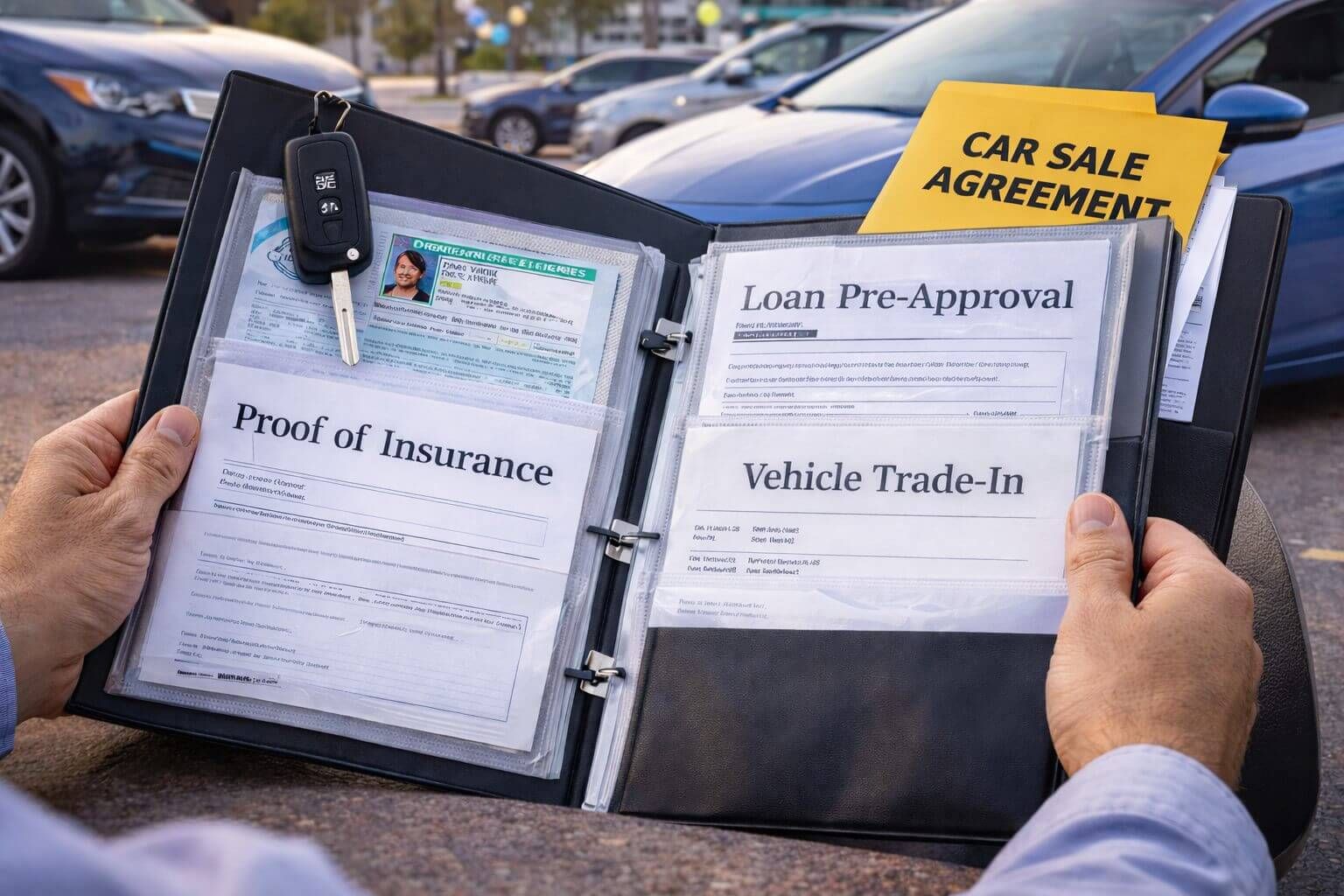
A used car’s advertised price is not always the amount you will pay. By the time taxes, title fees, registration, documentation fees, dealer add-ons, service contracts, and other charges appear on the paperwork, the final number can be much higher than the listing price.
That final number is called the out-the-door price. It is the total amount you pay to drive away with the vehicle, excluding separate ongoing costs such as insurance, fuel, maintenance, and financing interest over time.
Understanding dealer doc fees used car buyers commonly see is important because the lowest advertised price is not always the best deal. A car listed for less may become more expensive once fees and add-ons are included. Before you negotiate, ask for the full out-the-door price in writing and compare that number against the vehicle’s market value, warranty status, and actual condition.
What Is the Out-the-Door Price?
The out-the-door price is the full transaction price of the vehicle before any separate long-term financing costs. It includes the negotiated vehicle price plus required taxes and fees, and it may also include optional add-ons if you agree to buy them.
A typical out-the-door price may include:
- Vehicle selling price
- Sales tax
- Title fee
- Registration fee
- License plate fee
- Dealer documentation fee
- Electronic filing fee, where applicable
- Dealer-installed accessories, if accepted
- Optional protection products, if accepted
- Service contract or warranty product, if accepted
The out-the-door price helps you compare offers fairly. If one dealer quotes only the vehicle price and another dealer quotes the full final price, you are not comparing the same thing.
Why the Advertised Price Can Be Misleading
A used car listing may show an attractive price to get your attention. That price may not include taxes, title, registration, documentation fees, or dealer add-ons. In some cases, add-ons may not appear until the buyer reaches the finance office.
This is why you should not negotiate only around the monthly payment or advertised price. A lower monthly payment can hide a longer loan term, higher total cost, or added products rolled into financing.
Before visiting a dealership, ask for a written out-the-door quote. This helps you confirm whether advertised discounts are actually applied and whether new fees appear later.
What Are Dealer Doc Fees?
A dealer documentation fee, often called a doc fee, processing fee, administrative fee, or dealer handling fee, is a charge for preparing and processing sale paperwork. Dealers may say it covers title paperwork, registration documents, financing documents, compliance tasks, and administrative processing.
Doc fees are common, but they vary widely by state and dealership. Some states cap doc fees. Others allow dealers more flexibility. Some dealers treat the fee as non-negotiable, while others may adjust the vehicle price instead.
The important point is not only whether the fee exists. The important point is whether it is disclosed clearly and included in the total price you are comparing.
If one dealer has a lower vehicle price but a much higher doc fee, the deal may not be as good as it appears.
Doc Fee vs. Government Fees
Not every fee on a purchase agreement is a dealer profit item. Some charges go to state or local agencies.
Government-related fees may include:
- Sales tax
- Title fee
- Registration fee
- License plate fee
- Emissions or inspection-related fees, where applicable
- State electronic filing fees, where applicable
Dealer fees may include:
- Documentation fee
- Processing fee
- Dealer preparation fee
- Reconditioning fee
- Advertising fee
- Lot fee
- Delivery or handling fee
- Dealer-installed accessory charges
Ask the dealer to separate government fees from dealer-controlled charges. Government fees are usually harder to negotiate. Dealer-controlled fees and add-ons may be negotiable, removable, or offset through a lower selling price.
What Are Dealer Add-Ons?
Dealer add-ons are optional products or services sold with the vehicle. Some buyers want them. Others do not need them. The key is that you should understand what each add-on costs, what it covers, and whether you agreed to it.
Common dealer add-ons include:
- Extended service contract
- GAP coverage
- Tire and wheel protection
- Paint protection
- Fabric protection
- Rustproofing
- VIN etching
- Theft protection product
- Nitrogen-filled tires
- Window tint
- Door edge guards
- Appearance package
- Maintenance plan
- Key replacement plan
Add-ons can increase the total cost by hundreds or thousands of dollars. They may also be rolled into financing, which means you pay interest on them over time.
Before agreeing to any add-on, ask whether it is optional, whether it can be removed, and whether you can buy the same protection elsewhere for less.
Add-On vs. Required Fee
One of the most important questions to ask is whether a charge is required to buy the car.
Some dealers may say an add-on is already installed and must be paid for. Others may say it is part of the dealer package. If that happens, ask whether the advertised price already includes it. If the add-on is mandatory, it should be treated as part of the real purchase price when you compare vehicles.
Use this simple rule:
If you cannot buy the car without paying the charge, include it in the out-the-door price comparison.
If the charge is optional, decide whether it is useful and fairly priced.
How Dealer Fees Affect Used Car Value
Dealer fees and add-ons do not automatically increase the vehicle’s resale value. A $1,500 protection package may increase your purchase price, but it does not necessarily make the car worth $1,500 more when you sell it later.
Before accepting added costs, compare the final out-the-door price with the vehicle’s actual market value. A car value by VIN check can help you judge whether the final price makes sense based on the vehicle’s year, make, model, mileage, condition, title status, and history.
If the car is already priced near the top of the market, added fees can quickly make it overpriced.
Why MSRP Still Matters on Used Cars
MSRP is the original manufacturer’s suggested retail price when the vehicle was new. Used cars are not usually priced directly from MSRP, but the original sticker price can still provide useful context.
MSRP can help you understand:
- Original trim level
- Factory options
- Package value
- Whether the used price is reasonable for the configuration
- Whether the dealer is pricing a lower-trim vehicle like a higher-trim one
Use an MSRP lookup by VIN when you want to compare the original vehicle configuration with the dealer’s current asking price. This is especially helpful for trucks, SUVs, luxury cars, and vehicles with expensive factory packages.
Warranty Add-Ons: Worth It or Not?
A dealership may offer an extended warranty, vehicle service contract, maintenance plan, or other protection product. Some can be useful, especially for expensive-to-repair vehicles. Others may be overpriced, limited, or unnecessary.
Before paying for warranty-related add-ons, check whether the vehicle already has factory warranty coverage. A car warranty check by VIN can help you understand whether remaining coverage may still apply.
Ask these questions before buying a warranty product:
- Who backs the coverage?
- What parts are covered?
- What parts are excluded?
- Is there a deductible?
- Where can repairs be done?
- When does coverage start and end?
- Is it transferable?
- Can it be canceled?
- Does it duplicate existing factory warranty?
- Is the price negotiable?
Do not buy a warranty add-on based only on a verbal summary. Read the full contract.
How to Ask for the Real Out-the-Door Price
Ask for the out-the-door price before visiting the dealership or before spending hours negotiating.
You can say:
“Please send me the full out-the-door price in writing, including the vehicle price, taxes, title, registration, doc fee, dealer fees, and any required add-ons.”
Then ask:
“Are there any optional products or dealer-installed accessories included in that number?”
A written quote helps you compare dealers and reduces the chance of surprise charges later.
How to Compare Dealer Quotes
When comparing two used car offers, do not compare only the listing price. Compare the full out-the-door price.
| Item | Dealer A | Dealer B |
|---|---|---|
| Advertised price | ||
| Discount applied | ||
| Documentation fee | ||
| Title and registration | ||
| Taxes | ||
| Required add-ons | ||
| Optional add-ons | ||
| Warranty or service contract | ||
| Final out-the-door price |
The dealer with the lower advertised price may not have the lower final price. The out-the-door number is what matters.
Fees and Add-Ons You Should Question
Some charges may be legitimate, but they still deserve explanation.
Ask questions about:
- Dealer preparation fee
- Reconditioning fee
- Market adjustment
- Protection package
- VIN etching
- Nitrogen tires
- Paint or fabric protection
- Theft protection product
- Certification fee
- Delivery or transport fee
- Electronic filing fee
- Advertising fee
Ask whether each charge is required, optional, negotiable, already included in the advertised price, or removable.
If the answer is vague, ask for it in writing.
How to Negotiate Fees and Add-Ons
Some dealers may refuse to reduce a doc fee because they apply it to every buyer. Even then, you may still negotiate the vehicle selling price to offset the fee.
For example, if the dealer will not remove a $699 doc fee, you can ask for a $699 reduction in the vehicle price.
For optional add-ons, ask to remove them if you do not want them. If an add-on is already installed, ask whether the price is negotiable. If it is mandatory, include it in your out-the-door comparison and decide whether the deal still makes sense.
Negotiation works best when you focus on the total price, not individual line items.
Red Flags in Dealer Pricing
Be cautious if you notice:
- Dealer refuses to provide an out-the-door price in writing
- Advertised price changes after you arrive
- Required add-ons were not disclosed earlier
- Dealer says optional products are mandatory
- Fees appear only at the finance office
- Monthly payment is discussed more than total price
- Warranty products are added without clear consent
- Dealer discourages you from reading documents
- Contract does not match the quoted price
- You feel rushed to sign
A trustworthy dealer should be willing to explain every charge clearly.
Dealer Fee and Add-On Checklist
| What to Check | Why It Matters |
|---|---|
| Out-the-door price | Shows the real total before financing interest |
| Documentation fee | Can change the final cost significantly |
| Government fees | Usually less negotiable but should be itemized |
| Required add-ons | Should be included in price comparisons |
| Optional add-ons | Should not be added without your agreement |
| Warranty products | May duplicate existing coverage |
| Market value | Helps judge whether the final price is fair |
| Original MSRP | Helps compare trim and factory options |
| Written quote | Protects against surprise charges |
| Final contract | Must match what you agreed to |
Bottom Line
Dealer doc fees, add-ons, and paperwork charges can change the real cost of a used car. The best way to protect yourself is to focus on the out-the-door price instead of the advertised price or monthly payment.
Ask for the full out-the-door quote in writing. Separate government fees from dealer-controlled charges. Question every add-on. Compare the final number with market value, original MSRP, warranty status, and the vehicle’s condition.
A good deal is not just the lowest listing price. It is the fairest total price for the car you are actually buying.
FAQs
What are dealer doc fees on a used car?
Dealer doc fees are charges for preparing and processing sale paperwork. They may cover administrative work related to title, registration, financing, and compliance. The amount and rules vary by state and dealership.
Are dealer doc fees negotiable?
Sometimes. Some dealers say the doc fee itself is fixed, but you may still negotiate the vehicle selling price to offset it. Always compare the full out-the-door price.
What does out-the-door price mean?
The out-the-door price is the full amount needed to buy the vehicle, including the selling price, taxes, title, registration, dealer fees, and any add-ons you agree to buy.
Are dealer add-ons required?
Many add-ons are optional, but some dealers may say certain installed items are required. Ask whether each add-on is optional, removable, negotiable, and included in the advertised price.
Should I negotiate monthly payment or total price?
Negotiate the total out-the-door price first. Monthly payment can hide a longer loan term, higher interest cost, or added products rolled into financing.
Author
Graham Sutton
Graham Sutton is an automotive information writer covering VIN lookup tools, title status research, vehicle condition history, and resale-value risk factors. He creates detailed guides that help readers compare listings more effectively, identify hidden problems, and use vehicle history data to make safer buying decisions. His work is especially useful for shoppers who want a clearer picture of a vehicle before negotiating price.