Transmission type matters more than many used car buyers realize. A vehicle listed with an automatic transmission may actually have a CVT. A truck advertised with a heavy-duty transmission may only have the standard setup. A performance car listed as manual may turn out to be an automatic. In some cases, the seller may simply be mistaken. In others, the listing may be intentionally vague to make the car look more desirable.
A transmission lookup by VIN can help you verify the transmission type before you buy, but it should not be your only step. VIN-based tools may identify transmission details when the data is available, but transmission information is not always encoded or displayed the same way for every manufacturer, model year, or data source.
The safest approach is to use the VIN as a starting point, compare the result with the vehicle specs, build information, seller documents, physical inspection, and test drive behavior. If the transmission type affects price, towing capacity, performance, fuel economy, reliability, or repair cost, verify it before making an offer.
Why Transmission Type Matters
The transmission affects how the vehicle drives, how much it may cost to maintain, and how buyers value it later. Two vehicles with the same year, make, model, and mileage can have different ownership risks if they use different transmissions.
Transmission type can affect:
- Fuel economy
- Driving feel
- Towing capacity
- Resale value
- Repair cost
- Maintenance intervals
- Reliability expectations
- Parts availability
- Warranty or service contract coverage
- Buyer demand
For example, a conventional automatic, manual transmission, continuously variable transmission, dual-clutch transmission, and automated manual transmission can all behave differently. They may also have different maintenance needs and repair costs.
Before buying, make sure the transmission in the listing is the transmission in the vehicle.
Common Transmission Types Buyers See
Used car listings often simplify transmission details, but buyers should know the common categories.
Automatic Transmission
A traditional automatic uses gears and a torque converter. Many buyers prefer automatics because they are easy to drive and common across sedans, SUVs, trucks, and minivans.
Manual Transmission
A manual transmission requires the driver to shift gears using a clutch pedal and gear lever. Manuals are less common in newer vehicles but may be desirable for certain sports cars, economy cars, and enthusiast models.
CVT
A continuously variable transmission, or CVT, does not use fixed gears in the same way as a traditional automatic. It can improve fuel economy, but some buyers dislike the driving feel. Repair costs and reliability reputation can vary by brand and model.
Dual-Clutch Transmission
A dual-clutch transmission, or DCT, is often found in performance-oriented vehicles and some compact models. It can shift quickly but may have different maintenance needs than a conventional automatic.
Automated Manual or Single-Clutch Transmission
Some vehicles use automated manual systems that operate clutch and shifting functions electronically. These can feel different from both traditional automatics and manuals.
The label in a listing may not tell you enough. A seller may write “automatic” even when the car has a CVT or DCT. That is why verification matters.
Start With the VIN
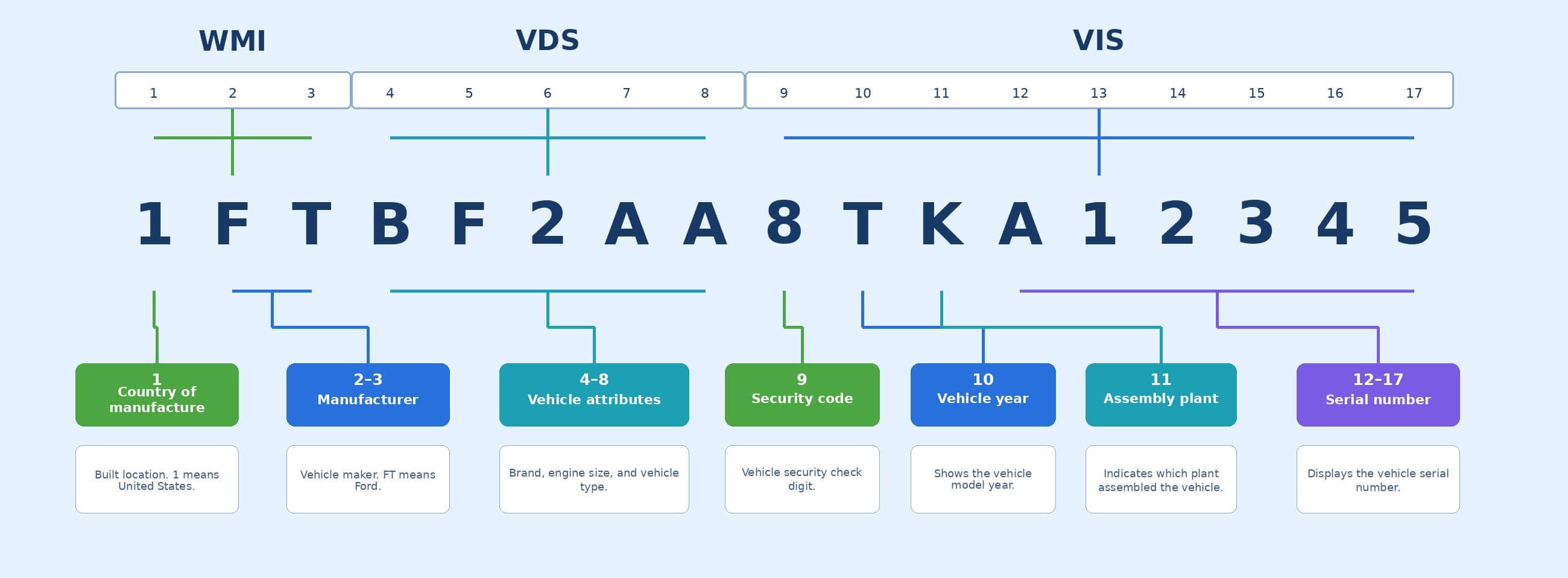
The VIN is the vehicle’s 17-character identification number. It can help identify the vehicle’s year, make, model, body type, engine, restraint system, manufacturing details, and other manufacturer-reported attributes depending on the vehicle.
Use a free VIN decoder to confirm the basic vehicle identity before checking transmission details. At minimum, the VIN should match the vehicle’s year, make, model, body style, and engine family.
Check the VIN on:
- Dashboard near the windshield
- Driver-side door jamb label
- Vehicle title
- Registration documents
- Insurance documents, if available
- Seller listing
- Service records
- Dealer paperwork
If the VIN does not match across the vehicle and documents, stop the purchase until the mismatch is explained.
Use a Transmission Lookup by VIN
A dedicated transmission lookup by VIN can help identify the transmission type or transmission-related details when available. This is especially helpful if the listing is vague, the seller is unsure, or the vehicle was offered with multiple transmission options.
A transmission lookup may help you confirm:
- Automatic vs manual
- CVT vs conventional automatic
- Transmission speed count, when available
- Drivetrain pairing
- Engine and transmission combination
- Model-specific equipment clues
- Whether the listing description appears accurate
However, buyers should understand the limitation: not every VIN result will show transmission type. Some manufacturers do not make transmission details easy to decode from the VIN alone, and some public decoders may show only general vehicle attributes.
If the VIN lookup does not show transmission details, that does not mean the car has no issue. It simply means you need to verify using other sources.
Check Vehicle Specs by VIN
Transmission type should be reviewed with the rest of the vehicle’s specifications. Use a vehicle specs by VIN lookup to compare the seller’s claims with available vehicle data.
This can help you verify:
- Engine size
- Drivetrain
- Trim level
- Fuel type
- Body style
- Vehicle class
- Standard or optional transmission pairings
- Towing-related clues for trucks and SUVs
For example, one trim may come only with a CVT, while another trim may offer a conventional automatic. A pickup may have different transmission pairings depending on engine, cab, drive type, or towing package.
Specs help you see whether the seller’s description is plausible.
Check the Build Sheet or Window Sticker
If the VIN lookup and specs are not enough, look for the original build sheet or window sticker. These may show factory-installed equipment and options more clearly than a basic VIN decoder.
A build sheet or window sticker may include:
- Transmission type
- Transmission code
- Engine and drivetrain
- Axle ratio
- Towing package
- Performance package
- Trim package
- Factory option groups
This is especially useful for trucks, SUVs, performance vehicles, luxury cars, and vehicles with multiple drivetrain combinations.
If a seller says a truck has a heavy-duty towing setup, the build details should support that claim. If a car is advertised as a manual, the build details should not point to an automatic configuration.
Review the Owner’s Manual and Service Records
Service records can also help confirm transmission type. Repair invoices, maintenance receipts, and dealer service records may identify the transmission fluid type, transmission service, or transmission repair history.
Look for records showing:
- Transmission fluid change
- Transmission filter service
- Clutch replacement
- CVT fluid service
- Transmission software update
- Valve body repair
- Torque converter repair
- Transmission replacement
- Transfer case service
- Differential service
Service records can also reveal risk. A vehicle with repeated transmission complaints, harsh shifting repairs, slipping issues, or early transmission replacement deserves more scrutiny.
Inspect the Vehicle Physically
A physical inspection can confirm what the documents suggest.
For manual transmission vehicles, look for:
- Clutch pedal
- Manual gear lever
- Clutch engagement feel
- Grinding during shifts
- Clutch slipping under acceleration
- Unusual pedal noise or vibration
For automatic, CVT, or DCT vehicles, look for:
- Gear selector layout
- Transmission mode labels
- Paddle shifters, if equipped
- PRNDL indicator
- Transmission warning lights
- Fluid leaks
- Delayed engagement
- Harsh shifting
- Jerking or shuddering
- Whining noises
Not every transmission issue is visible during a quick walkaround. That is why a test drive and inspection matter.
Test Drive for Transmission Behavior
A transmission may be correctly identified but still have problems. The test drive helps you evaluate how it behaves.
During the test drive, pay attention to:
- Smooth engagement from park to drive
- Smooth reverse engagement
- Shifting under light acceleration
- Shifting under moderate acceleration
- Downshifts when slowing
- Highway cruising behavior
- Stop-and-go behavior
- Shuddering, slipping, flaring, or hesitation
- Warning lights
- Unusual noises
- Burning smell after driving
For CVTs, pay attention to hesitation, whining, vibration, or surging. For manuals, pay attention to clutch slip, grinding, high clutch engagement, and difficulty selecting gears.
If anything feels wrong, have the vehicle inspected by a mechanic before buying.
Compare Transmission Type With Price
Transmission type can affect market value. Some buyers prefer manuals in sports cars. Others prefer automatics for daily driving. Some trucks with stronger engine and transmission combinations may command higher prices. Some vehicles with known transmission concerns may sell for less.
Ask whether the price reflects:
- Correct transmission type
- Current mileage
- Transmission service history
- Known model-specific concerns
- Remaining warranty
- Repair cost risk
- Current driving condition
- Market demand for that transmission
A seller should not price the vehicle as a rare manual if the car is automatic. A dealer should not price a truck like it has a towing package if the transmission and build details do not support it.
Watch for Listing Mistakes
Transmission mistakes are common in online listings. Sometimes the listing platform auto-fills details incorrectly. Sometimes the seller guesses. Sometimes a dealer imports inventory data with wrong fields.
Common listing issues include:
- “Automatic” used for CVT
- Manual listed when photos show automatic
- Wrong gear count
- Wrong drivetrain and transmission combination
- Performance trim listed without matching equipment
- Truck towing package claimed without build support
- Seller using generic specs from another trim
- Transmission type missing entirely
If you find a mismatch, ask for clarification. A simple mistake can be corrected. A seller who avoids the question may not be trustworthy.
Why Transmission Verification Matters for Warranty and Repairs
Transmission repairs can be expensive, and coverage may depend on warranty terms, service history, and whether the issue is pre-existing. If you plan to buy a service contract or rely on remaining warranty, the transmission type matters.
Ask:
- Is the transmission covered?
- Are CVT or DCT components included?
- Are clutch components excluded?
- Are seals and gaskets covered?
- Is diagnostic time covered?
- Are pre-existing problems excluded?
- Are maintenance records required?
- Is there a deductible?
Transmission type can change the real value of warranty coverage. A contract that sounds strong may exclude the parts you care about most.
Transmission Lookup Checklist
| What to Check | Why It Matters |
|---|---|
| VIN match | Confirms you are researching the correct vehicle |
| Transmission lookup | Helps identify transmission type when available |
| Vehicle specs | Confirms engine, drivetrain, and trim pairing |
| Build sheet or window sticker | Shows factory-installed configuration |
| Seller listing | Helps catch incorrect or vague details |
| Service records | Reveals maintenance and repair history |
| Physical inspection | Confirms visible transmission setup |
| Test drive | Reveals shifting or engagement issues |
| Warranty terms | Shows whether transmission repairs may be covered |
| Asking price | Should reflect the correct configuration and risk |
Red Flags to Watch For
Be cautious if:
- Seller refuses to provide the VIN
- Listing transmission does not match photos
- VIN results do not match the seller’s claims
- Build sheet shows a different configuration
- Seller says “automatic” but cannot say whether it is CVT or conventional automatic
- Transmission warning light is on
- Vehicle hesitates, slips, shudders, or jerks
- Service records show repeated transmission complaints
- Manual clutch slips or grinds
- Transmission fluid is leaking
- Seller refuses a mechanic inspection
A transmission mismatch is not always a scam, but it is always worth investigating.
Bottom Line
Verifying transmission type by VIN helps you avoid buying a used car that is mislisted, overpriced, or riskier than expected. The VIN is a strong starting point, but transmission details are not always available from every decoder or data source.
Use a transmission lookup by VIN, confirm the vehicle specs, review the build sheet or window sticker, check service records, inspect the vehicle, and test drive carefully. If the seller’s description, VIN results, physical vehicle, and driving behavior all line up, you can move forward with more confidence.
If they do not, ask questions before you make an offer. Transmission problems and mismatches can be expensive, so it is better to verify before you buy than to discover the issue after the sale.
FAQs
Can I check transmission type by VIN?
Yes, a transmission lookup by VIN may help identify the transmission type when the data is available. However, not every VIN decoder shows transmission details for every vehicle, so buyers should also check specs, build sheets, service records, and the vehicle itself.
Does every VIN show transmission type?
No. VIN data varies by manufacturer, model year, and data source. Some VIN tools may show transmission details, while others may only show general vehicle identity and specifications.
How can I tell if a car has a CVT?
Use the VIN and vehicle specs as a starting point, then confirm with the owner’s manual, window sticker, build sheet, service records, gear selector behavior, and test drive feel. A mechanic can also help verify the transmission type.
Why does transmission type affect used car value?
Transmission type can affect fuel economy, driving feel, repair cost, towing capacity, reliability expectations, buyer demand, and resale value. A vehicle should be priced according to its actual configuration.
What should I do if the listing has the wrong transmission?
Ask the seller to clarify and provide the VIN, build information, or documentation. If the wrong transmission affects price or value, negotiate accordingly or walk away if the seller cannot explain the mismatch.
Author
Julian Cross
Julian Cross is an automotive data writer who specializes in salvage title issues, odometer fraud, theft checks, accident records, and recall screening. His content helps used-car shoppers spot high-risk vehicles before purchase by turning raw vehicle data into practical insights. He focuses on the warning signs that matter most when evaluating private-party and dealership listings.