
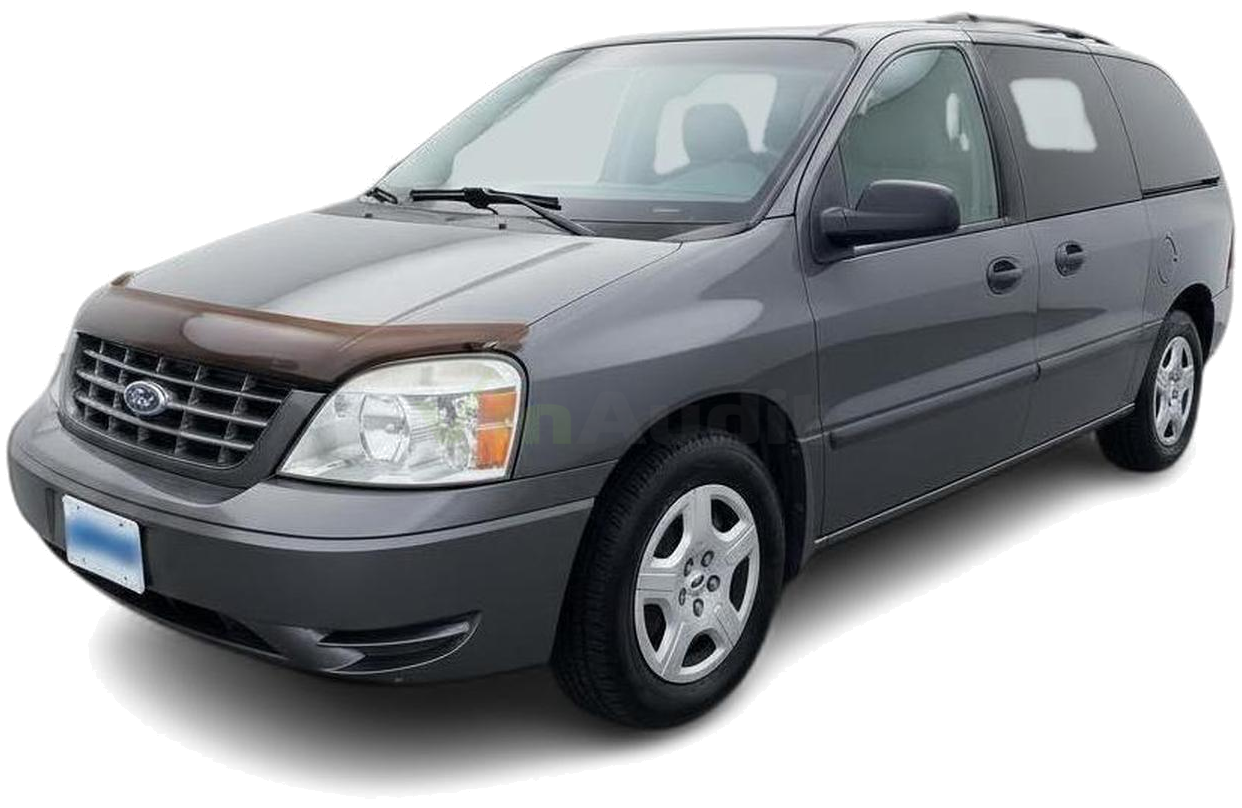
The Good
The 2005 Ford Freestar offers substantial advantages, primarily its outstanding value as a used vehicle, providing immense space for families at a low cost. Its comfortable, roomy interior appeals to emotional buyers seeking family road-trip comfort, while practical buyers appreciate the ample cargo capacity and adequate V6 performance for daily duties. Efficiency is average for its class, and parts are readily available, contributing to its practical appeal.
The Bad
Known weaknesses for the 2005 Ford Freestar include common transmission issues, particularly shifting problems and eventual failure. Fuel Delivery Module (FDM) failures are also frequent, potentially leading to stalling. Owners often report unreliable power sliding doors and electrical gremlins with the gauge cluster. Rust around the rear wheel wells and rocker panels is another significant concern, especially in regions exposed to road salt.
2005 Ford Freestar: Quick Overview
- Engine Options: The 2005 Ford Freestar primarily offered a 4.2L V6 engine. Earlier in the Freestar's run, a 3.9L V6 was also available, though less common by 2005. Both were paired with a 4-speed automatic transmission.
- Horsepower: The 4.2L V6 produced approximately 201 horsepower and 263 lb-ft of torque. The less common 3.9L V6 generated around 193 horsepower. These provided adequate power for family duties, though not class-leading.
- Fuel Economy: Expect an EPA-estimated fuel economy of around 16-17 MPG in the city and 22-23 MPG on the highway for the 4.2L V6, depending on driving conditions and specific model. The 3.9L offered similar figures.
- 0-60 Times: The 0-60 mph acceleration typically ranged from 9 to 10 seconds, which was standard for minivans of its era, emphasizing practicality over brisk acceleration.
- Towing Capacity: When properly equipped with the optional towing package, the 2005 Ford Freestar had a towing capacity of up to 3,500 pounds, making it suitable for light trailers or small boats.
- Trim-Level Features:
- S: The base model, featuring manual sliding doors, air conditioning, AM/FM stereo, and basic steel wheels.
- SE: Added power windows and locks, cruise control, a CD player, and sometimes rear climate control.
- SEL: Upped the ante with alloy wheels, power driver's seat, automatic headlights, and often standard power sliding doors and upgraded audio systems.
- Limited: The top-tier trim, offering premium features like leather upholstery, heated front seats, automatic climate control, a Reverse Sensing System, and optional features such as a power liftgate and a rear-seat DVD entertainment system. All trims typically offered seating for seven passengers with versatile fold-flat third-row seating, and some models had second-row seats that could tumble forward or be removed for expanded cargo space.
2005 Ford Freestar Specifications
Vehicle Information
| Year | 2005 |
| Make | Ford |
| Model | Freestar |
| Trim | - |
| Style | - |
| Type | Van |
| Category | Minivan |
Manufacturing Details
| Made In | Canada |
| Manufacturing City | OAKVILLE |
Dimensions
| Doors | 4-Door |
| Curb Weight | 4080 pounds |
| Gross Vehicle Weight Rating | 5880 pounds |
| Overall Height | 68.80 inches |
| Overall Length | 201.00 inches |
| Overall Width | 76.40 inches |
| Wheelbase Length | 120.80 inches |
| Standard Seating | 2 |
Engine & Performance
| Engine | 3.9L V6 |
| Engine Size | 3.9L |
| Engine Cylinders | 6 |
| Transmission | 4-Speed Automatic |
| Transmission Type | Automatic |
| Transmission Speeds | 4-Speed |
| Drivetrain | Front-Wheel Drive |
Additional Features
| Anti-Brake System | 4-Wheel ABS |
| Steering Type | Rack & Pinion |
Pricing
| Manufacturer Suggested Retail Price (MSRP) | $21,630 |
| Invoice Price | $19,746 |
| Delivery Charges | $710 |
Vehicle History Report
Specifications
History
Events
History Check
Check
Check
Check
Check
Listings
Recalls
Check
Analysis
What Problems Does the 2005 Ford Freestar Have?
Another common and critical issue is the failure of the Fuel Delivery Module (FDM) and fuel pump. This can lead to stalling, rough idling, or difficulty starting. The 2005 Freestar was specifically subject to a major recall (NHTSA Campaign 05V399000 and 05V043000) concerning the FDM due to a risk of cracking, potentially leading to fuel leaks and fire. This recall applies broadly to Freestar and Monterey models.
Power sliding doors are notorious for reliability issues, with motors, cables, and sensors failing, causing the doors to operate intermittently or not at all. Electrical gremlins are also prevalent, affecting components like the gauge cluster (intermittent power or total failure of gauges), dashboard lights, and power accessories.
Rust is a significant long-term concern, especially in regions that use road salt. It commonly appears on the rear wheel wells, rocker panels, subframes, and around the liftgate, compromising both aesthetics and structural integrity over time. Suspension components, such as ball joints, control arm bushings, and tie rod ends, also tend to wear out prematurely.
Other notable recalls for the Freestar/Monterey included NHTSA Campaign 04V407000 for the power sliding door module (risk of door opening unexpectedly) and concerns about seat belt buckles not latching properly. Owners considering this model should anticipate these issues and budget for potential repairs, as they significantly impact long-term ownership costs and reliability.
How long will the 2005 Ford Freestar last?
Long-term durability is severely hampered by common weaknesses that manifest over time. The automatic transmission is a notorious failure point, often needing rebuilding or replacement before 150,000 miles. Electrical problems, particularly with the gauge cluster and power sliding doors, become more frequent. Rust, especially in the undercarriage and body panels, is a persistent enemy, particularly in northern climates, and can lead to structural compromise. While a cheap purchase, its long-term reliability demands a generous repair budget.
What Technology & Safety Features are Included?
Entertainment Features: Standard across trims was an AM/FM stereo, with a single-disc CD player becoming common on SE and higher trims. An optional 6-disc in-dash CD changer was available. For rear passengers, a flip-down screen DVD entertainment system was a popular optional feature on SEL and Limited trims, providing a welcome distraction on long trips. Basic auxiliary audio input was not standard but might be found via specific head unit options.
Built-in Tech & Driver-Assistance: Standard tech included power windows, door locks, and mirrors on most trims above S. Cruise control was standard on SE and above. Higher trims like SEL and Limited offered conveniences such as power-adjustable pedals and automatic climate control. A Reverse Sensing System, essentially parking sensors, was an important optional driver-assistance feature available on the Limited trim, aiding in maneuvering this large vehicle.
Safety Features: The Freestar was equipped with essential safety features for its time. Dual front airbags were standard for driver and front passenger. Optional side-impact airbags for the front occupants enhanced protection. Four-wheel anti-lock brakes (ABS) were standard on all trims, providing improved stopping power. Traction control was optional on some models and standard on the Limited, helping maintain stability in slippery conditions. Child safety locks and the LATCH (Lower Anchors and Tethers for Children) system were included for securing car seats.
Crash-Test Ratings (NHTSA): The 2005 Ford Freestar performed well in NHTSA crash tests:
- Frontal Impact: Received 5 out of 5 stars for both driver and front passenger protection.
- Side Impact: Achieved 5 out of 5 stars for both front and rear occupants.
- Rollover: Rated 3 out of 5 stars for its rollover resistance (for FWD models), which is typical for a higher-center-of-gravity minivan.
What Colors Options are Available?
2005 Ford Freestar Prices and Market Value
The Freestar, like many minivans of its era, experienced very rapid and substantial depreciation. As a mass-market vehicle, high production volumes and the continuous introduction of newer, more advanced models contributed to its swift decline in value. Factors severely affecting its resale value include the prevalence of common mechanical issues (especially transmission and fuel pump problems), rust, high mileage, and general interior/exterior wear. A comprehensive service history can help, but generally, it's now primarily valued as very inexpensive, utilitarian transportation.
2005 Ford Freestar Cost of Ownership
However, repair costs are the primary concern, potentially making it costly to own long-term. Known issues like transmission failure, fuel pump replacement, and power sliding door repairs can be significant, often costing more than the vehicle's low purchase price. Rust repair also adds to potential expenses. While economical to buy initially, the Freestar requires a substantial repair budget, transitioning from an "economical" purchase to a "costly" long-term ownership proposition if major issues arise.
2005 Ford Freestar Fuel Efficiency
2005 Ford Freestar Safety Rating
NHTSA
IIHS
2005 Ford Freestar Recalls & Defects
Power Train:automatic Transmission:torque Converter
Power Train:automatic Transmission
Seats
Structure:body:hatchback/Liftgate
Fuel System, Gasoline
2005 Ford Freestar Warranty
Basic
Powertrain
Rust
2005 Ford Freestar Insurance
reasonable repair costs.
How Does the 2005 Ford Freestar Compare to Other Van?
In terms of Performance, the Freestar's 4.2L V6 (201 hp) offered adequate power, comparable to the Chrysler's 3.3L/3.8L V6s and GM's 3.5L/3.9L V6s. However, it typically fell short of the more powerful and refined Honda Odyssey (255 hp V6) and Toyota Sienna (230 hp V6), which often paired their engines with smoother 5-speed automatic transmissions compared to the Freestar's 4-speed.
Features were competitive for the time; the Freestar offered common minivan amenities like power sliding doors (optional/standard on higher trims), configurable seating, and a rear DVD entertainment system. Rivals generally matched these, with the Chrysler models introducing their innovative Stow & Go seating, and the Japanese brands often leading in available refinements and ergonomic design.
Reliability is where the Freestar significantly lags behind, especially its Japanese competitors. The notorious transmission issues, frequent Fuel Delivery Module failures, and persistent electrical problems (gauge cluster, power doors) are more common and severe than in the Honda Odyssey or Toyota Sienna, which are widely considered reliability benchmarks. While Chrysler/Dodge minivans also had their share of issues, the Freestar's specific problems can be particularly costly.
Price is the Freestar's strongest advantage, especially on the used market. New, it was competitively priced. Now, it's significantly cheaper to acquire than a used Odyssey or Sienna of the same vintage, making it an extremely budget-friendly entry into minivan ownership.
Alternatives:
- Better Alternatives (Reliability/Refinement): For significantly superior long-term reliability, better driving dynamics, and often more refined interiors, the 2005-2010 Honda Odyssey or 2004-2010 Toyota Sienna are highly recommended, though they will command higher used prices.
- Similar Alternatives (Price/Functionality): The 2005-2007 Dodge Grand Caravan/Chrysler Town & Country offer similar space and affordability, often with comparable levels of common issues. The 2005-2009 Chevrolet Uplander/Pontiac Montana are also in this tier, offering similar value-focused minivan utility.
Final Verdict: Is the 2005 Ford Freestar a Good Van?
Is it worth buying? Yes, but only under very specific conditions and with realistic expectations. It should be considered exclusively as a used vehicle, as its new price depreciation was steep. A thorough pre-purchase inspection is paramount to assess the transmission's health, look for rust, and check for any active recalls or fuel system issues. Consider SE or SEL trims for a good balance of features without excessive complexity. Avoid models with obvious transmission slipping or significant rust. It's a "buy cheap, expect to spend on repairs" type of vehicle; if you can get one for under $3,000 and budget an additional $1,000-$2,000 for potential immediate repairs, it can be a highly practical, albeit potentially problematic, mode of transportation.

Jovan
Jovan specializes in interpreting vehicle records and making sense of VIN data. With over 10 years of experience in the automotive data industry, his work ensures that every report is clear, accurate, and useful for car buyers.