
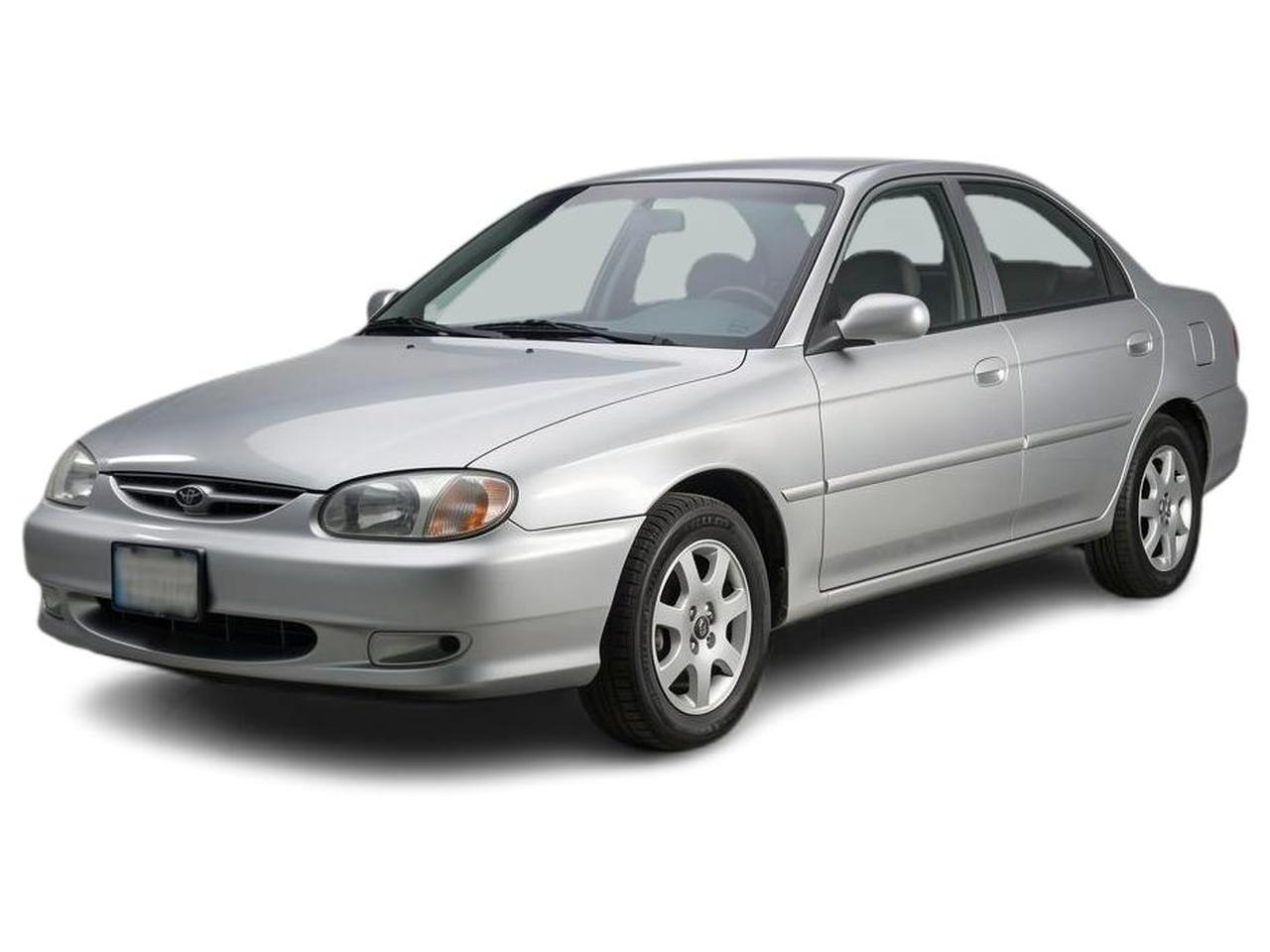
The Good
The 2000 KIA Sephia offered a compelling value proposition with its low purchase price and good fuel efficiency. It provided adequate performance for daily commutes, and its straightforward design appealed to those seeking unpretentious practicality. For budget-minded individuals, it represented an accessible entry into car ownership.
The Bad
Potential buyers of the 2000 KIA Sephia should be aware of common issues like premature rust, especially on the body panels and undercarriage. Some owners reported engine and transmission problems, as well as electrical gremlins and a less refined interior compared to competitors.
2000 KIA Sephia: Quick Overview
- Engine Options: The 2000 KIA Sephia primarily featured a 1.8-liter inline-4 engine.
- Horsepower: This engine typically produced around 122 horsepower.
- Fuel Economy: Fuel economy was a strong point, with estimates around 24 MPG city and 31 MPG highway for manual transmission models. Automatic transmission versions might see slightly lower figures.
- 0-60 Times: Acceleration was modest, with 0-60 MPH times generally in the 10-11 second range, depending on transmission and driving conditions.
- Towing Capacity: The KIA Sephia was not designed for towing and does not have a specified towing capacity.
- Trim-Level Features:
- LS Trim: Typically included power windows, power door locks, air conditioning, a tilt steering wheel, and a basic AM/FM/CD stereo system.
- GS Trim: Often added alloy wheels, a rear spoiler, fog lights, and potentially upgraded interior trim and upholstery.
- Body Styles: Available as a 4-door sedan and a 5-door hatchback.
- Transmission Options: A 5-speed manual transmission or a 4-speed automatic transmission were available.
- Braking: Front disc brakes and rear drum brakes were standard. Anti-lock braking system (ABS) was often an optional feature, particularly on higher trims or later production models.
- Suspension: Independent front suspension and a multi-link rear suspension provided a balance between ride comfort and handling for its class.
2000 KIA Sephia Specifications
Vehicle Information
| Year | 2000 |
| Make | Kia |
| Model | Sephia |
| Trim | - |
| Style | 4-Speed |
| Type | Sedan |
| Category | Compact Car |
Manufacturing Details
| Made In | South Korea |
| Manufacturing City | WHASUNG |
Dimensions
| Doors | 4-Door |
| Curb Weight | 2606 pounds |
| Gross Vehicle Weight Rating | - |
| Overall Height | 55.50 inches |
| Overall Length | 174.40 inches |
| Overall Width | 66.90 inches |
| Wheelbase Length | 100.80 inches |
| Standard Seating | 5 |
Engine & Performance
| Engine | 1.8L I4 |
| Engine Size | 1.8L |
| Engine Cylinders | 4 |
| Transmission | 4-Speed Automatic |
| Transmission Type | Automatic |
| Transmission Speeds | 4-Speed |
| Drivetrain | Front-Wheel Drive |
Additional Features
| Anti-Brake System | Non-ABS 4-Wheel ABS |
| Steering Type | Rack & Pinion |
Pricing
| Manufacturer Suggested Retail Price (MSRP) | $10,195 |
| Invoice Price | $9,791 |
| Delivery Charges | - |
Vehicle History Report
Specifications
History
Events
History Check
Check
Check
Check
Check
Listings
Recalls
Check
Analysis
What Problems Does the 2000 KIA Sephia Have?
Engine-related issues have also been noted. Some owners have experienced problems with the engine mounts, leading to excessive vibration. Issues with the ignition system, such as failing spark plugs or ignition coils, can cause misfires and rough running. The cooling system, including radiator leaks and thermostat failures, is another area that sometimes requires attention.
Transmission problems are also a concern. While less common than rust, some automatic transmissions have been reported to slip or fail to engage gears properly, often requiring costly repairs or replacement. The clutch in manual transmission models can also wear out prematurely.
Electrical gremlins are another aspect to watch out for. Owners have reported issues with the power windows not working, faulty power door locks, and problems with the central locking system. The instrument cluster can also be prone to failure, leading to non-functional gauges.
In terms of recalls, for the 2000 model year, specific recalls might have existed related to airbags, or fuel system components. It is crucial for potential buyers to check the National Highway Traffic Safety Administration (NHTSA) database for any outstanding recalls associated with the VIN.
Long-term reliability can be a mixed bag. While some Sephias have soldiered on for many miles with regular maintenance, others have succumbed to the aforementioned issues relatively early in their lifespan. The quality of interior materials also tends to degrade over time, with plastics becoming brittle and upholstery showing wear. Given its age and the reported issues, thorough pre-purchase inspection by a trusted mechanic is highly recommended.
How long will the 2000 KIA Sephia last?
What Technology & Safety Features are Included?
Entertainment: Standard entertainment typically included an AM/FM radio with a cassette player. Many models also came equipped with a CD player, which was a popular upgrade at the time. Speaker count was usually basic, often four or six speakers.
Technology: Convenience features were the primary focus of available technology. Power windows and power door locks were common, especially on higher trims like the GS. Air conditioning was also a standard or widely available feature. A tilt steering wheel was often included to enhance driver comfort.
Driver-Assistance Features: Advanced driver-assistance systems were virtually non-existent in the 2000 Sephia. Features like cruise control were available, particularly on higher trims, to aid on longer journeys. Anti-lock Braking System (ABS) was an optional feature, offering enhanced braking control during emergencies, though it wasn't standard across all models or trims.
Safety Features: Standard safety features included front airbags for the driver and front passenger. Three-point seatbelts were provided for all occupants. Some models might have offered rear-seat child-seat anchors (LATCH system), although this was not as widespread as in modern vehicles.
Crash-Test Ratings: Crash-test ratings for the 2000 KIA Sephia are not as extensively documented or as robust as those for contemporary vehicles due to evolving testing standards and less stringent requirements at the time. However, available information suggests that frontal and side-impact tests generally yielded average to below-average results for its class, particularly concerning occupant protection in severe impacts. It's advisable to consult the NHTSA or IIHS archives for specific test results, if available, but expectations should be tempered given the vehicle's age and market positioning.
What Colors Options are Available?
2000 KIA Sephia Prices and Market Value
2000 KIA Sephia Cost of Ownership
2000 KIA Sephia Fuel Efficiency
2000 KIA Sephia Safety Rating
NHTSA
IIHS
2000 KIA Sephia Recalls & Defects
Seat Belts:front:buckle Assembly
2000 KIA Sephia Warranty
Basic
Powertrain
Rust
2000 KIA Sephia Insurance
reasonable repair costs.
How Does the 2000 KIA Sephia Compare to Other Sedan?
Performance was generally adequate for its class but lagged behind some competitors. While its 1.8-liter engine provided around 122 horsepower, it wasn't as refined or as responsive as the powertrains found in the Civic or Corolla. The Ford Focus offered a more engaging driving experience and a wider range of engine options.
Features were a mixed bag. The Sephia offered essential amenities like power windows and locks, but it often lacked the more sophisticated technology and refinement found in its Japanese rivals. The Honda Civic and Toyota Corolla were known for their well-appointed interiors and a broader array of available features, even in their base trims.
Reliability is where the Sephia truly struggled compared to its competitors. The Honda Civic and Toyota Corolla have built legendary reputations for bulletproof reliability and longevity, often requiring less in terms of repairs over their lifespan. While the Ford Focus was a newer contender, it generally offered more consistent reliability than the Sephia, though it wasn't at the same level as the Japanese leaders. The Sephia's susceptibility to rust and more frequent mechanical issues were significant drawbacks in the long run.
Alternatives:
- Honda Civic (late 1990s-early 2000s): A benchmark for reliability, fuel efficiency, and enjoyable driving dynamics. Often commands a higher used price but offers superior long-term value.
- Toyota Corolla (late 1990s-early 2000s): Renowned for its unwavering reliability, comfortable ride, and straightforward usability. Another excellent choice for dependable transportation.
- Ford Focus (early 2000s): Offered a more engaging driving experience than the Sephia and a decent range of features. It's a more modern alternative but may not match the long-term reliability of Japanese rivals.
- Nissan Sentra (late 1990s-early 2000s): Another practical compact that offered good fuel economy and reasonable reliability, though perhaps not as refined as the Civic or Corolla.
Final Verdict: Is the 2000 KIA Sephia a Good Sedan?
Whether it's worth buying hinges heavily on the specific vehicle's condition. A meticulously maintained example with minimal rust and recent mechanical work could be a decent, albeit basic, option. However, potential buyers must be prepared for ongoing maintenance and potential repairs. For most, investing a bit more in a competitor like a Honda Civic or Toyota Corolla from the same era would likely prove more economical and reliable in the long run, despite a higher initial cost. Specific trims like the LS offered a bit more comfort, but the core mechanicals and long-term reliability concerns remain consistent across the range.

Drew B
Drew is a seasoned automotive expert and contributor to VinCheck.info. With nearly 15 years of experience as a former Porsche technician, he brings a wealth of hands-on knowledge to his writing. Born in North Carolina, a region renowned for its deep-rooted NASCAR culture, Drew developed a passion for cars early in life, often building and working on vehicles from a young age. At VINCheck, Drew leverages his extensive technical background to provide in-depth analyses of various vehicles. His articles often focus on engine performance, reliability, and maintenance insights, offering readers practical information grounded in real-world experience. Some of his notable contributions include reviews on the Mazda CX-5's longevity and detailed examinations of engine options for models like the 2011 Toyota Camry and Tacoma