
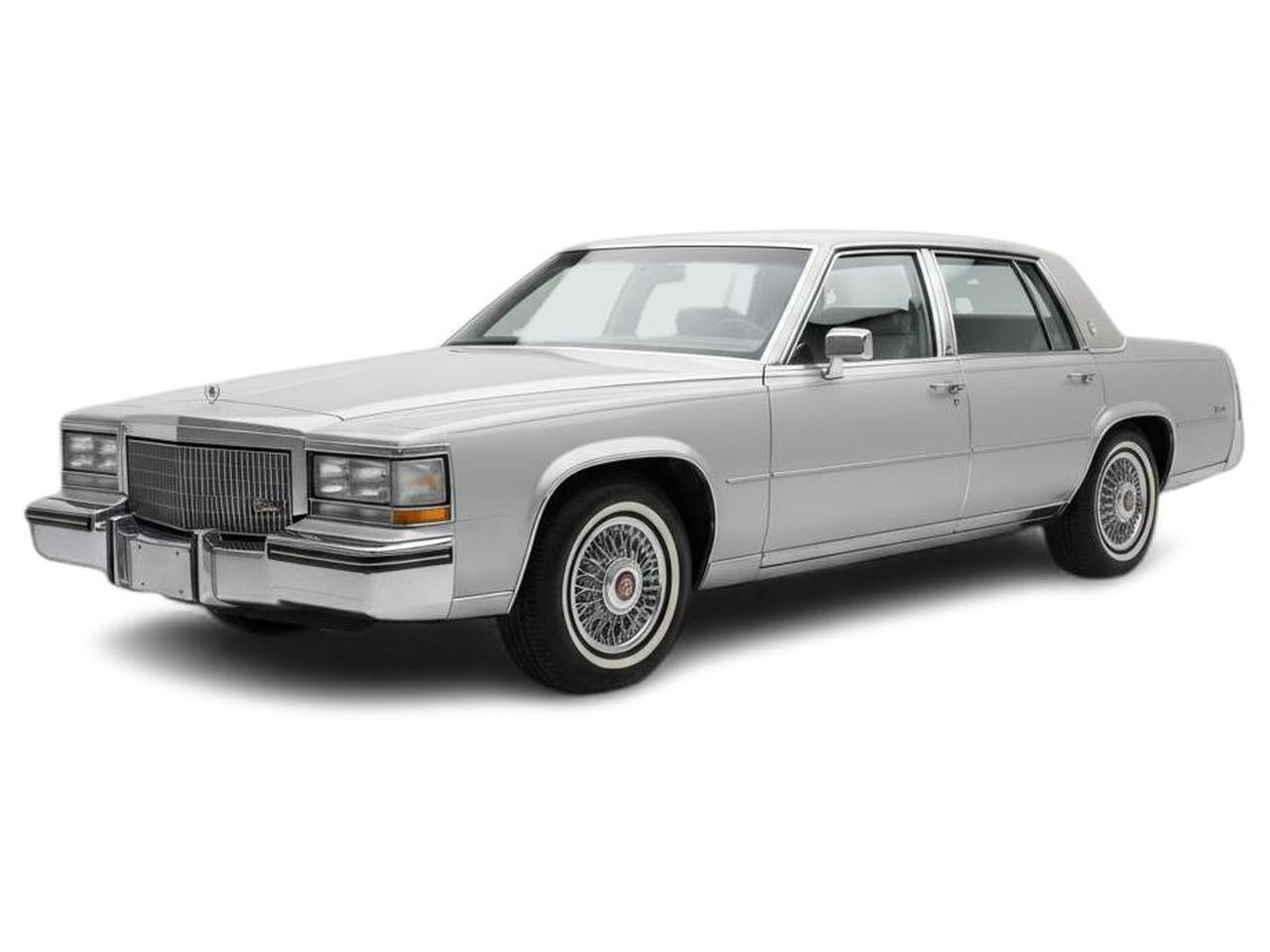
The 1989 Cadillac DeVille, part of the eighth generation of this iconic model (1985-1993), embodies American luxury and comfort. This front-wheel-drive, full-size luxury car was offered in Sedan and Coupe body styles, with the DeVille and the more opulent Brougham as key trims. New pricing for 1989 ranged from approximately $27,000 to $33,000. Its enduring popularity stemmed from its plush ride, spacious interior, and distinctive Cadillac styling, appealing to those seeking a comfortable and prestigious cruiser.
The Good
The 1989 DeVille excels in ride comfort, offering a serene and quiet cabin for emotional buyers. Practically, its spacious interior and smooth, predictable performance make it a comfortable and dependable daily driver, while its classic American design still holds appeal.
The Bad
Potential buyers should watch for issues with the digital dashboard displays, aging electronics (especially climate control and power accessories), and the 4.5L V8 engine's potential for oil leaks or head gasket problems. Rust can also be a concern in certain climates.
1989 Cadillac DeVille: Quick Overview
- Engine Options: The primary engine for the 1989 Cadillac DeVille was the 4.5L (273 cu in) V8.
- Horsepower: This V8 engine produced approximately 155 horsepower.
- Torque: Torque figures were around 240 lb-ft.
- Fuel Economy: Expect EPA estimates around 16 mpg city and 23 mpg highway. Real-world mileage could vary significantly with driving habits and vehicle condition.
- 0-60 Times: Acceleration was not a strong suit; 0-60 mph times were typically in the 10-11 second range.
- Towing Capacity: The DeVille was not designed for towing, and a towing capacity is not typically listed or recommended.
- Trim-Level Features (DeVille): Standard features included automatic climate control, cruise control, power windows and door locks, power-adjustable front seats, an AM/FM stereo with cassette player, tilt steering wheel, and a digital instrument cluster.
- Trim-Level Features (Brougham): The Brougham trim typically added more premium appointments such as leather seating surfaces, upgraded woodgrain interior accents, a six-way power passenger seat, and often a more sophisticated sound system. Optional features on both trims could include anti-lock brakes (ABS), a sunroof, and upgraded sound systems.
- Transmission: A 4-speed automatic transmission (THM-445) was standard.
- Drivetrain: Front-wheel drive was standard.
1989 Cadillac DeVille Specifications
Vehicle Information
| Year | 1989 |
| Make | Cadillac |
| Model | DeVille |
| Trim | - |
| Style | - |
| Type | Sedan |
| Category | Compact Car |
Manufacturing Details
| Made In | United States |
| Manufacturing City | ORION |
Dimensions
| Doors | 4-Door |
| Curb Weight | 3470 pounds |
| Gross Vehicle Weight Rating | - |
| Overall Height | 55.00 inches |
| Overall Length | 205.60 inches |
| Overall Width | 72.50 inches |
| Wheelbase Length | 113.80 inches |
| Standard Seating | 6 |
Engine & Performance
| Engine | 4.5L V8 |
| Engine Size | 4.5L |
| Engine Cylinders | 8 |
| Transmission | 4-Speed Automatic |
| Transmission Type | Automatic |
| Transmission Speeds | 4-Speed |
| Drivetrain | Front-Wheel Drive |
Additional Features
| Anti-Brake System | Non-ABS 4-Wheel ABS |
| Steering Type | Rack & Pinion |
Pricing
| Manufacturer Suggested Retail Price (MSRP) | $25,760 |
| Invoice Price | - |
| Delivery Charges | - |
Vehicle History Report
Vehicle
Specifications
Specifications
Ownership
History
History
All History
Events
Events
NMVTIS Title
History Check
History Check
Salvage/Rebuilt
Check
Check
Accident
Check
Check
Theft
Check
Check
Open Lien
Check
Check
Past Sale
Listings
Listings
Safety
Recalls
Recalls
Odometer
Check
Check
Market Price
Analysis
Analysis
What Problems Does the 1989 Cadillac DeVille Have?
The 1989 Cadillac DeVille, while generally built to last, has several commonly reported issues. One of the most prevalent concerns revolves around the digital instrument cluster, which is notorious for its failure. The vacuum fluorescent displays (VFDs) used often degrade over time, leading to dim or completely non-functional gauges. This can be an expensive repair. Another frequent problem area is the climate control system, particularly the electronic actuators that control airflow; these can fail, leading to inconsistent or non-existent AC/heat. Power windows and locks can also become sluggish or cease to function due to worn motors or faulty switches.
Under the hood, the 4.5L V8 engine, while smooth, can be prone to oil leaks, especially from the valve covers and the front crankshaft seal. Some owners have also reported issues with head gaskets, though this is less common than leaks. The fuel pump and related fuel system components can also be a source of trouble as the vehicles age. While there were no major recalls specific to the 1989 model year that stand out as widespread safety defects, regular maintenance is crucial for longevity. Long-term reliability concerns often stem from the age of the electronic components and the complexity of some systems for their era. Owners who have maintained their De Villes diligently with regular oil changes, coolant flushes, and addressing minor leaks promptly tend to have more reliable vehicles. However, be prepared for potential electrical gremlins and be aware of the specific issues related to the digital dash and climate control.
How long will the 1989 Cadillac DeVille last?
With diligent maintenance, a 1989 Cadillac DeVille can realistically achieve 200,000 to 250,000 miles, and in some cases, even more. Many owners report their vehicles are still running strong at well over 150,000 miles. The underlying mechanical components, particularly the V8 engine and transmission, are robust and designed for longevity. However, the primary weaknesses over time are often electrical. The digital dashboard, climate control modules, and power accessory motors are common points of failure that can impact usability and comfort long before the core powertrain wears out. Rust can also be a significant factor in areas with harsh winters, leading to structural degradation. Therefore, long-term durability heavily depends on where the car has lived and how consistently it has been cared for.
What Technology & Safety Features are Included?
The 1989 Cadillac DeVille was positioned as a luxury vehicle, and its technology and safety features reflected that aspiration for the era. Standard tech included a digital instrument cluster, which, while prone to failure, was a hallmark of Cadillac's modern approach. An AM/FM stereo with a cassette player was standard, offering basic entertainment. Automatic climate control was also a key feature, maintaining cabin temperature with minimal user input. Power-adjustable front seats were standard, enhancing occupant comfort.
Optional features added further luxury and convenience. Buyers could opt for anti-lock braking system (ABS), which was a significant safety advancement at the time, providing improved control during emergency stops. A premium sound system with more speakers and perhaps a graphic equalizer was also available. Other options could include a power sunroof, cruise control, and heated mirrors.
In terms of safety, the 1989 DeVille was equipped with seat belts, including motorized front shoulder belts. It also featured energy-absorbing bumpers and side-guard door beams. Airbags were not standard equipment in 1989; they became more common in luxury vehicles in the following years.
Crash-test ratings for vehicles of this vintage are not directly comparable to modern standards and often focused on specific impact types. However, as a large, heavy vehicle, the DeVille offered a degree of passive safety due to its mass and body structure. The lack of widespread advanced driver-assistance systems (like traction control, stability control, or lane departure warnings) is to be expected given the era.
Optional features added further luxury and convenience. Buyers could opt for anti-lock braking system (ABS), which was a significant safety advancement at the time, providing improved control during emergency stops. A premium sound system with more speakers and perhaps a graphic equalizer was also available. Other options could include a power sunroof, cruise control, and heated mirrors.
In terms of safety, the 1989 DeVille was equipped with seat belts, including motorized front shoulder belts. It also featured energy-absorbing bumpers and side-guard door beams. Airbags were not standard equipment in 1989; they became more common in luxury vehicles in the following years.
Crash-test ratings for vehicles of this vintage are not directly comparable to modern standards and often focused on specific impact types. However, as a large, heavy vehicle, the DeVille offered a degree of passive safety due to its mass and body structure. The lack of widespread advanced driver-assistance systems (like traction control, stability control, or lane departure warnings) is to be expected given the era.
What Colors Options are Available?
1989 Cadillac DeVille Prices and Market Value
When new, the 1989 Cadillac DeVille had a Manufacturer's Suggested Retail Price (MSRP) ranging from approximately $27,000 for the base DeVille to over $33,000 for the more luxurious Brougham trim. Like most vehicles, the DeVille experienced significant depreciation in its early years.
Currently, used market prices for a 1989 Cadillac DeVille vary widely based on condition, mileage, and trim level. Well-maintained examples in excellent condition can fetch anywhere from $5,000 to $10,000 or more, especially if they are low-mileage or rare variants. However, many examples are available in the $2,000 to $4,000 range, often requiring some cosmetic or mechanical attention. Factors heavily affecting resale value include the operational status of the digital dashboard and climate control, the presence of rust, and overall interior and exterior condition. Originality and documented maintenance history also boost value.
1989 Cadillac DeVille Cost of Ownership
Owning a 1989 Cadillac DeVille can be economical for fuel if driven gently on highways, but city driving yields lower MPG. Insurance costs are generally moderate for classic or collector vehicles of this age, especially if driven infrequently. Maintenance costs can be average, but repairs for its specific electronic components (like the digital dash or climate control) can become costly, particularly if specialized parts are needed. The overall ownership experience leans towards moderate to potentially costly, primarily due to the potential for expensive repairs on aging electronics and systems. While not prohibitively expensive, it's not a vehicle one would consider economical to own without a budget for potential upkeep.
1989 Cadillac DeVille Fuel Efficiency
Fuel Type
Gasoline
Fuel Capacity
18.00 gallons
City Mileage
17 miles/gallon
Highway Mileage
25 miles/gallon
1989 Cadillac DeVille Recalls & Defects
Fuel System, Gasoline
Recall date
2006-05-19
Recall no.
06e043000
Source
NHTSA
Summary
Certain Replacement Fuel Filters, Fram Brand Name P/N G3727, With Date Codes X52911 Through X60801 Sequentially or X600141 and A Mexico Country or Origin Marking ON THE Fuel Filter Housing Manufactured From October 18, 2005, Through March 21, 2006, Sold FOR USE ON THE Vehicles Listed Above and ON Certain School Buses. (TO SEE THE School Bus Engine Sizes, Click ON "document Search" and Then "bus Applications"). THE Connector ON THE Fuel Filter WAS NOT Manufactured TO Honeywell's Specification. AS A Result, THE O-Ring MAY NOT Seat Correctly ON THE Fuel Line.
Consequence
This Condition MAY Cause AN Inadequate Seal AT THE Connection, Potentially Leading TO A Fuel Leak. IN THE Presence OF AN Ignition Source, A Fire Could Occur.
Remedy
Honeywell Will Notify Owners and Replace THE Fuel Filters Free OF Charge. THE Recall Began ON October 18, 2006. Owners MAY Contact Fram Customer Service AT 1-800-890-2075 (Option 1).
Notes
This Recall Only Pertains TO Aftermarket Fram Fuel Filters and HAS NO Relation TO ANY Original Equipment Installed ON THE Vehicles Listed.customers MAY Contact THE National Highway Traffic Safety Administration's Vehicle Safety Hotline AT 1-888-327-4236 (Tty: 1-800-424-9153); or GO TO Http://Www.safercar.gov.
1989 Cadillac DeVille Warranty
Basic
Original warranty
0 months / No data
Estimated remaining
Expired
Powertrain
Original warranty
0 months / No data
Estimated remaining
Expired
Rust
Original warranty
0 months / No data
Estimated remaining
Expired
1989 Cadillac DeVille Insurance
Insurance for a 1989 Cadillac DeVille is moderately priced, reflecting its status as a Sedan with strong safety ratings and
reasonable repair costs.
How Does the 1989 Cadillac DeVille Compare to Other Sedan?
The 1989 Cadillac DeVille competed in the American luxury sedan segment against rivals like the Lincoln Continental and the Buick Roadmaster (though the Roadmaster was more of a traditional rear-drive competitor that later returned). Against its direct front-wheel-drive rival, the Lincoln Continental, the DeVille often offered a slightly more refined ride and a more distinctive Cadillac aesthetic. Performance-wise, both were focused on smooth cruising rather than acceleration, with V8 engines offering adequate power but not sporty dynamics. Features were comparable, with both offering power amenities, automatic climate control, and premium audio options.
In terms of reliability, both American luxury cars of this era could be hit-or-miss. While the underlying mechanicals were generally robust, the complex electronics were often points of failure. Cadillac's digital dash and climate control systems were notoriously problematic, potentially more so than some of the simpler analog systems found in certain Lincoln or Buick models. Price-wise, they were in a similar bracket when new.
Alternatives:
For similar comfort and a more traditional rear-wheel-drive experience, a **1989-1991 Buick Roadmaster** (if you can find one from that era, though the nameplate was resurrected later) or a comparable model from that generation offers a very plush ride. If seeking more modern features and potentially better long-term reliability (though still with their own issues), a **1992-1996 Cadillac DeVille** would be a step up, featuring improved electronics and more advanced safety features like airbags as standard. For a slightly sportier yet still comfortable option, a **1989-1991 Lexus LS 400** offered superior build quality, reliability, and performance, though it came at a significantly higher price point when new and commands a premium on the used market today. The 1989 DeVille remains a charming choice for its iconic American luxury feel, but its rivals and later models might offer better bang for your buck in terms of reliability and modern conveniences.
In terms of reliability, both American luxury cars of this era could be hit-or-miss. While the underlying mechanicals were generally robust, the complex electronics were often points of failure. Cadillac's digital dash and climate control systems were notoriously problematic, potentially more so than some of the simpler analog systems found in certain Lincoln or Buick models. Price-wise, they were in a similar bracket when new.
Alternatives:
For similar comfort and a more traditional rear-wheel-drive experience, a **1989-1991 Buick Roadmaster** (if you can find one from that era, though the nameplate was resurrected later) or a comparable model from that generation offers a very plush ride. If seeking more modern features and potentially better long-term reliability (though still with their own issues), a **1992-1996 Cadillac DeVille** would be a step up, featuring improved electronics and more advanced safety features like airbags as standard. For a slightly sportier yet still comfortable option, a **1989-1991 Lexus LS 400** offered superior build quality, reliability, and performance, though it came at a significantly higher price point when new and commands a premium on the used market today. The 1989 DeVille remains a charming choice for its iconic American luxury feel, but its rivals and later models might offer better bang for your buck in terms of reliability and modern conveniences.
Final Verdict: Is the 1989 Cadillac DeVille a Good Sedan?

The 1989 Cadillac DeVille is ideal for nostalgic enthusiasts who appreciate classic American luxury, smooth cruising, and a spacious, comfortable interior. It's best suited for buyers with a moderate budget for upkeep, as potential repairs to its electronics can be costly. It is **worth buying** primarily as a well-maintained used vehicle, especially if the digital dashboard and climate control systems are confirmed to be in good working order. The Brougham trim offers a more opulent experience. Avoid vehicles with significant rust or extensive documented electrical issues. It's a car for those who value comfort and style over cutting-edge performance and are prepared for the quirks of vintage technology. Purchasing one as a daily driver requires a higher tolerance for potential maintenance than a more modern, reliable vehicle.