
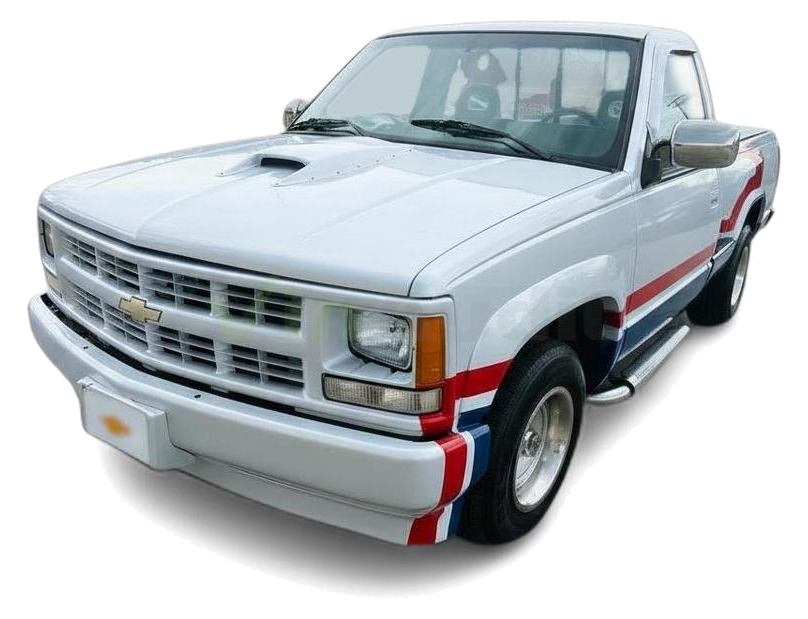
The Good
The 1990 C/K 1500 boasts robust V8 performance for hauling and towing, combined with legendary reliability and straightforward maintenance appealing to practical buyers. Its clean, enduring design and comfortable, spacious interior offered a modern driving experience. While not fuel-efficient, its excellent long-term value and plentiful parts make it an economical choice. Emotionally, it represents classic American truck nostalgia, blending rugged capability with a timeless aesthetic.
The Bad
Potential buyers should watch out for common rust issues, particularly around the wheel wells, rocker panels, and cab corners. Electrical gremlins, such as failing gauges or wiring harness problems, are also frequently reported. Other weaknesses include fuel pump failures, transmission wear (especially 4L60/700R4 models if neglected), and age-related deterioration of interior plastics and HVAC components.
1990 Chevrolet C/K 1500: Quick Overview
- Engine Options:
- 4.3L Vortec V6 (TBI – Throttle Body Injection)
- 5.0L (305 cu in) V8 (TBI)
- 5.7L (350 cu in) V8 (TBI) - Most popular and widely available.
- 6.2L Diesel V8 (less common in 1500, often found in heavier-duty models). - Horsepower:
- 4.3L V6: Approximately 160 hp
- 5.0L V8: Approximately 170 hp
- 5.7L V8: Approximately 190 hp
- 6.2L Diesel V8: Approximately 130-150 hp - Fuel Economy (Estimated Combined):
- V6: 15-18 MPG
- V8: 10-15 MPG (can vary significantly based on driving conditions, gearing, and maintenance). - 0-60 MPH Times:
- For V8 models, typically in the 9-11 second range, depending on configuration and engine. These trucks were not built for speed. - Towing Capacity:
- Highly variable based on engine, transmission, axle ratio, and cab/bed configuration.
- Generally ranged from 5,000 lbs to over 8,000 lbs for properly equipped 1500 models. - Trim-Level Features (examples):
- Cheyenne (Base): Basic vinyl or cloth bench seat, rubber floor mat, manual windows/locks, AM/FM radio, minimal exterior trim.
- Scottsdale (Mid-range): Upgraded cloth interior, chrome bumpers, some optional power accessories available, potentially air conditioning.
- Silverado (Top-tier): Premium cloth or velour seating, full carpeting, power windows and door locks, air conditioning, cruise control, tilt steering, upgraded AM/FM stereo with cassette, more extensive chrome trim, stylized wheels, and improved interior appointments. Optional features like heavy-duty cooling, larger fuel tanks, and various axle ratios were available across trims.
1990 Chevrolet C/K 1500 Specifications
Vehicle Information
| Year | 1990 |
| Make | Chevrolet |
| Model | C/K 1500 |
| Trim | - |
| Style | - |
| Type | Pickup Truck |
| Category | Standard Pickup Truck |
Manufacturing Details
| Made In | Canada |
| Manufacturing City | OSHAWA TRUCK |
Dimensions
| Doors | 2-Door |
| Curb Weight | 4500 pounds |
| Gross Vehicle Weight Rating | 5600 pounds |
| Overall Height | 70.40 inches |
| Overall Length | 194.10 inches |
| Overall Width | 76.80 inches |
| Wheelbase Length | 117.50 inches |
| Standard Seating | 2 |
Engine & Performance
| Engine | 4.3L V6 |
| Engine Size | 4.3L |
| Engine Cylinders | 6 |
| Transmission | 4-Speed Automatic |
| Transmission Type | Automatic |
| Transmission Speeds | 4-Speed |
| Drivetrain | Rear-Wheel Drive |
Additional Features
| Anti-Brake System | 2-Wheel ABS |
| Steering Type | Recirculating |
Pricing
| Manufacturer Suggested Retail Price (MSRP) | $18,424 |
| Invoice Price | - |
| Delivery Charges | - |
Vehicle History Report
Specifications
History
Events
History Check
Check
Check
Check
Check
Listings
Recalls
Check
Analysis
What Problems Does the 1990 Chevrolet C/K 1500 Have?
Transmission issues, especially with the 700R4/4L60 automatic transmissions, are prevalent if maintenance has been neglected, leading to slipping gears or complete failure. The Throttle Body Injection (TBI) system, while generally reliable, can suffer from worn injectors or clogged passages, affecting engine performance. Steering components, such as the idler arm, pitman arm, and tie rod ends, frequently wear out, leading to loose steering and requiring regular replacement. Furthermore, older ABS systems can be problematic, often triggering warning lights or failing entirely.
Regarding recalls, the 1990 C/K 1500 had several. Notable ones include a recall for fuel tank strap corrosion (NHTSA Campaign ID: 93V063000), which could lead to fuel tank separation. Another significant recall involved the cruise control deactivation switch, which, over time, could short circuit and potentially lead to an engine compartment fire (e.g., NHTSA Campaign IDs: 00V379000 and 04V596000, which were broader recalls covering this generation). Seat belt buckle reliability (NHTSA Campaign ID: 92V069000) and steering shaft problems (NHTSA Campaign ID: 90V035000) also led to recalls. Long-term reliability concerns primarily revolve around these age-related failures and the structural integrity of the body due to rust.
How long will the 1990 Chevrolet C/K 1500 last?
What Technology & Safety Features are Included?
For entertainment, standard offerings were typically an AM/FM radio. Higher trims and optional packages might include an AM/FM stereo with a cassette player. CD players were not factory options for this model year. Speaker systems were basic, usually consisting of two or four speakers depending on the cab configuration.
Driver-assistance features, as understood today, were non-existent. The most advanced "assistance" might have been an optional cruise control system, allowing for set speeds on highways. There were no features like blind-spot monitoring, lane-keeping assist, or parking sensors.
Safety features were equally basic. Standard safety equipment included three-point seatbelts for outboard occupants and a lap belt for the center passenger. Importantly, the 1990 C/K 1500 did not come with airbags; these became standard in later model years. Optional safety enhancements included rear-wheel anti-lock brakes (RABS), which prevented the rear wheels from locking up during hard braking. Front disc and rear drum brakes were standard. Structural safety relied on the robust, full-frame construction and the general mass of the vehicle.
Crash-test ratings from agencies like NHTSA or IIHS (which didn't exist in its current form for trucks then) are largely unavailable or not comparable to modern standards for specific models of this vintage. Safety testing was less comprehensive, and the focus was different. Therefore, direct crash-test ratings for the 1990 Chevrolet C/K 1500 are generally not available.
What Colors Options are Available?
1990 Chevrolet C/K 1500 Prices and Market Value
Current used market prices for a 1990 C/K 1500 vary wildly. A rough, high-mileage work truck might fetch $2,000-$5,000. Clean, rust-free examples in good running condition can command $8,000-$15,000. Exceptionally low-mileage, original, or fully restored trucks can even reach $20,000-$30,000+ among collectors. Factors affecting resale value include overall condition (especially rust-free bodywork), mileage, engine type (5.7L V8 often preferred), trim level (Silverado commands more), originality, and the presence of desirable options like air conditioning and power accessories. The "OBS" market has grown significantly, making these trucks a nostalgic investment.
1990 Chevrolet C/K 1500 Cost of Ownership
1990 Chevrolet C/K 1500 Fuel Efficiency
1990 Chevrolet C/K 1500 Safety Rating
NHTSA
IIHS
1990 Chevrolet C/K 1500 Warranty
Basic
Powertrain
Rust
1990 Chevrolet C/K 1500 Insurance
reasonable repair costs.
How Does the 1990 Chevrolet C/K 1500 Compare to Other Pickup Truck?
In terms of performance, all three offered a range of V6 and V8 engines. The C/K's 5.7L TBI V8 was a strong contender, offering competitive horsepower and torque for the era, similar to Ford's 5.0L and 5.8L V8s. Dodge's Magnum V8s (which arrived later in the D/W series) eventually provided a power advantage, but the 1990 Dodge V8s were generally less refined.
Features across all three were quite basic. However, the C/K 1500 was lauded for its more modern, car-like interior design and ergonomics compared to its rivals. Ford's interior was functional but less stylish, while Dodge's design felt significantly older and less refined, sticking with a more traditional "truck" feel. Power accessories, air conditioning, and upgraded stereos were optional on all top trims.
Reliability was a strong suit for both Chevy and Ford. Both platforms are renowned for their longevity when properly maintained. Common issues like rust and age-related electrical problems plagued all three, but the core mechanicals (engines, transmissions, frames) of the C/K and F-150 were exceptionally durable. The Dodge D/W series also had its loyal followers but was generally considered less modern and, in some aspects, less robust than its newer rivals.
For price, all three were competitively priced when new. In the current used market, prices are heavily dependent on condition, originality, and mileage. Clean examples of the C/K 1500 and F-150 tend to command similar values, often appreciating. Dodge D/W trucks, while having their niche, generally don't fetch as high prices unless they are extremely rare or custom builds.
Alternatives: For buyers considering a 1990 C/K 1500, the most direct and similar alternative is the 1987-1991 Ford F-150. Both offer robust platforms, ample parts availability, and strong community support. The GMC Sierra 1500 from the same era is essentially the same vehicle as the C/K 1500, offering identical performance and features with slightly different badging and trim variations.
Final Verdict: Is the 1990 Chevrolet C/K 1500 a Good Pickup Truck?
The key condition for purchase is finding an example with minimal rust and a well-maintained powertrain, ideally the ubiquitous 5.7L TBI V8. Opting for a Silverado trim offers greater comfort and convenience features. This truck is not for someone expecting modern amenities, advanced safety, or excellent fuel economy. Instead, it offers a rewarding ownership experience for those willing to address age-related wear and value its simplicity and enduring utility. It's an investment in a durable, appreciating classic, rather than a depreciating asset.

Jovan
Jovan specializes in interpreting vehicle records and making sense of VIN data. With over 10 years of experience in the automotive data industry, his work ensures that every report is clear, accurate, and useful for car buyers.