
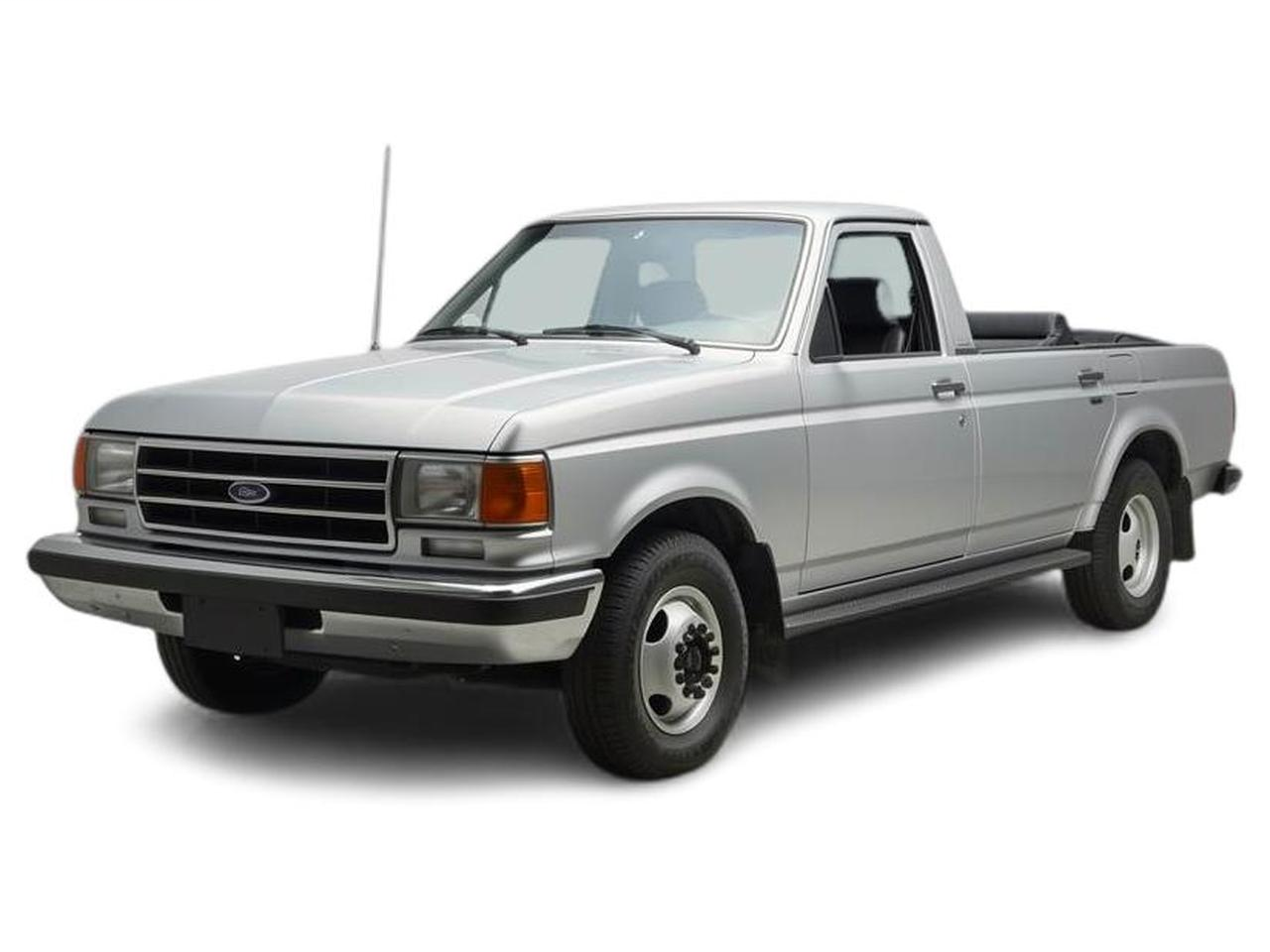
The Good
The 1990 F-Super Duty excels in raw power and undeniable reliability, appealing to practical needs for heavy lifting. Its imposing design stirs emotion with its rugged charm, while its straightforward mechanics offer long-term value and a sense of dependability for the practical buyer.
The Bad
Potential buyers of the 1990 F-Super Duty should watch out for rust, particularly on the frame and body panels, especially in areas with harsh winters. Older electrical components can also be a concern, and some engines might exhibit oil leaks or cooling system issues with age and mileage.
1990 Ford F-Super Duty: Quick Overview
- Engine Options: The 1990 Ford F-Super Duty offered a range of potent engine choices to tackle demanding tasks.
- 4.9L (300 cu in) I6: This inline-six engine was a workhorse known for its torque and durability. Horsepower typically ranged around 145 hp, with torque figures in the low 260s lb-ft.
- 5.0L (302 cu in) V8: A smaller V8 option, providing a balance of power and relative efficiency for its time. Horsepower was generally around 185 hp, with torque in the mid-270s lb-ft.
- 5.8L (351 cu in) Windsor V8: This V8 offered more power and towing capability than the 5.0L. Horsepower was typically in the 210-225 hp range, with torque around 315-330 lb-ft.
- 7.5L (460 cu in) V8: The largest gasoline engine option, designed for maximum towing and hauling. Horsepower figures were around 230 hp, with substantial torque in the 360-390 lb-ft range.
- 7.3L (444 cu in) IDI V8 Diesel: For those prioritizing brute force and fuel efficiency in heavy-duty applications, the naturally aspirated diesel was available. Horsepower was modest, often around 180-190 hp, but torque was exceptionally high, often exceeding 400 lb-ft.
- 4.9L (300 cu in) I6: This inline-six engine was a workhorse known for its torque and durability. Horsepower typically ranged around 145 hp, with torque figures in the low 260s lb-ft.
- Horsepower: Ranging from approximately 145 hp (4.9L I6) to 230 hp (7.5L V8 gasoline) and around 180-190 hp for the diesel.
- Fuel Economy: Fuel economy was not a strong suit for these heavy-duty trucks, especially with larger engines and towing loads. Expect figures in the low to mid-teens miles per gallon (MPG) for gasoline engines, and potentially slightly better for the diesel under optimal conditions, though still quite low.
- 0-60 Times: Official 0-60 mph times were rarely published for these trucks, as they were not designed for speed. However, expect leisurely acceleration, with longer times when loaded or towing, likely well over 10-15 seconds.
- Towing Capacity: This is where the F-Super Duty shined. Depending on the configuration, axle ratio, and engine, towing capacities could range significantly, often from 7,500 lbs up to 12,500 lbs or more for properly equipped models.
- Trim-Level Features:
- XL: The base trim, offering essential functionality and durability. Typically included vinyl seats, manual windows and locks, and a basic AM/FM radio.
- XLT: A step up in comfort and convenience, adding features like upgraded interior trim, power windows and locks (on some models), a better stereo system, and possibly cruise control.
- XLT Lariat: The top-tier trim, providing the most luxurious and feature-rich experience. Often included power-adjustable seats, enhanced interior appointments, chrome exterior accents, and a more premium sound system.
- XL: The base trim, offering essential functionality and durability. Typically included vinyl seats, manual windows and locks, and a basic AM/FM radio.
1990 Ford F-Super Duty Specifications
Vehicle Information
| Year | 1990 |
| Make | Ford |
| Model | F-Super Duty |
| Trim | - |
| Style | - |
| Type | Pickup Truck |
| Category | Medium Truck |
Manufacturing Details
| Made In | Canada |
| Manufacturing City | OAKVILLE |
Dimensions
| Doors | - |
| Curb Weight | - |
| Gross Vehicle Weight Rating | - |
| Overall Height | - |
| Overall Length | - |
| Overall Width | - |
| Wheelbase Length | - |
| Standard Seating | - |
Engine & Performance
| Engine | 7.5L V8 |
| Engine Size | 7.5L |
| Engine Cylinders | 8 |
| Transmission | - |
| Transmission Type | - |
| Transmission Speeds | - |
| Drivetrain | Rear-Wheel Drive |
Additional Features
| Anti-Brake System | - |
| Steering Type | - |
Pricing
| Manufacturer Suggested Retail Price (MSRP) | - |
| Invoice Price | - |
| Delivery Charges | - |
Vehicle History Report
Specifications
History
Events
History Check
Check
Check
Check
Check
Listings
Recalls
Check
Analysis
What Problems Does the 1990 Ford F-Super Duty Have?
On the mechanical front, the **cooling system** can be a point of concern. Radiators can develop leaks, heater cores can fail, and hoses can become brittle with age, leading to overheating. The **transmission** (both automatic and manual) can develop issues, with automatic transmissions sometimes exhibiting harsh shifting or a tendency to slip, especially under heavy load.
The **engine** itself, particularly the larger V8s and the diesel, is typically strong, but wear and tear can lead to issues like oil leaks (valve cover gaskets, oil pan gaskets), worn piston rings causing oil consumption, and in some cases, head gasket failures, though this is less common than with some other engines of the era. The **fuel system**, especially on carbureted models or those with early fuel injection, can experience issues with fuel pumps, injectors, or sensors, leading to drivability problems.
**Electrical components** are also a common source of trouble in vehicles of this age. Alternators can fail, starter motors can become weak, and wiring harnesses can degrade, leading to intermittent issues with lights, gauges, or accessories. Power window and lock motors can also fail.
While specific recalls for the 1990 model year related to major powertrain or structural defects are not as numerous as for some other vehicles, it's always prudent to check for any outstanding recalls with Ford. Long-term reliability is highly dependent on how well the truck has been maintained. Trucks that have been regularly serviced, especially with fluid changes and proactive rust prevention, tend to fare much better. However, even well-maintained examples will eventually require attention to wear items like bushings, ball joints, and brake components due to their age.
How long will the 1990 Ford F-Super Duty last?
What Technology & Safety Features are Included?
Technology and Entertainment: Standard entertainment typically consisted of an AM/FM radio. Higher trim levels, like the XLT Lariat, might have offered an optional cassette player or even a premium speaker system, but digital infotainment systems, touchscreens, or smartphone integration were non-existent. Analog gauges were the norm for displaying vehicle information such as speed, engine RPM, fuel level, and coolant temperature.
Driver-Assistance Features: Driver-assistance systems as we know them today were not available. Features like cruise control were optional on some models, but that was the extent of any advanced driving aids. The focus was on the driver’s direct control and the truck’s mechanical feedback.
Safety Features: Safety features were also rudimentary. Standard safety equipment included seat belts, and for the 1990 model year, anti-lock braking systems (ABS) were becoming more common, often as an optional feature, particularly for the rear wheels. Airbags were not standard in 1990; driver-side airbags became mandatory for all vehicles starting with the 1998 model year. Side-impact protection was limited to the inherent strength of the truck's frame and doors.
Crash-Test Ratings: Specific crash-test ratings for the 1990 Ford F-Super Duty from agencies like the NHTSA or IIHS are not readily available in the detailed format we see today. Older vehicles were not subjected to the same rigorous and comprehensive crash testing protocols. However, as a large, body-on-frame truck, it possessed considerable mass, which could offer a degree of protection in certain types of collisions, but without modern crumple zones or advanced restraint systems, its performance in a severe impact would be significantly less than contemporary vehicles.
What Colors Options are Available?
1990 Ford F-Super Duty Prices and Market Value
Currently, the used market prices for the 1990 F-Super Duty are highly variable. Condition is paramount. Trucks in excellent, well-maintained condition, especially with desirable engines like the 7.5L V8 or the 7.3L diesel, can command prices ranging from $5,000 to $15,000 or even more for exceptionally preserved examples. More common, higher-mileage trucks needing work might be found for $2,000 to $4,000.
Depreciation has been significant, as expected for a vehicle of this age. The resale value is heavily influenced by rust (a major detractor), mechanical condition, mileage, and the presence of desirable factory options. A clean, rust-free, and mechanically sound example, particularly those with lower mileage, will hold its value much better than a neglected one.
1990 Ford F-Super Duty Cost of Ownership
1990 Ford F-Super Duty Fuel Efficiency
1990 Ford F-Super Duty Warranty
Basic
Powertrain
Rust
1990 Ford F-Super Duty Insurance
reasonable repair costs.
How Does the 1990 Ford F-Super Duty Compare to Other Pickup Truck?
Performance: In terms of raw power and towing capacity, the F-Super Duty, especially with its larger V8s and the 7.3L diesel, held its own. The 7.5L (460) V8 was a torque monster for its time, competitive with the largest gasoline engines from GM and Dodge. The 7.3L IDI diesel was a strong performer for heavy-duty applications, though perhaps less refined than later designs. GM's offerings often had potent V8s, and Dodge's Ram trucks were known for their ruggedness.
Features: All three brands offered similar levels of basic features in 1990. The F-Super Duty's available XLT Lariat trim provided a good level of comfort and convenience for the time, comparable to higher trims from Chevrolet and Dodge. Modern tech was absent across the board.
Reliability: Ford's F-Series trucks, in general, have a strong reputation for reliability, and the 1990 F-Super Duty is no exception. While all trucks of this vintage will have wear items and potential rust issues, the F-Super Duty is known for its durable powertrains. Chevrolet and Dodge also built robust trucks in this era, with each having their own set of known issues, but the F-Series often edges out the competition in terms of overall longevity when properly maintained.
Price: New prices were competitive across the segment. Used, the 1990 F-Super Duty typically falls into a similar price bracket as comparable Silverado/Sierra and Ram models, with condition being the primary determinant.
Alternatives: If seeking a similar workhorse from the era, a 1990 Chevrolet Silverado 2500/3500 or a 1990 Dodge Ram 250/350 are very comparable options. These trucks offer similar capabilities and share many of the same aging concerns. If prioritizing slightly more modern (though still dated) features or potentially better fuel efficiency with comparable power, looking at slightly newer models from the mid-to-late 1990s (e.g., 1995-1998 Ford F-250/F-350) might be considered, though at a higher purchase price. For a more capable diesel, a 1994.5+ Power Stroke Ford or a Cummins-equipped Dodge would be a significant step up in performance and technology but at a much higher cost.
Final Verdict: Is the 1990 Ford F-Super Duty a Good Pickup Truck?
It is worth buying, but with significant caveats. The key condition is condition. A rust-free, well-maintained example, especially with the larger V8 or diesel engine, represents a solid investment in a truck that can still perform essential tasks reliably. Conversely, a neglected or heavily rusted truck is likely to become a money pit. Buying used is the only option. Focus on clean bodywork and a solid frame, as mechanical components, while potentially robust, are more easily repaired or replaced than major structural rust damage. Specific trims like the XLT or XLT Lariat offer more comfort, but the core capability lies in the chassis and powertrain of any F-Super Duty model.

Drew B
Drew is a seasoned automotive expert and contributor to VinCheck.info. With nearly 15 years of experience as a former Porsche technician, he brings a wealth of hands-on knowledge to his writing. Born in North Carolina, a region renowned for its deep-rooted NASCAR culture, Drew developed a passion for cars early in life, often building and working on vehicles from a young age. At VINCheck, Drew leverages his extensive technical background to provide in-depth analyses of various vehicles. His articles often focus on engine performance, reliability, and maintenance insights, offering readers practical information grounded in real-world experience. Some of his notable contributions include reviews on the Mazda CX-5's longevity and detailed examinations of engine options for models like the 2011 Toyota Camry and Tacoma