
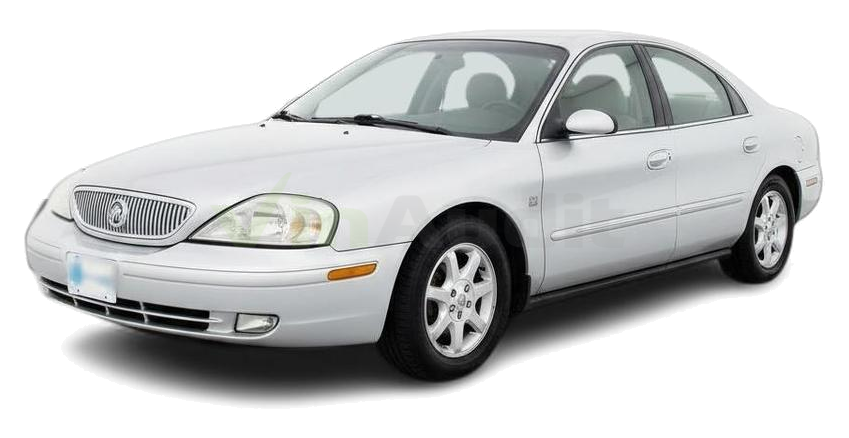
The Good
The 2000 Mercury Sable offered a comfortable, quiet ride and a spacious cabin, appealing to emotional buyers seeking a relaxed driving experience. Practically, it provided good value, decent fuel efficiency for its class, and generally reliable engines, particularly the Vulcan V6, making it an economical choice for everyday transport.
The Bad
Known weaknesses for the 2000 Mercury Sable include potential transmission issues, especially with the AX4N unit, leading to shuddering or failure. Owners should also watch for intake manifold gasket leaks, coil pack failures, and rust, particularly in salt-belt regions. Power window regulators are another common point of failure.
2000 Mercury Sable: Quick Overview
The 2000 Mercury Sable offered a choice of two V6 engines:
- Engine Options:
- 3.0-liter OHV (Overhead Valve) "Vulcan" V6: Standard on GS models.
- 3.0-liter DOHC (Dual Overhead Cam) "Duratec" V6: Optional on LS models, offering more power.
- Horsepower:
- Vulcan V6: Approximately 155 horsepower at 4900 rpm.
- Duratec V6: Approximately 200 horsepower at 5750 rpm.
- Fuel Economy (EPA estimates, FWD):
- Vulcan V6: Around 19 MPG city / 27 MPG highway.
- Duratec V6: Around 18 MPG city / 25 MPG highway.
- 0-60 MPH Times:
- Vulcan V6: Roughly 9.5-10.5 seconds.
- Duratec V6: Approximately 7.5-8.5 seconds, providing noticeably brisker acceleration.
- Towing Capacity:
- Generally rated for around 1,000-1,500 pounds when properly equipped, though not its primary purpose.
- Trim-Level Features:
- GS (Base Trim): Standard features included air conditioning, power windows, power door locks, power mirrors, an AM/FM stereo, and a tilt steering column. It typically came with 15-inch steel wheels.
- LS (Uplevel Trim): Added more premium features such as alloy wheels, cruise control, a power-adjustable driver's seat, a CD player, remote keyless entry, and an overhead console. Optional upgrades for the LS included automatic climate control, a Mach audio system, leather seating surfaces, and front side airbags. The wagon variants offered enhanced cargo flexibility with fold-flat rear seats.
2000 Mercury Sable Specifications
Vehicle Information
| Year | 2000 |
| Make | Mercury |
| Model | Sable |
| Trim | - |
| Style | GS Sedan FWD 4AT 3.0L V6 |
| Type | Sedan |
| Category | passenger |
Manufacturing Details
| Made In | United States |
| Manufacturing City | ATLANTA |
Dimensions
| Doors | 4-Door |
| Curb Weight | 3200 pounds |
| Gross Vehicle Weight Rating | - |
| Overall Height | 56 inches |
| Overall Length | 192 inches |
| Overall Width | 72 inches |
| Wheelbase Length | 108 inches |
| Standard Seating | 5 |
Engine & Performance
| Engine | 3L V6 |
| Engine Size | 3L |
| Engine Cylinders | 6 |
| Transmission | 4-Speed Automatic |
| Transmission Type | Automatic |
| Transmission Speeds | 4-Speed |
| Drivetrain | Front-Wheel Drive |
Additional Features
| Anti-Brake System | 4-Wheel ABS |
| Steering Type | Rack & Pinion |
Pricing
| Manufacturer Suggested Retail Price (MSRP) | $19,500 |
| Invoice Price | $18,000 |
| Delivery Charges | $600 |
Vehicle History Report
Specifications
History
Events
History Check
Check
Check
Check
Check
Listings
Recalls
Check
Analysis
What Problems Does the 2000 Mercury Sable Have?
Another common issue is with the ignition system, including coil pack failures and deteriorated spark plug wires, leading to misfires and rough engine operation. The plastic intake manifold gasket is also a notorious weak point, prone to cracking and leaking coolant, which can cause overheating if not addressed promptly.
Power window regulators are known to fail, leaving windows stuck either up or down. HVAC blend door actuators can also malfunction, leading to improper temperature control within the cabin. Rust is another long-term concern, particularly in regions that use road salt, often appearing on rear wheel wells, rocker panels, and subframe components.
Regarding recalls, the 2000 model year Sable, along with many other Ford and Mercury vehicles of that era, was subject to recalls related to the cruise control deactivation switch. This switch, if faulty, could potentially overheat and cause a fire, even when the vehicle was turned off. Owners were advised to have these switches inspected and, if necessary, replaced or disconnected. Checking the NHTSA database for specific VIN-based recalls is always recommended for any used vehicle purchase. These issues underscore the importance of thorough pre-purchase inspections for any 2000 Mercury Sable.
How long will the 2000 Mercury Sable last?
What Technology & Safety Features are Included?
Driver-assistance features were minimal by today's standards but standard for its time. Power steering was universal, and cruise control was an optional or standard feature on the LS. Anti-lock brakes (ABS) were an optional safety upgrade, often bundled with traction control. The focus was on fundamental driving aids rather than autonomous or complex systems.
In terms of safety, the 2000 Sable came standard with dual front airbags for the driver and passenger. Front side airbags were an available option, primarily on the LS trim, offering additional protection in side-impact collisions. Child safety locks for the rear doors and a LATCH system for child seat installation were also standard.
Crash-test ratings for the 2000 Mercury Sable were generally favorable for its class. The National Highway Traffic Safety Administration (NHTSA) typically awarded the Sable 4 or 5 out of 5 stars for frontal impact protection for both driver and passenger. Side-impact ratings were generally 3 stars for both front and rear occupants, reflecting the prevalent design and safety standards of the late 1990s and early 2000s. The Insurance Institute for Highway Safety (IIHS) rated the similar Ford Taurus (on which the Sable is based) "Acceptable" for its moderate overlap front crash test, which was a good rating for that period, though it did not conduct small overlap front tests at that time.
What Colors Options are Available?
2000 Mercury Sable Prices and Market Value
Factors severely affecting its resale value include its age, high mileage on most units, and the overall decline in demand for older, large sedans. Furthermore, the known potential for costly transmission repairs and increasing maintenance needs as components wear out contribute to its low market value, making it a very affordable entry-level vehicle for those seeking basic transportation.
2000 Mercury Sable Cost of Ownership
Maintenance is relatively inexpensive, as parts are widely available and many repairs are straightforward for a skilled DIY enthusiast or independent mechanic. However, potential major repairs, particularly transmission rebuilds, can be costly and quickly exceed the vehicle's market value. Thus, while routine ownership is economical, prospective buyers should budget for potential "big ticket" items inherent to an older vehicle. Overall, it's economical for a daily driver, but diligence on inspection is critical.
2000 Mercury Sable Fuel Efficiency
2000 Mercury Sable Recalls & Defects
2000 Mercury Sable Warranty
Basic
Powertrain
Rust
2000 Mercury Sable Insurance
reasonable repair costs.
How Does the 2000 Mercury Sable Compare to Other Sedan?
Performance: The Sable's 3.0L Vulcan V6 offered adequate, but not exhilarating, performance. The optional 3.0L Duratec V6 provided a more competitive 200 horsepower, often outpacing base engines of rivals and nearing the performance of V6 Accords or Camrys. However, it generally couldn't match the sportier driving dynamics or higher horsepower offerings of a Nissan Maxima.
Features: Feature-wise, the Sable was competitive with base and mid-tier trims of its rivals, offering power accessories, AC, and optional amenities like a CD player and power seats. It generally lacked the sophisticated interior materials or advanced optional features found in some higher-trim Japanese rivals but was on par with domestic competitors like the Impala.
Reliability: This is where the Sable often lagged behind its Japanese counterparts. While its Vulcan engine was often praised for longevity, the automatic transmission was a known weak point, contrasting with the stellar reputations of the Camry and Accord. Reliability was generally comparable to, or slightly better than, domestic rivals like the Impala.
Price: The Sable's primary strength was its value. It typically undercut the prices of comparably equipped Toyota Camrys and Honda Accords when new, offering more car for the money. On the used market, this price difference is even more pronounced, with Sables being significantly cheaper than its Japanese rivals.
Recommended Alternatives:
- For superior reliability and resale value (if budget allows): Toyota Camry or Honda Accord. These vehicles generally offer fewer major mechanical headaches, especially their transmissions.
- For similar value and domestic feel: Chevrolet Impala or Pontiac Grand Prix. These offer comparable size and features at a similar price point but might share some reliability concerns as the Sable.
- For sportier performance: Nissan Maxima (often available with a more powerful V6 and sharper handling).
The Sable carved out a niche as a budget-friendly family sedan, but for long-term peace of mind, Japanese rivals were generally superior.
Final Verdict: Is the 2000 Mercury Sable a Good Sedan?
Is it worth buying today? Yes, but under specific conditions. As a used vehicle, its low price makes it appealing. Look for well-maintained examples, preferably with documented transmission service or a recently replaced unit. The 3.0L Vulcan engine often offers more straightforward reliability than the Duratec, though the latter provides more power. A thorough pre-purchase inspection by a trusted mechanic is non-negotiable to assess transmission health, rust, and common failure points. Avoid examples with obvious transmission problems. If you find a solid one for under $2,000, it can be a dependable, economical daily driver, offering significant value despite its age.

Eugene S
Eugene is an automotive enthusiast with over 15 years of experience in the used car market. As a writer at VINCheck.info, he brings deep industry insight and a passion for cars, helping readers make smart, informed decisions. Eugene has written hundreds of used car reviews and is known for breaking down complex automotive topics into clear, actionable advice. Over the years, he has driven and worked on a wide range of vehicles—starting with tuning street cars in his early days and eventually focusing on performance upgrades and reliability improvements. Today, he specializes in evaluating used vehicles through the lens of real-world ownership and enthusiast needs. A longtime fan of Porsche, Eugene especially appreciates vehicles that blend durability with driving enjoyment.