
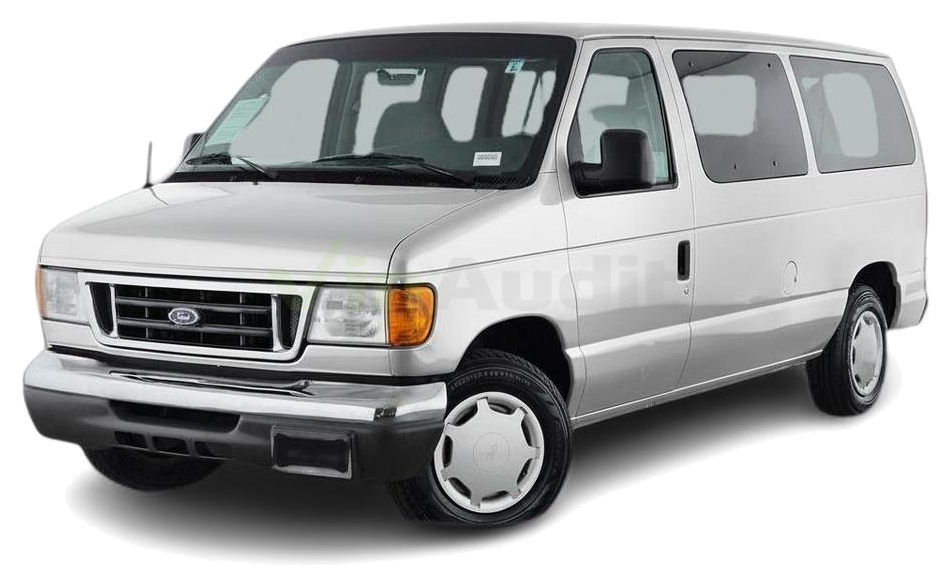
The Good
Its primary advantages include formidable performance from powerful V8 and V10 engines, excellent towing and payload capacity, and renowned long-term reliability for its robust chassis. Practical buyers appreciate its utilitarian design, straightforward maintenance, and strong value on the used market. Emotionally, it's celebrated as a "get-the-job-done" workhorse, offering boundless versatility for custom builds and dependable service.
The Bad
Key weaknesses include poor fuel economy, especially with gas engines, and a spartan interior lacking modern refinement. The ride can be harsh when unladen, and handling is truck-like. Potential issues to watch for include spark plug problems in the Triton gas engines and well-documented reliability concerns with the 6.0L Power Stroke diesel, alongside common rust development.
2006 Ford E350 Super Duty: Quick Overview
- Engine Options:
- 5.4L Triton SOHC V8 Gasoline
- 6.8L Triton SOHC V10 Gasoline
- 6.0L Power Stroke OHV V8 Turbo Diesel - Horsepower:
- 5.4L V8: Approximately 255 hp
- 6.8L V10: Approximately 305 hp
- 6.0L Diesel: Approximately 325 hp - Fuel Economy (Estimates, highly variable):
- Gasoline engines: Generally 10-15 MPG combined
- Diesel engine: Generally 12-18 MPG combined - 0-60 MPH Times:
- Not designed for speed, 0-60 times are slow and depend heavily on engine, load, and configuration. Typically range from 8 to 12+ seconds. - Towing Capacity:
- Varies significantly by engine, axle ratio, and specific configuration. Can range from around 7,000 lbs up to approximately 10,000 lbs when properly equipped with the right engine and towing package. - Trim-Level Features:
- XL (Entry-Level): Primarily aimed at commercial use or basic passenger transport. Features often included vinyl seating, manual windows and locks (power options available), AM/FM radio, and basic climate control. Focuses on utility and durability.
- XLT (Mid-Level, typically passenger-focused): Offered more comfort and convenience. Standard features often included cloth seats, power windows and door locks, air conditioning, cruise control, improved audio systems (CD player optional), and more refined interior trim. Passenger models could accommodate up to 15 occupants.
- Commercial/Cargo Variants: These were essentially XL models stripped for maximum cargo space and customization. Often came with minimal interior appointments, bulkhead options, and reinforced floors for heavy-duty applications.
- Super Duty Designation: Implies a heavier-duty chassis, suspension, brakes, and driveline components compared to lighter E-Series vans, allowing for higher Gross Vehicle Weight Ratings (GVWR) and Gross Combined Weight Ratings (GCWR).
2006 Ford E350 Super Duty Specifications
Vehicle Information
| Year | 2006 |
| Make | Ford |
| Model | E350 Super Duty |
| Trim | - |
| Style | - |
| Type | Van |
| Category | Cargo Van |
Manufacturing Details
| Made In | United States |
| Manufacturing City | AVON LAKE |
Dimensions
| Doors | 3-Door |
| Curb Weight | 5485 pounds |
| Gross Vehicle Weight Rating | 9400 pounds |
| Overall Height | 84.10 inches |
| Overall Length | 231.90 inches |
| Overall Width | 79.30 inches |
| Wheelbase Length | 138.00 inches |
| Standard Seating | 2 |
Engine & Performance
| Engine | 5.4L V8 |
| Engine Size | 5.4L |
| Engine Cylinders | 8 |
| Transmission | 5-Speed Automatic |
| Transmission Type | Automatic |
| Transmission Speeds | 5-Speed |
| Drivetrain | Rear-Wheel Drive |
Additional Features
| Anti-Brake System | 4-Wheel ABS |
| Steering Type | Recirculating |
Pricing
| Manufacturer Suggested Retail Price (MSRP) | $27,515 |
| Invoice Price | $24,483 |
| Delivery Charges | $795 |
Vehicle History Report
Specifications
History
Events
History Check
Check
Check
Check
Check
Listings
Recalls
Check
Analysis
What Problems Does the 2006 Ford E350 Super Duty Have?
The 6.0L Power Stroke turbo diesel engine, while powerful, is arguably the most problematic. Known issues include the "EGR cooler" and "oil cooler" clogging and failing, leading to overheating and potential head gasket failures. Other common diesel problems involve the "FICM" (Fuel Injection Control Module), "HPOP" (High-Pressure Oil Pump), and fuel injector failures. These diesel-related repairs can be extremely expensive, often leading owners to "bulletproof" their engines with aftermarket parts to address these design flaws.
Beyond the engines, common concerns across the model include rust on the body panels, frame, and brake lines, especially in regions exposed to road salt. Front suspension components like ball joints and tie rods wear out over time due due to the vehicle's heavy nature. Recalls for the 2006 E350 included NHTSA Recall 06V392000 for potential ABS module failure, 07V499000 for fuel tank strap corrosion, and 08V382000 concerning the cruise control deactivation switch, which posed a fire risk.
How long will the 2006 Ford E350 Super Duty last?
What Technology & Safety Features are Included?
Safety features, while fundamental, provided essential protection. Standard equipment included driver and front passenger airbags and an Anti-lock Braking System (ABS) for improved stopping control. Heavy-duty frame construction and side impact beams contributed to passive safety. Traction control might have been an option on some higher trims or specific packages, but it was not universally standard. Crash-test ratings for full-size vans like the E350 from NHTSA were often less comprehensive than for passenger cars. For the 2006 E350, NHTSA provided ratings of 3 out of 5 stars for both frontal driver and frontal passenger impact. Side-impact tests were typically not conducted ("N/A"), and the rollover rating was 3 out of 5 stars, indicating a higher risk of rollover, which is common for tall, heavy-duty vans. These ratings reflect a vehicle built to a different standard, prioritizing payload and utility over advanced passenger car safety systems.
What Colors Options are Available?
2006 Ford E350 Super Duty Prices and Market Value
2006 Ford E350 Super Duty Cost of Ownership
2006 Ford E350 Super Duty Fuel Efficiency
2006 Ford E350 Super Duty Safety Rating
NHTSA
IIHS
2006 Ford E350 Super Duty Warranty
Basic
Powertrain
Rust
2006 Ford E350 Super Duty Insurance
reasonable repair costs.
How Does the 2006 Ford E350 Super Duty Compare to Other Van?
Performance: The E350 offers strong V8 and V10 gas engines, plus the powerful 6.0L Power Stroke diesel. It excels in raw towing and payload capacity. The Express/Savana siblings were similarly equipped with robust GM 5.3L/6.0L V8 gasoline engines and the durable 6.6L Duramax diesel. Performance-wise, they were largely comparable in terms of heavy-duty capability. The Sprinter, conversely, offered a less powerful but more fuel-efficient diesel, focusing on cargo volume and maneuverability.
Features: Both the E350 and the Express/Savana were built as utilitarian vehicles. Their interiors were basic, focused on functionality rather than creature comforts, offering similar standard and optional features like basic audio, manual or power accessories, and air conditioning. The Sprinter, being a German design, typically offered a more ergonomic cockpit and often slightly more refined interior materials, though still far from luxury.
Reliability: This is a key differentiator. The E350's gas engines (V8/V10) are generally reliable with good maintenance, but the 6.0L Power Stroke diesel has well-documented, expensive issues. The Chevrolet Express/GMC Savana, on the other hand, boasted the highly reliable GM small-block V8s and a generally more robust Duramax diesel, often considered less problematic than Ford's 6.0L. The Sprinter, while a Mercedes, could suffer from rust and specific sensor issues, with parts and specialized labor often being more expensive.
Price: New, the E350 and Express/Savana were competitively priced. On the used market, their pricing remains similar, with diesel variants commanding a premium. Sprinters were typically more expensive new and held their value better, but came with higher maintenance and repair costs.
Alternatives:
- For superior gas engine reliability: The Chevrolet Express 3500 or GMC Savana 3500 are excellent alternatives, often considered more straightforward for long-term ownership, especially with their venerable V8 gasoline engines.
- For better fuel economy and modern design (at a higher cost): The Mercedes-Benz Sprinter offers better fuel efficiency, a higher roof option, and improved ergonomics, but prepare for higher acquisition and maintenance expenses.
Final Verdict: Is the 2006 Ford E350 Super Duty a Good Van?
For most buyers, the 5.4L V8 or 6.8L V10 gas engine models are generally a safer and more economical long-term choice, provided they have a clean maintenance history and are rust-free. The 6.0L Power Stroke diesel is only recommended if it has documented "bulletproofing" modifications (EGR delete, head studs, etc.) or if the buyer is fully prepared for significant potential repair costs. A pre-purchase inspection is critical regardless of engine choice. If you prioritize raw utility, affordability (used), and durability over modern comforts and fuel efficiency, the E350 Super Duty can be an excellent investment.

Simon A
Simon is a contributor to VinCheck, where he provides articles and reviews on various automotive topics. His work focuses on delivering accurate and up-to-date information about used cars, helping readers make informed decisions.