An open recall on a used car does not always mean you should walk away, but it should always make you pause. A recall means the manufacturer or the National Highway Traffic Safety Administration has identified a safety-related defect or noncompliance that needs attention. The issue could be minor, but it could also involve airbags, brakes, steering, fuel systems, seat belts, electrical components, fire risk, or loss of vehicle control.
Before buying, run a used car recall check by VIN, understand whether the repair is available, ask who will handle it, and decide whether the risk is acceptable before money changes hands. In many cases, safety recall repairs are free through an authorized dealer, but timing, parts availability, vehicle age, and severity of the defect can affect your decision.
A used car with one open recall may still be a reasonable purchase if the remedy is available and the repair is straightforward. A car with serious unresolved recalls, no available remedy, seller pressure, or related warning signs may be better left alone.
What Is an Open Recall?
An open recall means a safety recall applies to the specific vehicle and the required repair has not yet been completed. The recall remains “open” until the vehicle receives the manufacturer-approved remedy and the repair is recorded.
A recall can involve many types of issues, including:
- Airbag defects
- Seat belt problems
- Brake system defects
- Steering issues
- Fuel leaks
- Fire risk
- Electrical faults
- Transmission or rollaway risks
- Engine stalling
- Software defects
- Child seat anchor or restraint concerns
- Tire or equipment defects
Some recalls are simple software updates. Others require parts replacement, inspection, or more involved repairs. The recall notice should explain the safety risk and the manufacturer’s remedy.
Why Recall Checks Matter Before Buying
A used car can look clean, pass a test drive, and still have unresolved recall work. Sellers may not know about the recall. Dealers may disclose it but leave the repair to the next owner. Private sellers may ignore it. Online listings may mention “open recall” without explaining the risk.
A recall check helps you answer:
- Does this exact VIN have an unrepaired safety recall?
- What system is affected?
- Is the repair available now?
- Can an authorized dealer complete it?
- Will the repair be free?
- Is the defect serious enough to delay purchase?
- Should the seller fix it before sale?
- Should the recall affect your offer?
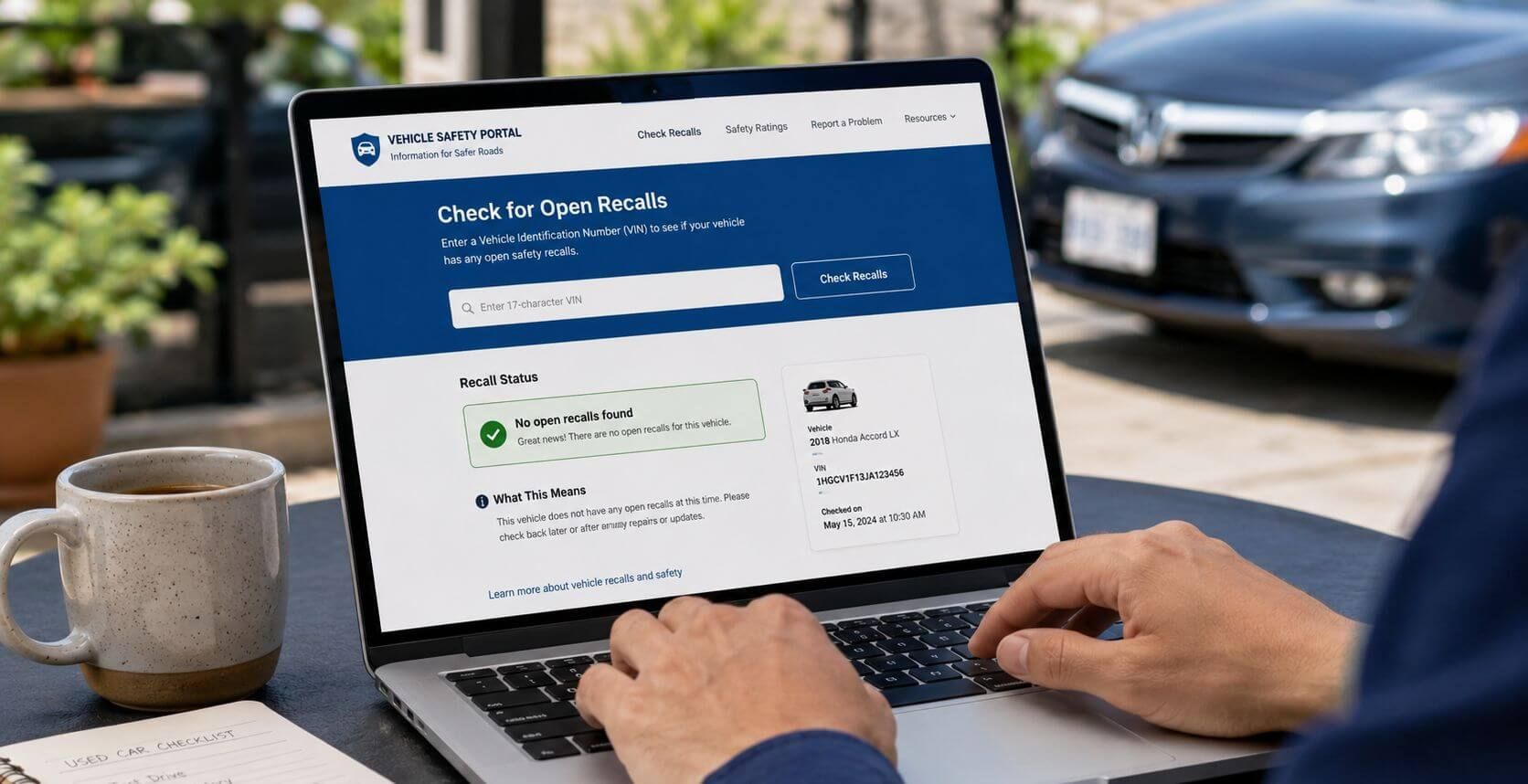
Before making a decision, run a VIN recall check and review the result carefully.
Where to Find the VIN for a Recall Check
A recall search is most useful when you use the correct VIN. A year, make, and model search may show general recall campaigns, but a VIN search helps identify whether a specific vehicle has an unrepaired recall.
Check the VIN on:
- Dashboard near the windshield
- Driver-side door jamb label
- Vehicle title
- Registration documents
- Insurance documents, if available
- Seller listing
- Service records
- Dealer paperwork
If the VIN in the listing does not match the vehicle or title, pause the purchase. A mismatch can be a simple typo, but it can also indicate title fraud, VIN cloning, or a misrepresented car.
Use a free VIN decoder first if you want to confirm the vehicle’s year, make, model, body style, and basic identity before checking recalls.
Who Pays for Recall Repairs?
In most current safety recall situations, the manufacturer provides the recall remedy at no charge through an authorized dealer. The remedy may be a repair, replacement, software update, inspection, or another manufacturer-approved fix.
However, buyers should understand the limits. Federal recall repair obligations are generally tied to vehicle age, and older vehicles may not always qualify for a legally required free remedy. Manufacturers may still voluntarily repair older recalled vehicles, but you should confirm with an authorized dealer before buying.
Before assuming the repair is free, ask:
- Is this recall currently open for this VIN?
- Is the remedy available now?
- Will parts and labor be covered?
- Does vehicle age affect coverage?
- Does the title history affect coverage?
- Is an appointment available soon?
- Will the dealer provide written confirmation?
Do not rely only on the seller’s statement that “recalls are always free.” Confirm with the manufacturer or authorized dealer.
Does a Used Car Warranty Pay for Recall Repairs?
A recall is different from a warranty claim. A recall is a manufacturer safety action. A warranty is coverage for certain defects or repairs within a specific time, mileage, or agreement.
If a vehicle has an open safety recall, the recall remedy is usually handled through the manufacturer’s recall process, not through a used car warranty or service contract. Still, warranty status can matter for related issues, diagnostics, or separate repairs that are not part of the recall remedy.
Before buying, use a car warranty check by VIN to see whether the vehicle may still have factory warranty coverage or other protection. Then ask the dealer which repairs fall under the recall and which repairs, if any, would be your responsibility.
Can Dealers Sell Used Cars With Open Recalls?
Many buyers assume a dealer cannot sell a used car with an open recall. That is not always safe to assume. Federal rules clearly restrict the sale of new vehicles with certain unrepaired safety recalls, but used vehicle rules can vary depending on the vehicle, seller type, state law, manufacturer policy, and dealership practice.
This is why buyers should never assume a used car has been repaired just because it is on a dealer lot. The FTC Buyers Guide also reminds buyers to check for safety recalls before purchasing a used vehicle.
If a dealer is selling a used car with an open recall, ask:
- Has the recall repair been completed?
- If not, why not?
- Is the remedy available?
- Will the dealer repair it before delivery?
- Can I get that promise in writing?
- Is there a manufacturer stop-sale policy?
- Is the vehicle safe to drive before the repair?
If the dealer will not answer clearly, be cautious.
Private Seller Recall Risks
Private sellers may be less familiar with recall rules than dealers. Some may not know the vehicle has an open recall. Others may know but hope the buyer does not ask.
When buying from a private seller, ask:
- Did you receive any recall notices?
- Did you complete the recall repair?
- Do you have dealer paperwork?
- Which dealer performed the repair?
- Is there an appointment already scheduled?
- Are parts currently available?
- Are there any symptoms related to the recall?
If the seller says the repair was done, ask for documentation. If there is no proof, verify the VIN with an authorized dealer.
What If the Recall Has No Remedy Yet?
Sometimes a recall is announced before the final repair is available. The manufacturer may still be developing the fix, waiting for parts, or rolling out repair instructions in phases.
This matters because you may not be able to fix the vehicle immediately after purchase.
If the recall has no remedy yet, ask:
- What safety risk does the recall involve?
- Is there interim safety guidance?
- Should the vehicle be parked outside?
- Should certain features not be used?
- Is driving discouraged?
- When is the remedy expected?
- Will the manufacturer provide updates?
- Will a loaner or rental be available?
A no-remedy recall does not always mean you must walk away, but it raises the risk. If the defect is serious and there is no repair available, buying may not be worth it.
When an Open Recall Is Usually Manageable
Some recalls are easier to manage than others. A used car with an open recall may still be worth considering when:
- The remedy is available now
- An authorized dealer confirms repair is free
- The repair appointment can be scheduled quickly
- The defect does not make the vehicle unsafe to drive immediately
- The seller is transparent
- The price reflects any inconvenience
- There are no related warning lights or symptoms
- The vehicle otherwise has clean title and history
- You receive written documentation after repair
In these cases, you can ask the seller or dealer to complete the repair before closing the sale. If that is not possible, schedule the repair immediately after purchase.
When to Walk Away
Some recall situations are serious enough to make walking away the safer choice.
Consider walking away if:
- The recall involves fire risk, brake failure, steering loss, airbag failure, or stalling
- The manufacturer says not to drive the vehicle
- The remedy is not available and timing is uncertain
- Parts are backordered for months
- The seller refuses to disclose recall information
- The seller pressures you to buy before checking the VIN
- The vehicle shows symptoms related to the recall
- The dealer will not put repair promises in writing
- The car has other major red flags, such as title brands or mileage issues
- Insurance, warranty, or financing is affected by related concerns
An open recall is not always a deal breaker, but safety should come before price.
How Open Recalls Affect Negotiation
An open recall can be a negotiation point, especially if it affects timing, convenience, safety, or confidence. However, be reasonable. If the repair is available, free, and quick, the price impact may be small. If the issue is serious or the fix is delayed, the impact may be larger.
You can ask the seller to:
- Complete the recall repair before sale
- Provide dealer repair documentation
- Reduce the price for inconvenience
- Hold the vehicle until the repair is complete
- Allow you to verify recall status with a dealer
- Put all promises in writing
You can say:
“The VIN shows an open safety recall. I’m still interested, but I want the recall completed before delivery or reflected in the price because I’ll need to schedule the repair and confirm the vehicle is safe.”
Keep the conversation factual. Do not exaggerate the recall, but do not ignore it.
Recall Check vs. Vehicle History Report
A recall check and a vehicle history report are not the same thing. A vehicle history report may show title records, accidents, sale history, mileage entries, and sometimes recall-related information. A recall check focuses specifically on open safety recalls tied to the VIN.
Use both when possible.
| Check | What It Helps Reveal | Buyer Use |
|---|---|---|
| Recall check | Open safety recalls on a specific VIN | Helps identify unrepaired safety issues |
| VIN decoder | Vehicle identity and basic specs | Helps confirm you are checking the right car |
| Warranty check | Remaining coverage or warranty clues | Helps understand repair protection |
| Vehicle history report | Title, mileage, accident, sale, and ownership clues | Helps evaluate overall risk |
| Inspection | Current mechanical and physical condition | Helps find problems records may not show |
A clean vehicle history report does not guarantee there are no open recalls. Run the recall check separately.
What to Ask the Dealer or Seller
Before buying a used car with an open recall, ask:
- What recall is open?
- What part or system is affected?
- Is the repair available now?
- Can an authorized dealer fix it for free?
- Has the manufacturer issued interim safety instructions?
- Is the vehicle safe to drive before repair?
- Will you complete the recall before sale?
- Can I get repair proof in writing?
- Are there related symptoms or warning lights?
- Has this recall affected any previous repairs?
If the seller cannot answer, contact an authorized dealer with the VIN.
Used Car Recall Check Checklist
| What to Check | Why It Matters |
|---|---|
| Correct VIN | Ensures you are checking the right vehicle |
| Recall status | Shows whether unrepaired safety recalls exist |
| Recall description | Explains the risk and affected system |
| Remedy availability | Determines whether repair can be completed now |
| Repair cost | Confirms whether manufacturer covers the remedy |
| Vehicle age | May affect free remedy obligations |
| Dealer appointment | Shows how quickly the issue can be fixed |
| Seller disclosure | Reveals transparency and trustworthiness |
| Related symptoms | Helps identify current safety concerns |
| Written proof | Confirms repair completion |
Red Flags to Watch For
Be cautious if:
- Seller refuses to provide the VIN
- Seller says recalls do not matter
- Dealer will not check recall status
- Recall involves serious safety risk
- Remedy is unavailable
- Parts are backordered with no timeline
- Vehicle has warning lights related to the recalled system
- Seller claims repair was done but has no proof
- Recall repair is used to distract from other title or mileage issues
- You are pressured to buy before checking the VIN
A recall is a safety issue, not just paperwork.
Bottom Line
Open recalls on used cars should always be checked before purchase. In many cases, recall repairs are completed at no charge through an authorized dealer, but buyers still need to verify whether the remedy is available, whether the vehicle qualifies, how serious the risk is, and whether the repair can be completed quickly.
A used car with a minor open recall and available free repair may still be a good buy. A car with a serious unresolved recall, no remedy, unclear repair timing, or an evasive seller may not be worth the risk.
Before buying, confirm the VIN, run a recall check, call an authorized dealer, ask for written repair documentation, and decide whether the vehicle is safe and fairly priced. If the recall story does not line up, walk away.
FAQs
What does an open recall mean on a used car?
An open recall means a safety recall applies to that specific vehicle and the manufacturer-approved repair has not yet been completed.
Are used car recall repairs free?
Many safety recall repairs are provided at no charge by the manufacturer through an authorized dealer, but vehicle age and other limits can apply. Always confirm with the manufacturer or dealer using the VIN.
Should I buy a used car with an open recall?
It depends on the recall. If the remedy is available, free, and easy to complete, it may be manageable. If the recall is serious, has no remedy, or affects safe driving, it may be better to walk away.
Can a dealer sell a used car with an open recall?
Do not assume every used car on a dealer lot has completed recall repairs. Rules and practices can vary, so buyers should check the VIN, ask for repair status, and get promises in writing before purchase.
How do I check recalls before buying a used car?
Find the VIN on the vehicle or documents, run a VIN recall check, review any open recall details, and contact an authorized dealer to confirm whether the repair is available and free.
Author
Elise Rowan
Elise Rowan is a vehicle ownership and consumer protection writer with a strong focus on title transfers, vehicle liens, registration records, and buyer due diligence. She writes educational content for people buying from private sellers, auctions, and online marketplaces, with an emphasis on helping readers verify a vehicle’s financial and legal background before committing to a purchase.