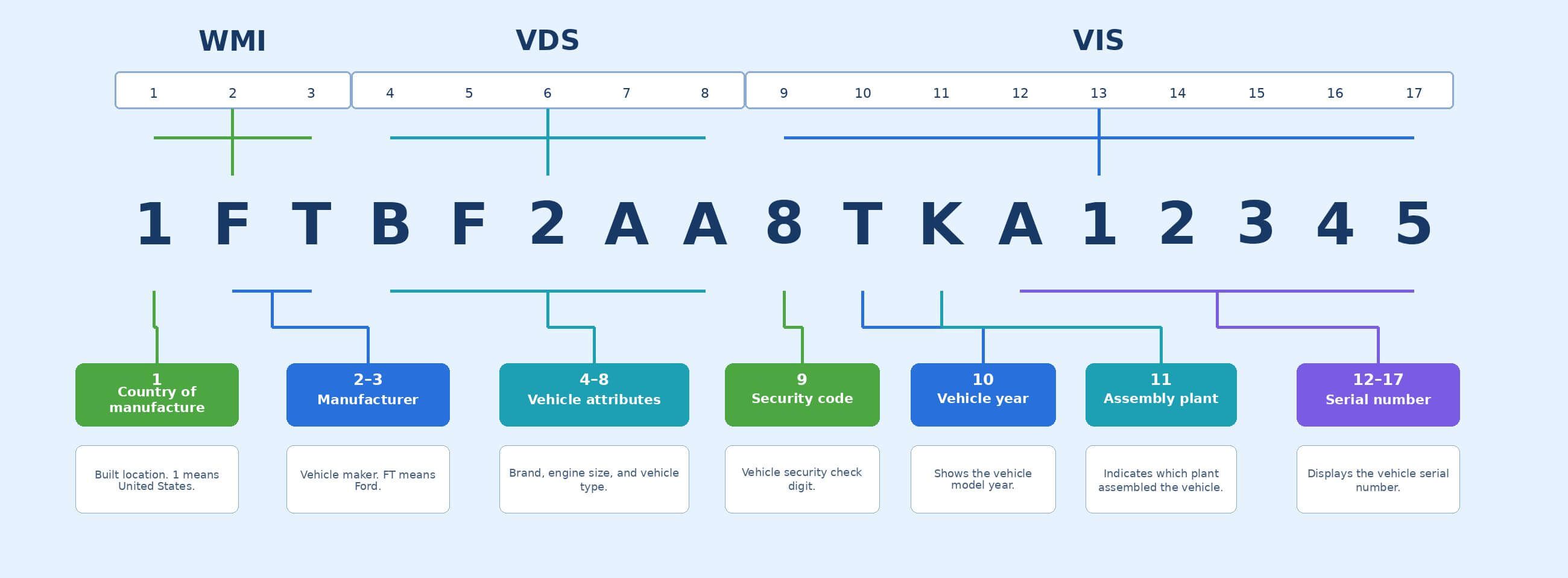
When buying a used car, one of the most valuable details you can check is the Vehicle Identification Number, or VIN. At first glance, a VIN looks like a random string of letters and numbers. In reality, it is a standardized code that reveals important facts about the vehicle’s identity.
A VIN decoding chart helps you break that code down section by section. With it, you can verify where the car was built, who made it, what type of vehicle it is, which engine or trim it may have, and whether the seller’s description matches the vehicle’s actual profile.
In this guide, you will learn how to read a VIN, what each section means, how to use a VIN decoding chart correctly, and why decoding should always come before you commit to a used-car purchase.
Why VIN Decoding Matters Before You Buy
A used-car listing does not always tell the full truth. Sellers can misstate trim levels, hide accident-related repairs, swap badges, or present a vehicle in a way that makes it seem newer or better equipped than it really is.
That creates a real risk for buyers.
If you do not decode the VIN, you may overlook problems such as:
- Incorrect model year claims
- Engine or trim mismatches
- Rebuilt or flood-related warning signs found later in history reports
- Fake or altered VIN information
- Vehicles with suspicious or inconsistent identity details
A VIN decoding chart gives you a quick way to verify what the vehicle is supposed to be before you dig deeper into its history.
What Is a VIN Decoding Chart?
A VIN decoding chart is a reference guide that explains what each character or group of characters in a 17-character VIN represents.
Vehicles built after 1981 generally follow a standardized VIN structure. Each part of the VIN points to a specific piece of information, such as:
- Country of origin
- Manufacturer
- Vehicle type
- Engine or body details
- Model year
- Assembly plant
- Serial number
You can think of it as the vehicle’s identity blueprint.
How to Read a VIN Number
A standard VIN has 17 characters. Each section has a specific purpose.
Positions 1 to 3: World Manufacturer Identifier
The first three characters are called the World Manufacturer Identifier, or WMI. This section tells you where the vehicle was built and which manufacturer produced it.
| Position | Meaning | Example |
|---|---|---|
| 1 | Country of origin | 1 = USA, J = Japan, K = Korea |
| 2 | Manufacturer | H = Honda, T = Toyota, V = Volkswagen |
| 3 | Vehicle type or division | G = Passenger car, T = Truck |
This section helps confirm whether the seller’s description matches the vehicle’s real origin and manufacturer.
Positions 4 to 8: Vehicle Descriptor Section
Characters 4 through 8 form the Vehicle Descriptor Section, or VDS. These positions describe important vehicle attributes. Exact meanings vary by manufacturer, but they often point to the model, body style, engine, restraint system, and transmission.
| Position | Meaning | Example |
|---|---|---|
| 4 | Model or trim | A = Base, B = Sport, C = Touring |
| 5 | Body style | 2 = 2-door, 4 = 4-door, W = Wagon |
| 6 | Engine type | 1 = 1.5L, 2 = 2.0L Turbo, 3 = V6 |
| 7 | Restraint system | A = Front airbags, B = Front and side airbags |
| 8 | Transmission | M = Manual, A = Automatic, C = CVT |
This is one of the most useful sections when you want to confirm whether the listed trim, powertrain, or configuration is accurate.
Position 9: Check Digit
The ninth character is the check digit. This is a security feature used to validate whether the VIN follows the correct mathematical format.
| Position | Meaning |
|---|---|
| 9 | Check digit used to detect fake or altered VINs |
A wrong check digit can be a serious warning sign that the VIN was mistyped, altered, or fabricated.
Position 10: Model Year
The tenth character tells you the model year.
| Character | Model Year |
|---|---|
| A | 2010 |
| B | 2011 |
| M | 2021 |
| N | 2022 |
| P | 2023 |
This matters because the model year is not always the same as the sale year or listing year. If the seller claims the vehicle is newer than what the VIN shows, that is a red flag.
Position 11: Assembly Plant
The eleventh character identifies the assembly plant. The meaning depends on the manufacturer.
| Position | Meaning |
|---|---|
| 11 | Assembly plant code used by the manufacturer |
For example, one manufacturer may use a certain letter to represent a U.S. factory, while another may use the same letter for an entirely different location.
Positions 12 to 17: Serial Number
The final six characters form the serial number. These digits are unique to the specific vehicle.
| Positions | Meaning |
|---|---|
| 12 to 17 | Unique production serial number |
While this section does not usually tell you trim or engine details by itself, it helps distinguish one vehicle from another and is important for accurate record tracking.
Example of a VIN Breakdown
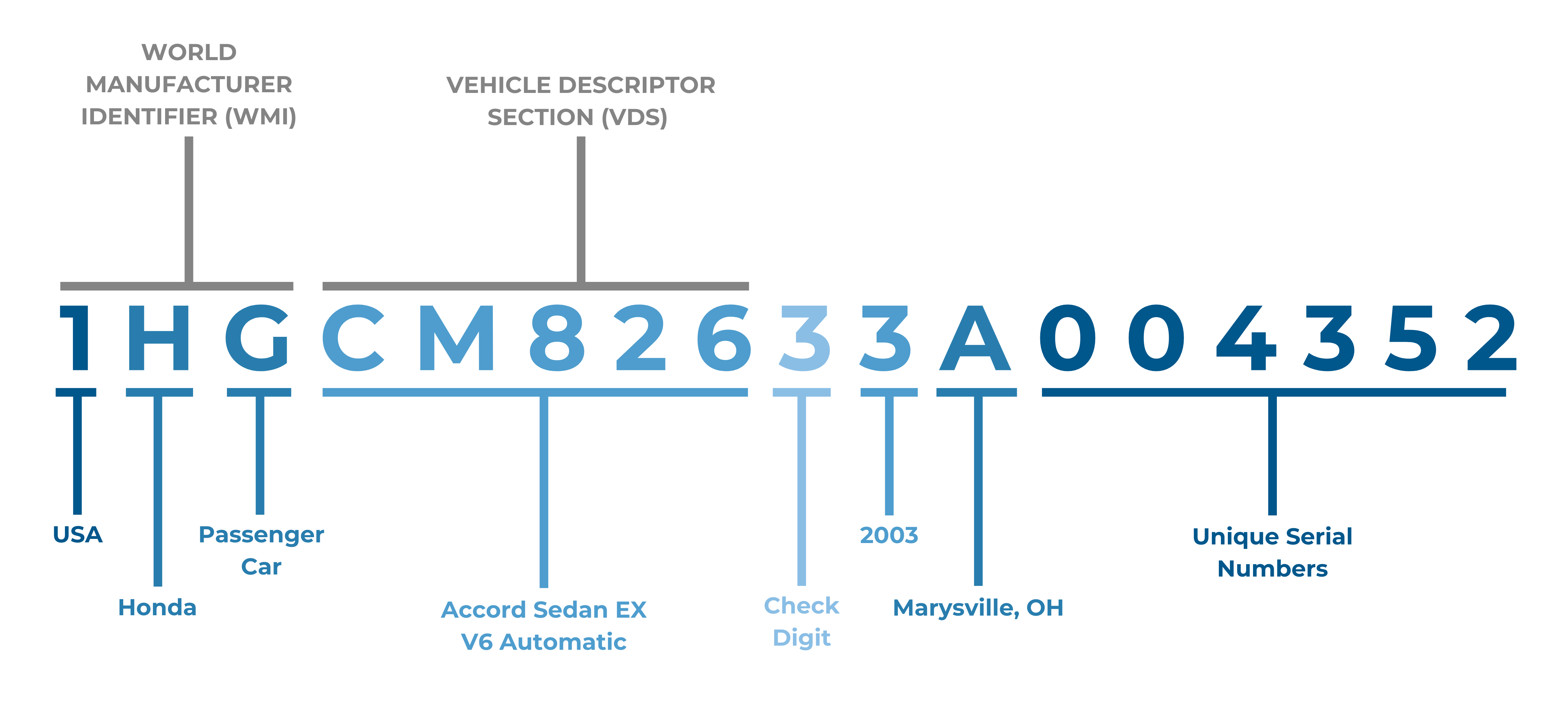
Using the sample breakdown:
- 1HG = USA, Honda, passenger car
- CM826 = Accord sedan EX V6 automatic
- 3 = Check digit
- 3 = Model year 2003
- A = Assembly plant in Marysville, Ohio
- 004352 = Unique serial number
This is where a car VIN decoder becomes especially helpful. It turns an unreadable code into details you can actually use during a purchase decision.
How to Use a VIN Decoding Chart
Using a VIN decoding chart is simple when you follow the process carefully.
1. Find the VIN
Look for the VIN in common locations such as:
- The dashboard on the driver’s side near the windshield
- The driver-side door frame or door jamb
- The vehicle title or registration
- Insurance paperwork
2. Match Each Section to the Chart
Go section by section instead of trying to decode everything at once. Start with the manufacturer identifier, then move through the vehicle descriptor, model year, plant code, and serial number.
3. Verify Key Details
Compare the decoded VIN details to what the seller claims. Confirm the make, model, year, engine, trim, and other key identifiers.
4. Use a VIN Chart Together With a Full Decoder Tool
A chart shows what the VIN should mean. For broader information, such as title brands, recalls, theft status, and accident-related records, use a full decoder and history tool such as the free VIN decoder.
Red Flags a VIN Decoding Chart Can Help You Spot
A decoding chart is not just educational. It can help you catch warning signs before you spend money.
Be cautious if:
- The VIN says the car is a 2022 model, but the seller advertises it as a 2024
- The VIN indicates a 4-cylinder configuration, but the vehicle is being marketed as a V6 trim
- The check digit appears invalid
- The VIN details do not match the badge, trim, or equipment on the car
These mismatches do not always prove fraud, but they absolutely justify deeper investigation.
Use the VIN Chart First, Then Run a Full VIN Check
A VIN decoding chart tells you how the vehicle was identified at the factory. It does not tell you what happened to the vehicle after it left the assembly line.
To uncover the full story, follow decoding with a complete VIN-based history lookup.
A full check can help reveal:
- Title records such as salvage, flood, rebuilt, or lemon branding
- Accident history
- Odometer readings
- Open recalls
- Theft records or recovery status
Start with a free VIN check at VinCheck.info to see the broader vehicle background.
Final Thoughts
A VIN decoding chart gives you a strong starting point when shopping for a used vehicle. It helps you confirm the car’s basic identity, catch mismatches early, and understand what the VIN is actually saying before you trust a listing or seller.
But decoding alone is only the first step.
If you want the complete picture, you still need a full history report to check for hidden damage, title problems, fraud indicators, or unresolved issues that the VIN structure itself cannot reveal.
When buying a used car, start with the chart, confirm the basics, and then run a full VIN check before making any decision.
Related Resources
Let the VIN speak, but make sure you verify what it says before you buy.
Author
Elise Rowan
Elise Rowan is a vehicle ownership and consumer protection writer with a strong focus on title transfers, vehicle liens, registration records, and buyer due diligence. She writes educational content for people buying from private sellers, auctions, and online marketplaces, with an emphasis on helping readers verify a vehicle’s financial and legal background before committing to a purchase.