
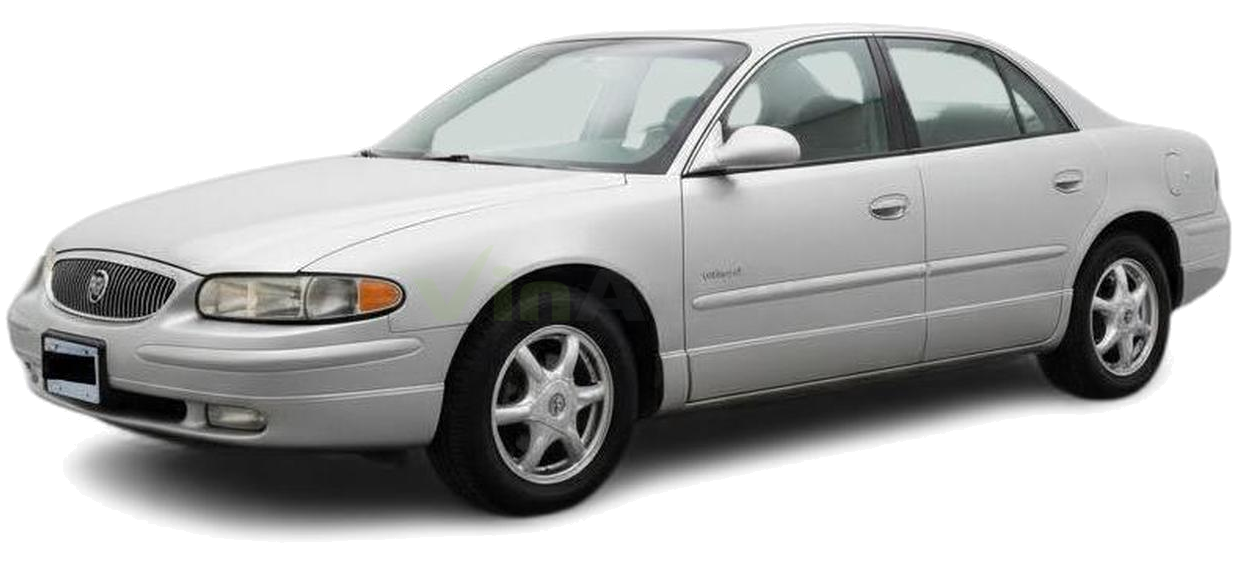
The Good
The 2000 Buick Regal offered a notably comfortable and quiet ride, appealing to those valuing serenity on the road. Its V6 engines provided adequate power, while the refined interior conveyed a sense of upscale comfort. For practical buyers, it represented good value, offering a well-equipped package for its price.
The Bad
Potential buyers should be aware of common issues such as transmission problems, particularly with the 4T65-E transmission, and potential electrical gremlins. Some owners report issues with interior wear and tear, especially on the dashboard and seat materials, over time.
2000 Buick Regal: Quick Overview
- Engine Options: The 2000 Buick Regal offered two primary engine choices.
- A 3.8L V6 engine, standard on most trims.
- A supercharged 3.8L V6 engine, exclusive to the GS trim.
- A 3.8L V6 engine, standard on most trims.
- Horsepower:
- The standard 3.8L V6 produced approximately 195 horsepower.
- The supercharged 3.8L V6 in the GS trim delivered around 240 horsepower.
- The standard 3.8L V6 produced approximately 195 horsepower.
- Fuel Economy (EPA Estimates):
- For the standard 3.8L V6, expect around 18 MPG city and 27 MPG highway.
- The supercharged GS might see slightly lower figures, closer to 17 MPG city and 25 MPG highway, due to its performance orientation.
- For the standard 3.8L V6, expect around 18 MPG city and 27 MPG highway.
- 0-60 Times:
- The standard V6 models typically accelerated from 0-60 mph in the low to mid-8-second range.
- The supercharged GS was notably quicker, achieving 0-60 mph in around 7 seconds.
- The standard V6 models typically accelerated from 0-60 mph in the low to mid-8-second range.
- Towing Capacity: The Buick Regal was not designed for significant towing. Typically, towing capacity was limited and not a primary advertised feature. Consult the owner's manual for any specific ratings, but it would be minimal.
- Trim-Level Features:
- Regal (Base): Featured power windows, power locks, air conditioning, cruise control, and an AM/FM stereo with CD player.
- LS: Added features like upgraded cloth upholstery, a power driver's seat, steering wheel audio controls, and a premium sound system.
- GS: The sportiest trim, it included the supercharged engine, performance-tuned suspension, leather seating, heated front seats, a sunroof, and unique interior/exterior styling cues. Optional features often included a sunroof, premium audio systems, and more advanced climate control.
- Regal (Base): Featured power windows, power locks, air conditioning, cruise control, and an AM/FM stereo with CD player.
2000 Buick Regal Specifications
Vehicle Information
| Year | 2000 |
| Make | Buick |
| Model | Regal |
| Trim | - |
| Style | GS Sedan FWD 4AT 3.1L V6 |
| Type | Sedan |
| Category | passenger |
Manufacturing Details
| Made In | Canada |
| Manufacturing City | OSHAWA #2 |
Dimensions
| Doors | 4-Door |
| Curb Weight | 3350 pounds |
| Gross Vehicle Weight Rating | - |
| Overall Height | 56 inches |
| Overall Length | 197 inches |
| Overall Width | 73 inches |
| Wheelbase Length | 110 inches |
| Standard Seating | 5 |
Engine & Performance
| Engine | 3.1L V6 |
| Engine Size | 3.1L |
| Engine Cylinders | 6 |
| Transmission | 4-Speed Automatic |
| Transmission Type | Automatic |
| Transmission Speeds | 4-Speed |
| Drivetrain | Front-Wheel Drive |
Additional Features
| Anti-Brake System | 4-Wheel ABS |
| Steering Type | Rack & Pinion |
Pricing
| Manufacturer Suggested Retail Price (MSRP) | $24,995 |
| Invoice Price | $23,000 |
| Delivery Charges | $750 |
Vehicle History Report
Specifications
History
Events
History Check
Check
Check
Check
Check
Listings
Recalls
Check
Analysis
What Problems Does the 2000 Buick Regal Have?
Another area of concern for some owners is the electrical system. Issues such as malfunctioning power windows, power locks, and dashboard warning lights can occur. This can sometimes be attributed to worn wiring harnesses or failing sensors. Specific to the 2000 model year, while no widespread, major recalls were issued that impacted all vehicles, individual owners might have experienced isolated problems with various components.
Interior wear is also a point of discussion for long-term owners. The dashboard materials can become sticky or crack over time, especially in warmer climates. Seat upholstery, particularly on the driver's side, can show signs of wear and tear. For the Regal GS, the supercharger itself is generally robust, but leaks in the intercooler system or issues with the supercharger clutch could arise.
While the 3.8L V6 engines are generally considered reliable, like any engine, they can develop issues such as intake manifold gasket leaks or head gasket problems if not properly maintained. Regular oil changes and coolant flushes are essential. Despite these potential issues, many owners have found the 2000 Buick Regal to be a dependable car when properly cared for, with reliability often tied directly to how well it was maintained throughout its life.
How long will the 2000 Buick Regal last?
What Technology & Safety Features are Included?
In terms of driver-assistance features, the 2000 Regal was quite basic. Traction control was available, particularly on the GS model, which aided in maintaining grip during acceleration in slippery conditions. Anti-lock brakes (ABS) were also a common feature, helping drivers maintain steering control during emergency braking. However, advanced aids like adaptive cruise control, lane departure warning, or blind-spot monitoring were not present, as these technologies were nascent or non-existent in mass-market vehicles at the turn of the millennium.
Safety was a priority for Buick, and the 2000 Regal incorporated several standard safety features. These included front airbags for the driver and passenger, and side-impact airbags were often available as an option or standard on higher trims. The structure of the vehicle was designed to absorb impact energy. According to crash-test ratings available from organizations like the National Highway Traffic Safety Administration (NHTSA) for similar models from this era, the Regal generally performed adequately in frontal and side-impact tests, often receiving four out of five stars in key categories, indicating a good level of occupant protection for its time. However, it's important to note that these ratings are based on older testing methodologies.
What Colors Options are Available?
2000 Buick Regal Prices and Market Value
2000 Buick Regal Cost of Ownership
2000 Buick Regal Fuel Efficiency
2000 Buick Regal Recalls & Defects
2000 Buick Regal Warranty
Basic
Powertrain
Rust
2000 Buick Regal Insurance
reasonable repair costs.
How Does the 2000 Buick Regal Compare to Other Sedan?
Features were a strong suit for the Regal, emphasizing comfort and a near-luxury feel. It often boasted more premium interior materials and a quieter cabin than many mainstream rivals. However, vehicles like the Camry and Accord were known for having slightly more advanced or user-friendly technology options.
Reliability is where the Regal faced challenges. While the 3.8L V6 engine itself is generally robust, the 4T65-E transmission has a reputation for being less durable than the powertrains found in the Toyota Camry and Honda Accord, which are legendary for their long-term dependability. The Ford Taurus and Chevy Impala, sharing some mechanical underpinnings with the Regal, also had their own sets of common issues.
Regarding price, the Regal was often positioned as a value-oriented option, offering a premium feel at a price point competitive with, or sometimes slightly below, its key rivals, especially when comparing higher trims.
Alternatives: For buyers prioritizing ultimate reliability above all else, the Toyota Camry and Honda Accord remain superior choices, though they might offer a less plush ride and a more utilitarian interior in their base trims. If a comfortable ride and a bit more power are desired without the potential transmission woes, a well-maintained Ford Crown Victoria or Mercury Grand Marquis (rear-wheel drive, different class but similar price point) offer robust powertrains and a classic American sedan experience. The Chevrolet Impala, sharing the GM W-body platform, offers similar comfort and performance, particularly with the supercharged variant, but also faces similar transmission concerns.
Final Verdict: Is the 2000 Buick Regal a Good Sedan?

Drew B
Drew is a seasoned automotive expert and contributor to VinCheck.info. With nearly 15 years of experience as a former Porsche technician, he brings a wealth of hands-on knowledge to his writing. Born in North Carolina, a region renowned for its deep-rooted NASCAR culture, Drew developed a passion for cars early in life, often building and working on vehicles from a young age. At VINCheck, Drew leverages his extensive technical background to provide in-depth analyses of various vehicles. His articles often focus on engine performance, reliability, and maintenance insights, offering readers practical information grounded in real-world experience. Some of his notable contributions include reviews on the Mazda CX-5's longevity and detailed examinations of engine options for models like the 2011 Toyota Camry and Tacoma