
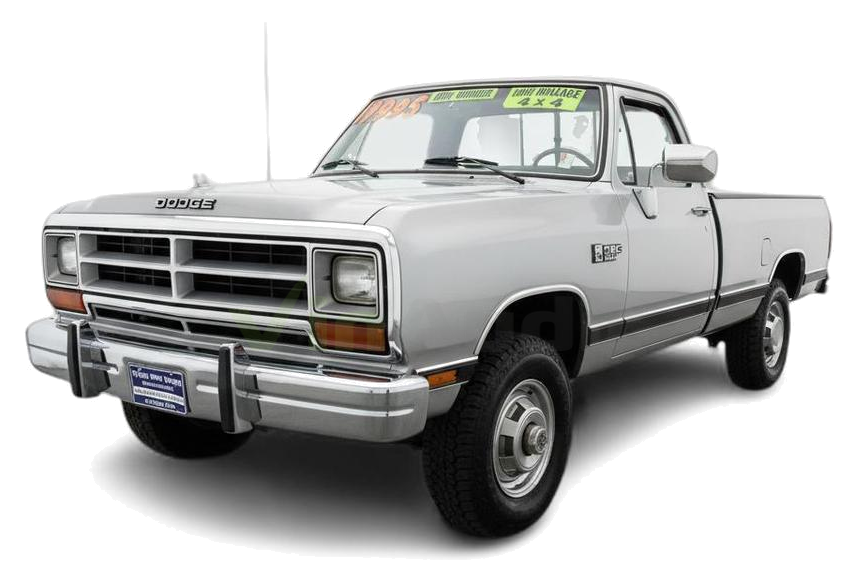
The Good
Its chief advantage is robust performance for towing and hauling, particularly with the exceptionally reliable Cummins diesel. Practical buyers appreciate its durable, simple mechanics and the excellent long-term value as a functional work truck. Emotionally, its classic, no-nonsense design and "tough truck" image appeal to enthusiasts seeking a piece of automotive history built to last.
The Bad
Known weaknesses include significant susceptibility to rust on body panels and the frame, outdated safety features, and a less refined ride compared to modern trucks. Gasoline engine variants can be quite thirsty. Interior components also tend to show their age, with plastics becoming brittle over time. Electrical gremlins can also emerge with age.
1990 Dodge Ram 250: Quick Overview
- Engine Options:
- 3.9L (239 cu in) V6 (slant-six)
- 5.2L (318 cu in) V8 (Magnum-predecessor)
- 5.9L (360 cu in) V8
- 5.9L (359 cu in) Cummins Turbo Diesel I6 (12-valve) - Horsepower:
- 3.9L V6: Approx. 125 hp
- 5.2L V8: Approx. 170 hp
- 5.9L V8: Approx. 190 hp
- 5.9L Cummins Diesel: Approx. 160 hp and a robust 400 lb-ft of torque - Fuel Economy (Estimated, highly variable):
- Gasoline engines: Typically 8-12 MPG city, 12-16 MPG highway
- Cummins Turbo Diesel: Often 15-20+ MPG, even better for some owners on the highway - 0-60 MPH Times (Estimated):
- These are work trucks, not performance vehicles. Times generally range from 10-15+ seconds for gasoline models and 12-18+ seconds for the diesel, depending on configuration and load. - Towing Capacity:
- As a 3/4-ton truck, the 1990 Ram 250 was rated for significant towing. Capacities varied greatly by engine, axle ratio, and transmission, typically ranging from 7,000 to over 10,000 lbs. The Cummins diesel was the top performer in this regard. - Trim-Level Features:
- "S" (Base): Very basic, often with vinyl bench seats, rubber floor mats, manual windows and locks, and an AM radio. Designed for utilitarian work.
- "LE" or "Royal LE" (Upgraded): Offered more creature comforts such as cloth or velour seating, carpeted floors, an AM/FM stereo (with optional cassette), air conditioning, cruise control, power windows and locks (less common on 250 series but available), and more extensive chrome trim. Options included 4WD, various axle ratios, and different bed lengths (long bed being common).
1990 Dodge Ram 250 Specifications
Vehicle Information
| Year | 1990 |
| Make | Dodge |
| Model | Ram 250 |
| Trim | - |
| Style | 2-Door LB |
| Type | Pickup Truck |
| Category | Standard Pickup Truck |
Manufacturing Details
| Made In | United States |
| Manufacturing City | WARREN |
Dimensions
| Doors | 2-Door |
| Curb Weight | 4035 pounds |
| Gross Vehicle Weight Rating | 7400 pounds |
| Overall Height | 73.00 inches |
| Overall Length | 210.80 inches |
| Overall Width | 79.50 inches |
| Wheelbase Length | 131.00 inches |
| Standard Seating | 3 |
Engine & Performance
| Engine | 5.9L I6 |
| Engine Size | 5.9L |
| Engine Cylinders | 6 |
| Transmission | 4-Speed Automatic |
| Transmission Type | Automatic |
| Transmission Speeds | 4-Speed |
| Drivetrain | Rear-Wheel Drive |
Additional Features
| Anti-Brake System | Non-ABS |
| Steering Type | Recirculating |
Pricing
| Manufacturer Suggested Retail Price (MSRP) | $13,382 |
| Invoice Price | - |
| Delivery Charges | - |
Vehicle History Report
Specifications
History
Events
History Check
Check
Check
Check
Check
Listings
Recalls
Check
Analysis
What Problems Does the 1990 Dodge Ram 250 Have?
The most pervasive issue is rust. Owners consistently report rust developing in cab corners, fender wells, rocker panels, bed sides, and even on the frame. This is a critical concern, particularly in regions with harsh winters or coastal climates, and can significantly impact the vehicle's structural integrity and value.
Steering and suspension components are also common wear items. Issues with steering linkage, kingpins (rather than ball joints on earlier 2WD models), and leaf springs often require attention. Neglecting these can lead to vague steering, poor handling, and accelerated tire wear.
Electrical gremlins are another typical complaint for vehicles of this vintage. Failing gauges (especially the speedometer), flickering lights, and issues with wiring harnesses are not uncommon. Heater cores are prone to leaking, causing coolant loss and a foggy interior. Exhaust manifold leaks are also frequently reported.
For gasoline engines, particularly with carburetors or early throttle body injection (TBI) systems, fuel delivery and emissions-related issues can arise, making them less reliable and harder to start in varying temperatures than modern EFI.
Regarding the revered 5.9L Cummins diesel engine, specific concerns include the "Killer Dowel Pin" (KDP). While more prevalent in later 1st-gen and early 2nd-gen engines, the dowel pin can back out, potentially causing catastrophic engine damage. Many owners perform a KDP "fix" as a preventative measure. Fuel lift pump failures, injector line leaks, and issues with the Bosch VE injection pump are also reported, though often at very high mileages.
Recalls for a 1990 vehicle are rare and specific information can be hard to track down; major safety recalls are unlikely for such an old model, but minor ones related to components like seatbelt buckles or light switches might have existed. Long-term reliability is excellent for the Cummins powertrain and frame, but the body and ancillary systems require diligence.
How long will the 1990 Dodge Ram 250 last?
The frame and core powertrain are incredibly robust. However, long-term weaknesses primarily include body rust, which can compromise structural integrity. Interior plastics become brittle and crack. Electrical systems develop age-related issues, and suspension components require periodic replacement. Despite these, the fundamental mechanical simplicity allows for cost-effective maintenance, contributing to its longevity, assuming rust is kept in check.
What Technology & Safety Features are Included?
Built-in Tech & Entertainment: The "tech" was limited to basic instrumentation: a speedometer, odometer, fuel gauge, oil pressure, voltmeter, and coolant temperature. For entertainment, a simple AM/FM radio was standard in most trims, with an optional AM/FM cassette player available in higher LE trims. There was no advanced infotainment system, digital displays, or connectivity features common today. Basic creature comforts like air conditioning, power windows, and power door locks were optional, often found on the more upscale LE variants, but not universally common on the work-oriented 250 series. Cruise control was also an available convenience feature.
Driver-Assistance Features: Modern driver-assistance technologies were non-existent. There were no features like ABS (anti-lock braking system) as standard (rear-wheel ABS might have been an option on some later models, but not widespread on 1990 heavy-duty trucks), traction control, stability control, blind-spot monitoring, or parking sensors. Drivers relied entirely on their skill and vigilance.
Safety Features: Safety features were basic. The primary safety components included three-point seatbelts for front occupants (two-point lap belts for center passenger) and a sturdy, body-on-frame construction. Airbags were not standard equipment and were not widely adopted in trucks until later in the decade. The steering column might have had some energy-absorbing capabilities, and the chassis was inherently robust. Side-impact protection was minimal, and crumple zones were not engineered to modern standards.
Crash-Test Ratings: Independent crash-test ratings from organizations like the NHTSA or IIHS, as we know them today, were not conducted for vehicles of this vintage. If crash tests were performed by manufacturers, the results were not publicly disseminated in a comparable format. Therefore, no official crash-test ratings are available, and safety performance would likely be poor when compared against contemporary vehicles designed with advanced safety engineering.
What Colors Options are Available?
1990 Dodge Ram 250 Prices and Market Value
Current used market prices vary wildly, from $3,000 for a well-worn gasoline model to upwards of $15,000-$25,000 for exceptionally clean, low-mileage Cummins diesel examples, with some custom builds fetching even more.
Depreciation was steep initially, like most vehicles, but has largely flatlined for gas models. Notably, well-preserved Cummins-powered 1st-gen Rams have seen an appreciation in value, becoming desirable classics. Factors affecting resale value include the presence of the 5.9L Cummins diesel (the primary driver of value), 4WD, overall condition (especially rust-free body and frame), mileage, transmission type (manual often preferred for Cummins), and documented maintenance history. A clean title and original parts also boost value.
1990 Dodge Ram 250 Cost of Ownership
Maintenance and repair parts are generally affordable and widely available, and the vehicle's mechanical simplicity makes many repairs DIY-friendly. However, major issues like a failing Cummins injection pump can be expensive. Overall, it can be economical if you perform your own maintenance and select a well-maintained Cummins, but costly if it's a neglected gasoline model requiring frequent professional repairs.
1990 Dodge Ram 250 Fuel Efficiency
1990 Dodge Ram 250 Safety Rating
NHTSA
IIHS
1990 Dodge Ram 250 Warranty
Basic
Powertrain
Rust
1990 Dodge Ram 250 Insurance
reasonable repair costs.
How Does the 1990 Dodge Ram 250 Compare to Other Pickup Truck?
In terms of performance, the Dodge Ram 250 with its 5.9L Cummins Turbo Diesel engine was a game-changer. It offered superior torque, fuel efficiency, and durability compared to any diesel offered by its rivals at the time. Ford offered the 7.3L IDI (Indirect Injection) diesel, which was reliable but less powerful and efficient than the Cummins. Chevrolet's 6.2L (and later 6.5L) Detroit Diesel was generally considered less robust and powerful than either the Cummins or the IDI. For gasoline engines, all three brands offered strong V8 options (Dodge 360, Ford 460, Chevy 454), providing ample power for their time, with similar fuel economy.
Features across all three were quite basic by modern standards. All offered similar trim levels with increasing amenities like air conditioning, cruise control, power windows/locks (optional), and AM/FM cassette stereos. No manufacturer held a significant advantage in built-in tech or driver-assistance. It was an era of straightforward, functional trucks.
Reliability is where the Cummins-powered Dodge truly shined, becoming legendary for engine longevity. The rest of the Dodge truck, while solid, was prone to rust and steering/suspension wear, similar to its rivals. Ford's 7.3L IDI diesel and its big-block gasoline engines were also known for strong reliability, though Ford trucks of this era were equally susceptible to body rust. Chevrolet's gasoline V8s (Small Block and Big Block) were incredibly dependable, but their diesel options were generally not as highly regarded as the Cummins or IDI.
Regarding price, new prices were competitive across the board. In the current used market, the Cummins-powered 1990 Dodge Ram 250 typically commands the highest prices, especially for well-preserved examples, due to the engine's reputation. Ford F-250s with the 7.3L IDI diesel also hold their value well. Gasoline versions of all three tend to be significantly more affordable.
Recommended alternatives include the Ford F-250 with the 7.3L IDI diesel for a comparable, albeit slightly less powerful, diesel work truck. A Chevrolet C/K 2500 with a 7.4L (454) big-block V8 is an excellent alternative if gasoline power is sufficient and diesel isn't a strict requirement, offering robust hauling without the "diesel premium."
Final Verdict: Is the 1990 Dodge Ram 250 a Good Pickup Truck?
It is absolutely worth buying, but exclusively as a used vehicle, as new models are obviously unavailable. The optimal choice is a model equipped with the 5.9L Cummins turbo diesel engine, preferably with 4WD, due to its unparalleled reliability, fuel efficiency, and torque. Seek out examples that are as rust-free as possible, with good maintenance records. This truck is not for those seeking a plush ride, cutting-edge safety, or excellent fuel economy with a gas engine. It excels as a capable and increasingly collectible classic work truck for the discerning and mechanically inclined owner.

Cathleen V
Cathleen is an exceptional freelance writer covering hot topics in the automotive world from a gearhead's perspective. Her articles delve into various aspects of automotive technology and history, offering readers detailed insights into engine performance, reliability, and maintenance. Through her engaging and informative writing, Cathleen provides valuable information to automotive enthusiasts and consumers alike, helping them make informed decisions about vehicle maintenance and purchases.