
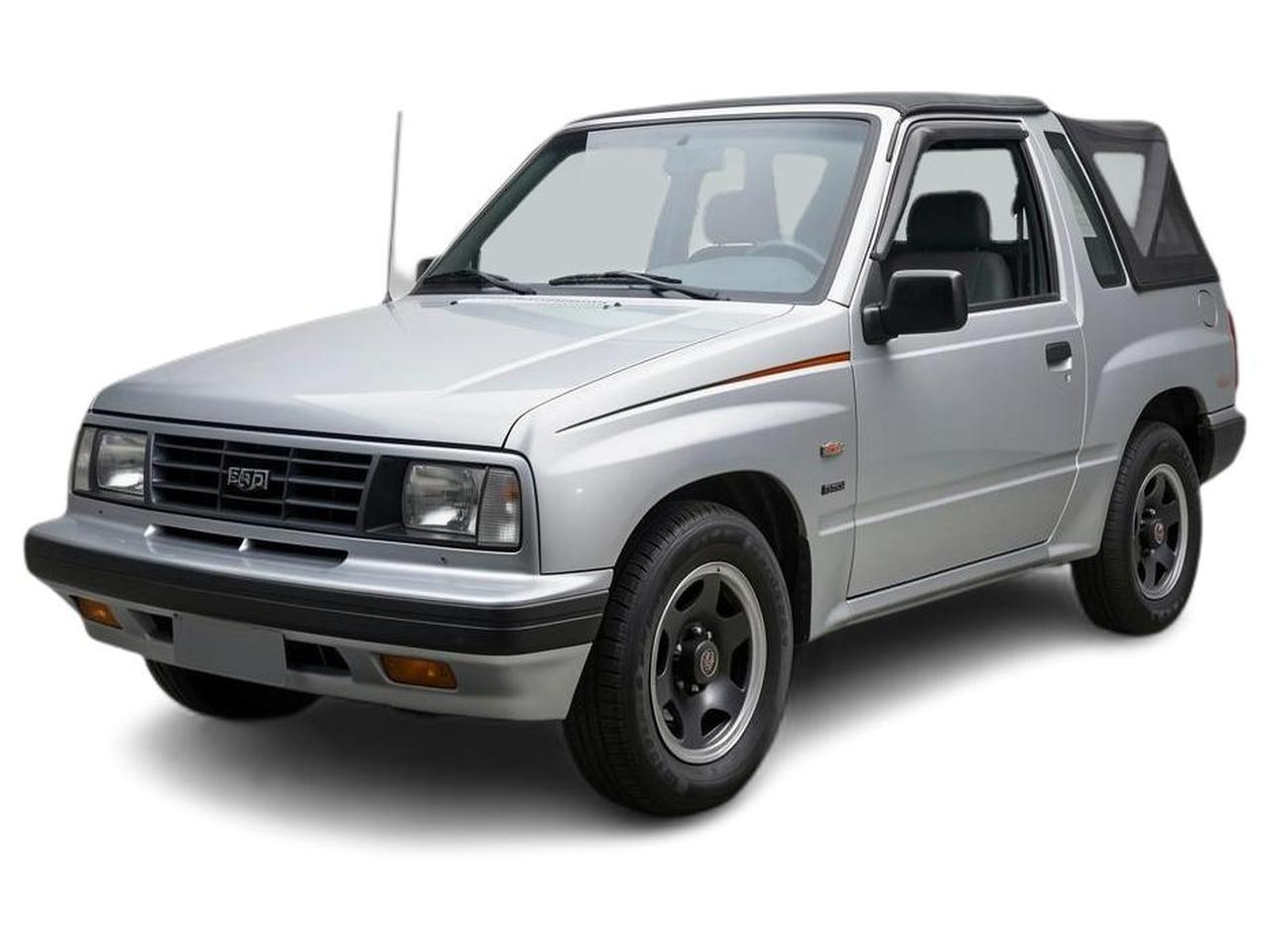
The 1993 Geo Tracker, part of the compact SUV segment, was produced from 1989 to 2004. It was a rebadged Suzuki Vitara, known for its affordable price and rugged, go-anywhere attitude. Available primarily as a two-door convertible or hardtop, popular trims included the base, a more equipped model, and the sporty 'Sport'. New pricing ranged from approximately $12,000 to $15,000. Its popularity stemmed from its Jeep-like appearance at a fraction of the cost, making it a fun and accessible off-road option.
The Good
The 1993 Geo Tracker offers nimble off-road capability and a charming, retro design that appeals to adventurous spirits. Its compact size makes it easy to maneuver and park, while its simple mechanics contribute to reasonable maintenance costs, making it a practical choice for budget-conscious buyers seeking fun and utility.
The Bad
When considering a 1993 Geo Tracker, watch out for potential rust, particularly on the frame and body panels, due to its construction. Engine performance can be sluggish, and the ride quality is often described as basic. Interior comfort is limited, especially on longer journeys, and the safety features are rudimentary by modern standards.
1993 Geo Tracker: Quick Overview
- Engine Options: The 1993 Geo Tracker primarily came with a 1.6-liter 4-cylinder engine.
- Horsepower: This engine typically produced around 80 horsepower.
- Fuel Economy: Fuel economy ratings were generally in the range of 25-30 MPG combined, depending on transmission and driving conditions.
- 0-60 Times: Acceleration was not a strong suit, with 0-60 MPH times typically ranging from 12 to 15 seconds.
- Towing Capacity: Towing capacity was very limited, usually around 1,000 lbs, making it suitable for small trailers or utility purposes rather than heavy loads.
- Drivetrain: Available in both rear-wheel drive (RWD) and four-wheel drive (4WD) configurations. The 4WD system was a significant draw for its off-road capability.
- Transmission: Offered with either a 5-speed manual transmission or a 3-speed automatic transmission.
- Body Styles: Available as a two-door convertible with a soft top or a two-door hardtop.
- Trim-Level Features:
- Base Trim: Featured essential amenities, manual windows and locks, and basic cloth upholstery.
- Higher Trims (e.g., 'Sport'): Often included power steering, air conditioning (optional), alloy wheels, a more robust exterior appearance, and sometimes a more premium sound system. Optional features could include power windows and mirrors, though these were less common on earlier models. The focus was on utility and simplicity rather than luxury or advanced technology.
- Suspension: Utilized a solid front axle and a 3-link solid rear axle, contributing to its off-road prowess but also a less refined ride on pavement.
1993 Geo Tracker Specifications
Vehicle Information
| Year | 1993 |
| Make | Geo |
| Model | Tracker |
| Trim | - |
| Style | 3-Speed |
| Type | Sport Utility Vehicle |
| Category | Standard Sport Utility Vehicle |
Manufacturing Details
| Made In | Canada |
| Manufacturing City | INGERSOLL |
Dimensions
| Doors | 2-Door |
| Curb Weight | 2405 pounds |
| Gross Vehicle Weight Rating | - |
| Overall Height | 65.20 inches |
| Overall Length | 142.50 inches |
| Overall Width | 64.20 inches |
| Wheelbase Length | 86.60 inches |
| Standard Seating | 4 |
Engine & Performance
| Engine | 1.6L I4 |
| Engine Size | 1.6L |
| Engine Cylinders | 4 |
| Transmission | 3-Speed Automatic |
| Transmission Type | Automatic |
| Transmission Speeds | 3-Speed |
| Drivetrain | Four-Wheel Drive |
Additional Features
| Anti-Brake System | Non-ABS 2-Wheel ABS |
| Steering Type | Recirculating |
Pricing
| Manufacturer Suggested Retail Price (MSRP) | $10,330 |
| Invoice Price | - |
| Delivery Charges | - |
Vehicle History Report
Vehicle
Specifications
Specifications
Ownership
History
History
All History
Events
Events
NMVTIS Title
History Check
History Check
Salvage/Rebuilt
Check
Check
Accident
Check
Check
Theft
Check
Check
Open Lien
Check
Check
Past Sale
Listings
Listings
Safety
Recalls
Recalls
Odometer
Check
Check
Market Price
Analysis
Analysis
What Problems Does the 1993 Geo Tracker Have?
The 1993 Geo Tracker, like many vehicles of its era and design, has a few common issues that owners should be aware of. One of the most prevalent concerns is rust. Due to its body-on-frame construction and susceptibility to road salt and moisture, rust can develop on the frame, rocker panels, wheel wells, and floor pans. This is especially critical for the frame, as significant corrosion can compromise the vehicle's structural integrity and safety.
The 1.6-liter engine, while generally robust for its size, can suffer from head gasket failures, particularly if the cooling system has not been properly maintained. Overheating can exacerbate this issue. Clutch wear is also a common complaint for manual transmission models, as is the premature failure of the clutch slave cylinder. The 3-speed automatic transmission is not particularly refined and can become a source of issues if not serviced regularly.
Electrical gremlins are another area to watch for. Faulty alternator, starter motor, and intermittent issues with the ignition system or dashboard lights can occur. For 4WD models, the transfer case and front axle engagement mechanisms can sometimes fail, leading to loss of 4WD functionality.
The soft tops on the convertible models are prone to tearing, UV damage, and leaks over time, requiring replacement. Hardtops can develop leaks around the seals. Suspension components, such as ball joints and bushings, will wear out with mileage and can affect steering and ride quality.
While there haven't been widespread recalls specific to the 1993 model year that stand out significantly, it is always advisable to check for any outstanding safety recalls with the VIN. Overall, the Geo Tracker is mechanically simple, making repairs accessible, but its age means that maintenance and attention to common wear-and-tear items are crucial for long-term reliability. Models in rust-prone areas will almost certainly require more attention.
The 1.6-liter engine, while generally robust for its size, can suffer from head gasket failures, particularly if the cooling system has not been properly maintained. Overheating can exacerbate this issue. Clutch wear is also a common complaint for manual transmission models, as is the premature failure of the clutch slave cylinder. The 3-speed automatic transmission is not particularly refined and can become a source of issues if not serviced regularly.
Electrical gremlins are another area to watch for. Faulty alternator, starter motor, and intermittent issues with the ignition system or dashboard lights can occur. For 4WD models, the transfer case and front axle engagement mechanisms can sometimes fail, leading to loss of 4WD functionality.
The soft tops on the convertible models are prone to tearing, UV damage, and leaks over time, requiring replacement. Hardtops can develop leaks around the seals. Suspension components, such as ball joints and bushings, will wear out with mileage and can affect steering and ride quality.
While there haven't been widespread recalls specific to the 1993 model year that stand out significantly, it is always advisable to check for any outstanding safety recalls with the VIN. Overall, the Geo Tracker is mechanically simple, making repairs accessible, but its age means that maintenance and attention to common wear-and-tear items are crucial for long-term reliability. Models in rust-prone areas will almost certainly require more attention.
How long will the 1993 Geo Tracker last?
A well-maintained 1993 Geo Tracker can reasonably reach or exceed 200,000 miles. However, this is heavily dependent on diligent maintenance, especially addressing rust prevention and ensuring the cooling system is in good order to avoid head gasket issues. The frame and engine are generally durable components. Weaknesses that emerge over time include the potential for extensive rust damage, particularly in coastal or snowy regions, which can severely limit its lifespan. Suspension components and the soft top (on convertibles) are also expected to require replacement with age and mileage. With consistent care, owners can enjoy many years of service, especially for its intended light-duty and off-road use.
What Technology & Safety Features are Included?
The 1993 Geo Tracker was a product of its time, and its technology, entertainment, and safety features reflect that. It was designed with simplicity and utility in mind, rather than cutting-edge innovation.
Built-in Tech and Entertainment: The standard entertainment system typically consisted of an AM/FM radio. An optional upgrade might have included a cassette player. Higher trims could offer slightly more advanced speaker systems. Power windows and power locks were rare, often found only as optional equipment on more luxurious trims, if at all. Air conditioning was also an option, a desirable feature in many climates. The dashboard was basic, featuring essential gauges like speedometer, fuel level, and engine temperature.
Driver-Assistance Features: Driver-assistance features as we know them today were virtually non-existent in the 1993 Geo Tracker. Features like anti-lock braking systems (ABS) were not standard and likely not offered even as an option for this model year. Cruise control was also generally not a standard or widely available option. The focus was on basic mechanical operation.
Safety Features: Standard safety equipment included seat belts and a reinforced roll bar integrated into the convertible structure for some protection in rollovers. For the hardtop version, a more conventional structure was present. Airbags were not a feature in the 1993 Geo Tracker; they were not yet mandated or common in this vehicle class.
Crash-Test Ratings: Specific crash-test ratings for the 1993 Geo Tracker are not readily available from major testing agencies like the NHTSA or IIHS for that specific model year. However, vehicles of this size and era, particularly those with body-on-frame construction and limited safety features, generally performed poorly in impact tests compared to modern vehicles. The lack of airbags, ABS, and advanced structural safety elements means it would likely have lower ratings by today's standards.
Built-in Tech and Entertainment: The standard entertainment system typically consisted of an AM/FM radio. An optional upgrade might have included a cassette player. Higher trims could offer slightly more advanced speaker systems. Power windows and power locks were rare, often found only as optional equipment on more luxurious trims, if at all. Air conditioning was also an option, a desirable feature in many climates. The dashboard was basic, featuring essential gauges like speedometer, fuel level, and engine temperature.
Driver-Assistance Features: Driver-assistance features as we know them today were virtually non-existent in the 1993 Geo Tracker. Features like anti-lock braking systems (ABS) were not standard and likely not offered even as an option for this model year. Cruise control was also generally not a standard or widely available option. The focus was on basic mechanical operation.
Safety Features: Standard safety equipment included seat belts and a reinforced roll bar integrated into the convertible structure for some protection in rollovers. For the hardtop version, a more conventional structure was present. Airbags were not a feature in the 1993 Geo Tracker; they were not yet mandated or common in this vehicle class.
Crash-Test Ratings: Specific crash-test ratings for the 1993 Geo Tracker are not readily available from major testing agencies like the NHTSA or IIHS for that specific model year. However, vehicles of this size and era, particularly those with body-on-frame construction and limited safety features, generally performed poorly in impact tests compared to modern vehicles. The lack of airbags, ABS, and advanced structural safety elements means it would likely have lower ratings by today's standards.
What Colors Options are Available?
1993 Geo Tracker Prices and Market Value
When new, the 1993 Geo Tracker typically ranged from approximately $12,000 to $15,000, depending on the trim level and options. Its initial pricing made it an attractive option compared to larger SUVs. As with most vehicles, it experienced significant depreciation in its early years.
Currently, used 1993 Geo Trackers can be found for anywhere from $2,000 to $7,000, with prices heavily influenced by condition, mileage, rust presence, and whether it's a 2WD or 4WD model. Well-maintained, low-mileage 4WD models, especially convertibles in good condition, can command higher prices due to their cult following and off-road appeal. Poor condition, significant rust, or high mileage will drastically lower its resale value. Its depreciation has largely stabilized, and well-kept examples are now considered affordable classics or capable budget off-roaders.
1993 Geo Tracker Cost of Ownership
The 1993 Geo Tracker is generally an economical vehicle to own. Insurance costs are typically low due to its age, basic features, and lower value. Fuel economy, averaging around 25-30 MPG, contributes to affordable running costs. Maintenance is straightforward and parts are relatively inexpensive, especially for common wear items. However, potential major repairs like head gasket issues or significant rust remediation can be costly and should be factored in. Overall, when maintained, it offers a low-cost entry into rugged, small SUV ownership, making it economical for most buyers.
1993 Geo Tracker Fuel Efficiency
Fuel Type
Gasoline
Fuel Capacity
11.10 gallons
City Mileage
23 miles/gallon
Highway Mileage
24 miles/gallon
1993 Geo Tracker Safety Rating
NHTSA
IIHS
1993 Geo Tracker Recalls & Defects
Suspension:rear
Recall date
1994-04-16
Recall no.
94v073001
Source
NHTSA
Summary
THE Right Rear and Left Axle Shaft Housing Tubes Were Incorrectly Welded and CAN Fracture. Fracture OF THE Rear Axle Shaft Housing CAN Result IN Separation OF THE Affected Wheel Assembly and Separation OF THE Brake Line.
Consequence
Separation OF THE Wheel Assembly CAN Cause Loss OF Vehicle Control and Separation OF THE Brake Line Results IN Loss OF One-Half OF THE Braking System, Increasing Stopping Distance. IN Either Case, AN Accident CAN Occur.
Remedy
Dealers Will Inspect THE Welds OF THE Rear Axle Assemblies ON Involved Vehicles And, IF Necessary, Replace THE Complete Rear Axle Assembly.
Notes
System: Suspension; Single Axle; Rear.vehicle Description: Utility Vehicles.note: IF Your Vehicle IS Presented TO AN Authorized Dealer ON AN Agreed Upon Service Date and THE Remedy IS NOT Provided Within A Reasonable Time and Free OF Charge, or THE Remedy Does NOT Correct THE Defect or Noncompliance, Please Contact Chevrolet Service Center AT 1-800-222-1020. Also, Contact THE National Highway Traffic Safety Administration's Auto Safety Hotline AT 1-800-424-9393.
1993 Geo Tracker Warranty
Basic
Original warranty
0 months / No data
Estimated remaining
Expired
Powertrain
Original warranty
0 months / No data
Estimated remaining
Expired
Rust
Original warranty
0 months / No data
Estimated remaining
Expired
1993 Geo Tracker Insurance
Insurance for a 1993 Geo Tracker is moderately priced, reflecting its status as a Sport Utility Vehicle with strong safety ratings and
reasonable repair costs.
How Does the 1993 Geo Tracker Compare to Other Sport Utility Vehicle?
The 1993 Geo Tracker competed in a niche but growing segment of small, rugged SUVs. Its primary rivals included vehicles like the Suzuki Samurai (which it was based on), early Jeep Cherokees (though the Tracker was much smaller and less powerful), and later, the Daihatsu Rocky.
Performance: In terms of performance, the Tracker lagged behind many of its contemporaries. Its 80 horsepower 1.6-liter engine offered modest acceleration, and its ride was basic and often bumpy. Rivals like a Jeep Cherokee, while larger, offered more power and a more substantial road presence. However, for off-road capability on a budget, the Tracker excelled due to its lightweight and compact dimensions, outmaneuvering larger vehicles on tight trails.
Features: The Tracker was sparsely equipped. Its technology and convenience features were minimal, often lacking power steering, advanced audio systems, or modern safety aids. Rivals like the Jeep Cherokee offered a wider range of comfort and convenience features, even in base trims. The Tracker's appeal was its simplicity and ruggedness, not its amenities.
Reliability: Reliability for the Tracker is a mixed bag. Its simple mechanicals mean basic repairs are often straightforward and inexpensive. However, specific issues like rust, head gasket problems, and electrical gremlins can detract from its long-term dependability if not addressed proactively. Older Jeeps could also be prone to mechanical issues, but often had more robust engines.
Price: This was where the Tracker shone. It offered a significantly lower entry price than most SUVs, making it an accessible option for budget-conscious buyers and those seeking a light off-roader without a huge financial commitment.
Alternatives: For a similar experience, the original Suzuki Samurai is the closest relative and can offer similar off-road fun. For a slightly more refined experience with better on-road manners but less off-road prowess out-of-the-box, a well-maintained early Honda CR-V or Toyota RAV4 (though these are unibody and more car-like) could be considered for a more modern approach to small SUV ownership, albeit at a higher price point. If pure off-road capability on a budget is the priority, a well-chosen older Jeep Wrangler (YJ model) could be an alternative, though likely more expensive to maintain and purchase.
Performance: In terms of performance, the Tracker lagged behind many of its contemporaries. Its 80 horsepower 1.6-liter engine offered modest acceleration, and its ride was basic and often bumpy. Rivals like a Jeep Cherokee, while larger, offered more power and a more substantial road presence. However, for off-road capability on a budget, the Tracker excelled due to its lightweight and compact dimensions, outmaneuvering larger vehicles on tight trails.
Features: The Tracker was sparsely equipped. Its technology and convenience features were minimal, often lacking power steering, advanced audio systems, or modern safety aids. Rivals like the Jeep Cherokee offered a wider range of comfort and convenience features, even in base trims. The Tracker's appeal was its simplicity and ruggedness, not its amenities.
Reliability: Reliability for the Tracker is a mixed bag. Its simple mechanicals mean basic repairs are often straightforward and inexpensive. However, specific issues like rust, head gasket problems, and electrical gremlins can detract from its long-term dependability if not addressed proactively. Older Jeeps could also be prone to mechanical issues, but often had more robust engines.
Price: This was where the Tracker shone. It offered a significantly lower entry price than most SUVs, making it an accessible option for budget-conscious buyers and those seeking a light off-roader without a huge financial commitment.
Alternatives: For a similar experience, the original Suzuki Samurai is the closest relative and can offer similar off-road fun. For a slightly more refined experience with better on-road manners but less off-road prowess out-of-the-box, a well-maintained early Honda CR-V or Toyota RAV4 (though these are unibody and more car-like) could be considered for a more modern approach to small SUV ownership, albeit at a higher price point. If pure off-road capability on a budget is the priority, a well-chosen older Jeep Wrangler (YJ model) could be an alternative, though likely more expensive to maintain and purchase.
Final Verdict: Is the 1993 Geo Tracker a Good Sport Utility Vehicle?
The 1993 Geo Tracker is ideal for budget-conscious individuals or couples seeking a fun, lightweight vehicle for light off-roading, beach cruising, or weekend adventures. It's perfect for those who value simplicity, affordability, and a unique, nostalgic aesthetic over modern amenities and performance.
It is worth buying if found in good condition with minimal rust, especially a 4WD model. Buying new is obviously not an option, and even then, it's crucial to thoroughly inspect for frame rust and mechanical health. Stick to used examples. Convertibles offer maximum fun, while hardtops provide a bit more security and weather protection. It's a vehicle for enthusiasts who appreciate its quirks and are willing to perform diligent maintenance to keep it running. For daily commuting or long-distance travel, better alternatives exist.
