
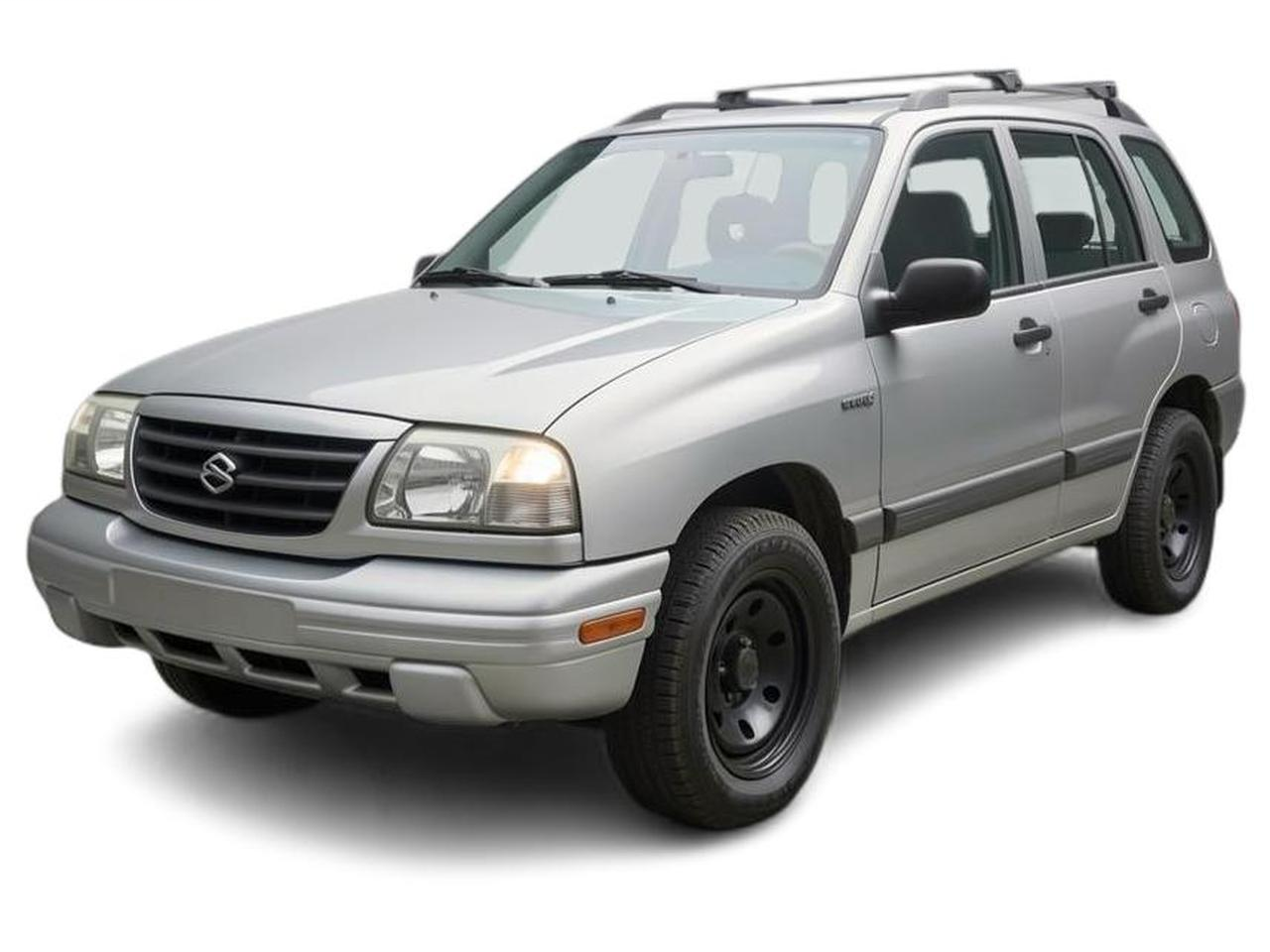
The 2003 Suzuki Vitara, part of the second generation (1999-2005), is a compact SUV known for its approachable price and decent off-road capability. Available in various body styles including 3-door and 5-door configurations, it offered trims like the JX, JLX, and SE. Pricing at launch was generally in the lower to mid-$20,000s. Its popularity stemmed from offering a blend of SUV practicality and car-like handling at an affordable price point, appealing to those seeking adventure without a hefty cost.
The Good
The 2003 Vitara offers a surprisingly capable and fun driving experience, especially for its class. Its compact size makes it easy to maneuver, while its accessible price tag and decent fuel economy appeal to practical buyers. Emotionally, its rugged styling and go-anywhere attitude inspire confidence for weekend adventures.
The Bad
Potential buyers should be aware of the Vitara's relatively modest power output, especially with the base engine. Interior materials can feel a bit basic and wear over time. Also, watch out for rust, particularly in the undercarriage and wheel wells, as well as potential issues with the automatic transmission.
2003 Suzuki Vitara: Quick Overview
- Engine Options: The 2003 Suzuki Vitara primarily offered two engine options:
- A 2.0-liter inline-4 cylinder engine.
- A 2.5-liter V6 engine (less common on base models).
- Horsepower:
- The 2.0-liter engine typically produced around 125-135 horsepower.
- The 2.5-liter V6 engine offered more power, around 155-160 horsepower.
- Fuel Economy:
- Expect combined MPG figures generally in the range of 18-20 MPG, with variations based on engine, drivetrain (2WD or 4WD), and transmission (manual or automatic).
- 0-60 Times:
- With the 2.0-liter engine, 0-60 mph times were generally in the 10-12 second range, feeling adequate for city driving but less so for highway merging.
- The V6 engine provided a noticeable improvement, bringing 0-60 times closer to the 9-10 second mark.
- Towing Capacity:
- Towing capacity for the 2003 Vitara was typically modest, around 1,500 to 2,000 lbs, suitable for small trailers or personal watercraft.
- Trim-Level Features: Key trims and their general features included:
- JX: Often the base trim, featuring essentials like power windows, power locks, air conditioning, and a basic AM/FM/CD audio system.
- JLX: A mid-range option that typically added alloy wheels, cruise control, and a better audio system. Some JLX models might have featured upgraded interior upholstery.
- SE (Sport Edition): This trim often came with more aggressive styling cues, sometimes including body-colored trim, fog lights, and potentially a sport-tuned suspension. It usually included most features found in the JLX trim.
- Available Drivetrain: Both 2WD (rear-wheel drive) and 4WD options were available across most trims, enhancing its appeal for those seeking light off-road capability.
2003 Suzuki Vitara Specifications
Vehicle Information
| Year | 2003 |
| Make | Suzuki |
| Model | Vitara |
| Trim | - |
| Style | 2-Door 5-Speed |
| Type | Sport Utility Vehicle |
| Category | Standard Sport Utility Vehicle |
Manufacturing Details
| Made In | Canada |
| Manufacturing City | ONTARIO |
Dimensions
| Doors | 2-Door |
| Curb Weight | 2833 pounds |
| Gross Vehicle Weight Rating | 3593 pounds |
| Overall Height | 65.80 inches |
| Overall Length | 152.00 inches |
| Overall Width | 67.30 inches |
| Wheelbase Length | 86.60 inches |
| Standard Seating | 4 |
Engine & Performance
| Engine | 2L I4 |
| Engine Size | 2L |
| Engine Cylinders | 4 |
| Transmission | 5-Speed Manual |
| Transmission Type | Manual |
| Transmission Speeds | 5-Speed |
| Drivetrain | Four-Wheel Drive |
Additional Features
| Anti-Brake System | Non-ABS 4-Wheel ABS |
| Steering Type | Rack & Pinion |
Pricing
| Manufacturer Suggested Retail Price (MSRP) | $15,599 |
| Invoice Price | $15,979 |
| Delivery Charges | $510 |
Vehicle History Report
Vehicle
Specifications
Specifications
Ownership
History
History
All History
Events
Events
NMVTIS Title
History Check
History Check
Salvage/Rebuilt
Check
Check
Accident
Check
Check
Theft
Check
Check
Open Lien
Check
Check
Past Sale
Listings
Listings
Safety
Recalls
Recalls
Odometer
Check
Check
Market Price
Analysis
Analysis
What Problems Does the 2003 Suzuki Vitara Have?
The 2003 Suzuki Vitara, like many vehicles of its era, has some commonly reported issues that potential buyers should be aware of. One of the most persistent concerns is related to the automatic transmission. Owners have reported instances of transmission slippage, harsh shifting, and complete failure, particularly as the vehicle accumulates mileage. Regular fluid changes and proper maintenance are crucial, but even then, transmission problems can arise. Another area of concern is the potential for rust, especially in climates where salt is used on roads during winter. The undercarriage, frame rails, and wheel wells are susceptible to corrosion, which can compromise the vehicle's structural integrity. Inspecting these areas thoroughly is recommended. Engine-related issues are generally less frequent, but some owners have experienced minor oil leaks or cooling system problems. The 2.0-liter engine, while adequate, can sometimes feel underpowered, leading to drivers pushing it harder, which may contribute to wear over time. Electrical gremlins, such as issues with power windows, door locks, or the infotainment system, can also crop up, though these are often minor and fixable. Recalls for the 2003 model year are not extensive, but it's always advisable to check the NHTSA website for any outstanding safety recalls. In terms of long-term reliability, the Vitara is often considered a mixed bag. While some owners report trouble-free ownership for many years, others have encountered significant repairs, particularly with the transmission. The overall reliability often depends heavily on how well the vehicle has been maintained throughout its life. Early and consistent maintenance, especially for the transmission and any signs of rust, can significantly prolong its service life.
How long will the 2003 Suzuki Vitara last?
Based on owner data and anecdotal evidence, a well-maintained 2003 Suzuki Vitara can realistically achieve an average of 150,000 to 200,000 miles. Some dedicated owners have pushed their Vitas well beyond this, reaching 250,000 miles or more. The long-term durability is heavily influenced by maintenance habits. The biggest factor impacting its longevity is the automatic transmission; failure here can often be a costly repair that outweighs the vehicle's value. Rust is another significant factor, especially in rust-belt regions, which can limit its lifespan by affecting structural integrity. Engines are generally robust if oil changes are kept up with. Overall, while capable of reaching high mileage, the Vitara's long-term durability is not as consistently high as some of its Japanese competitors, with the transmission and rust being its primary weaknesses over time.
What Technology & Safety Features are Included?
The 2003 Suzuki Vitara was equipped with a modest array of technology and safety features befitting its affordable compact SUV segment.
Built-in Tech and Entertainment:
Standard entertainment typically included an AM/FM radio with a CD player. Higher trims might have offered an upgraded audio system with more speakers. Features like power windows and power door locks were standard on most trims, with power mirrors also common. Air conditioning was also a standard amenity. Connectivity options were basic, as expected for this era, with no integrated Bluetooth or USB ports. A simple interior climate control system managed heating and cooling.
Driver-Assistance and Safety Features:
Safety features for the 2003 Vitara were relatively basic. Standard safety equipment generally included front airbags for the driver and front passenger. Anti-lock braking system (ABS) was often standard or available as an option, especially on higher trims, providing enhanced braking control. Daytime running lights were also a common inclusion.
Optional Features:
Optional features could include things like fog lights, roof rails for added cargo carrying capacity, and a limited-slip differential on 4WD models for improved off-road traction. Some higher trims might have offered cruise control as standard or optional. Heated mirrors could also have been an option on some models.
Crash-Test Ratings:
Crash-test ratings for the 2003 Suzuki Vitara are available from the National Highway Traffic Safety Administration (NHTSA). The Vitara generally received moderate ratings. For frontal impacts, it often achieved 3 or 4 stars out of 5 for the driver and front passenger. Side-impact ratings were typically in a similar range. It's important to note that these ratings reflect the safety standards and testing procedures of the early 2000s, and newer vehicles often offer significantly more advanced safety technologies and achieve higher scores.
Built-in Tech and Entertainment:
Standard entertainment typically included an AM/FM radio with a CD player. Higher trims might have offered an upgraded audio system with more speakers. Features like power windows and power door locks were standard on most trims, with power mirrors also common. Air conditioning was also a standard amenity. Connectivity options were basic, as expected for this era, with no integrated Bluetooth or USB ports. A simple interior climate control system managed heating and cooling.
Driver-Assistance and Safety Features:
Safety features for the 2003 Vitara were relatively basic. Standard safety equipment generally included front airbags for the driver and front passenger. Anti-lock braking system (ABS) was often standard or available as an option, especially on higher trims, providing enhanced braking control. Daytime running lights were also a common inclusion.
Optional Features:
Optional features could include things like fog lights, roof rails for added cargo carrying capacity, and a limited-slip differential on 4WD models for improved off-road traction. Some higher trims might have offered cruise control as standard or optional. Heated mirrors could also have been an option on some models.
Crash-Test Ratings:
Crash-test ratings for the 2003 Suzuki Vitara are available from the National Highway Traffic Safety Administration (NHTSA). The Vitara generally received moderate ratings. For frontal impacts, it often achieved 3 or 4 stars out of 5 for the driver and front passenger. Side-impact ratings were typically in a similar range. It's important to note that these ratings reflect the safety standards and testing procedures of the early 2000s, and newer vehicles often offer significantly more advanced safety technologies and achieve higher scores.
What Colors Options are Available?
2003 Suzuki Vitara Prices and Market Value
When new, the 2003 Suzuki Vitara had an original MSRP that typically ranged from approximately $18,000 for base models to over $25,000 for well-equipped V6 versions with 4WD. Its value proposition was strong at launch, offering a lot of utility for the money. Currently, the used market prices for a 2003 Vitara are quite low, often falling between $2,000 and $5,000, depending heavily on condition, mileage, and trim level. Depreciation has been substantial, as is typical for vehicles of this age and segment. Factors significantly affecting its resale value include the presence of rust, the condition of the transmission, overall maintenance history, and mileage. A Vitara with a clean bill of health, especially concerning rust and transmission, will command a higher price than one with visible wear and tear or mechanical concerns.
2003 Suzuki Vitara Cost of Ownership
The 2003 Suzuki Vitara is generally considered an economical vehicle to own. Insurance premiums are typically modest, reflecting its lower market value and standard safety features. Fuel costs are reasonable, with the 4-cylinder engine offering decent MPG, though the V6 will consume more. Routine maintenance, such as oil changes and tire rotations, is generally affordable. However, long-term ownership costs can be impacted by potential repair expenses. Transmission issues, if they arise, can be significant. While parts are generally available, specialized repairs might increase costs. Overall, the Vitara is economical for day-to-day running, but potential owners should budget for possible mid-life repair surprises.
2003 Suzuki Vitara Fuel Efficiency
Fuel Type
Gasoline
Fuel Capacity
14.80 gallons
City Mileage
22 miles/gallon
Highway Mileage
25 miles/gallon
2003 Suzuki Vitara Safety Rating
NHTSA
IIHS
2003 Suzuki Vitara Warranty
Basic
Original warranty
36 months / 36,000 miles
Estimated remaining
Expired
Powertrain
Original warranty
84 months / 100,000 miles
Estimated remaining
Expired
Rust
Original warranty
36 months / unlimited miles
Estimated remaining
Expired
2003 Suzuki Vitara Insurance
Insurance for a 2003 Suzuki Vitara is moderately priced, reflecting its status as a Sport Utility Vehicle with strong safety ratings and
reasonable repair costs.
How Does the 2003 Suzuki Vitara Compare to Other Sport Utility Vehicle?
The 2003 Suzuki Vitara competed in a crowded compact SUV segment against rivals like the Honda CR-V, Toyota RAV4, Ford Escape, and Mazda Tribute.
Performance: In terms of performance, the Vitara lagged behind many of its competitors. Its base 2.0-liter engine felt underpowered, especially for highway merging and hauling. Rivals like the CR-V and RAV4 offered smoother, more refined powertrains that provided a better balance of acceleration and efficiency. The Vitara's V6 offered a bit more pep but was still not class-leading. Off-road capability was a strong suit for the Vitara, particularly in 4WD trims, often surpassing the car-based crossovers like the RAV4 and CR-V, which were more focused on on-road comfort.
Features: Feature-wise, the Vitara was generally competitive for its price point, offering essentials like power windows, locks, and A/C. However, rivals often provided more advanced optional features, such as a more sophisticated infotainment system, climate control, and more comprehensive safety options. The interior materials in the Vitara were also perceived as less premium than those found in the Honda and Toyota offerings.
Reliability: Reliability is where the Vitara often faced its toughest comparisons. While the engines were generally sound with good maintenance, the automatic transmission was a known weak point, with more frequent issues reported than with the rock-solid transmissions in the Honda CR-V and Toyota RAV4. The Ford Escape and Mazda Tribute also had their own reliability quirks, but the Vitara's transmission issues were a significant concern for long-term ownership.
Price: The Vitara's main advantage was its attractive price point, often undercutting its Japanese rivals when new. This value proposition continued into the used market, making it an appealing budget option.
Alternatives:
Performance: In terms of performance, the Vitara lagged behind many of its competitors. Its base 2.0-liter engine felt underpowered, especially for highway merging and hauling. Rivals like the CR-V and RAV4 offered smoother, more refined powertrains that provided a better balance of acceleration and efficiency. The Vitara's V6 offered a bit more pep but was still not class-leading. Off-road capability was a strong suit for the Vitara, particularly in 4WD trims, often surpassing the car-based crossovers like the RAV4 and CR-V, which were more focused on on-road comfort.
Features: Feature-wise, the Vitara was generally competitive for its price point, offering essentials like power windows, locks, and A/C. However, rivals often provided more advanced optional features, such as a more sophisticated infotainment system, climate control, and more comprehensive safety options. The interior materials in the Vitara were also perceived as less premium than those found in the Honda and Toyota offerings.
Reliability: Reliability is where the Vitara often faced its toughest comparisons. While the engines were generally sound with good maintenance, the automatic transmission was a known weak point, with more frequent issues reported than with the rock-solid transmissions in the Honda CR-V and Toyota RAV4. The Ford Escape and Mazda Tribute also had their own reliability quirks, but the Vitara's transmission issues were a significant concern for long-term ownership.
Price: The Vitara's main advantage was its attractive price point, often undercutting its Japanese rivals when new. This value proposition continued into the used market, making it an appealing budget option.
Alternatives:
- Honda CR-V (2002-2006): Offers superior reliability, a more refined driving experience, and better fuel economy. Lacks the Vitara's rugged off-road capability.
- Toyota RAV4 (2000-2005): Excellent reliability, car-like handling, and good fuel economy. Also less off-road capable than the Vitara.
- Ford Escape/Mazda Tribute (2001-2007): Share a platform and offer more powerful engine options. Reliability can be comparable to or slightly better than the Vitara, with fewer transmission-specific concerns.
Final Verdict: Is the 2003 Suzuki Vitara a Good Sport Utility Vehicle?

The 2003 Suzuki Vitara is best suited for budget-conscious buyers seeking a small, capable SUV for light off-roading, beach trips, or hauling outdoor gear without breaking the bank. It's ideal for those who prioritize affordability and utility over refined driving dynamics and cutting-edge features. Whether it's worth buying hinges heavily on condition and price. As a used vehicle, it can be a great deal if well-maintained, especially if the transmission and frame are rust-free. Buyers should thoroughly inspect for rust and potential transmission issues. The 4WD models are particularly appealing for their adventurous spirit. It's not recommended for those seeking a daily commuter prioritizing comfort and fuel efficiency, or for those who want a vehicle with minimal potential for unexpected repair bills.