
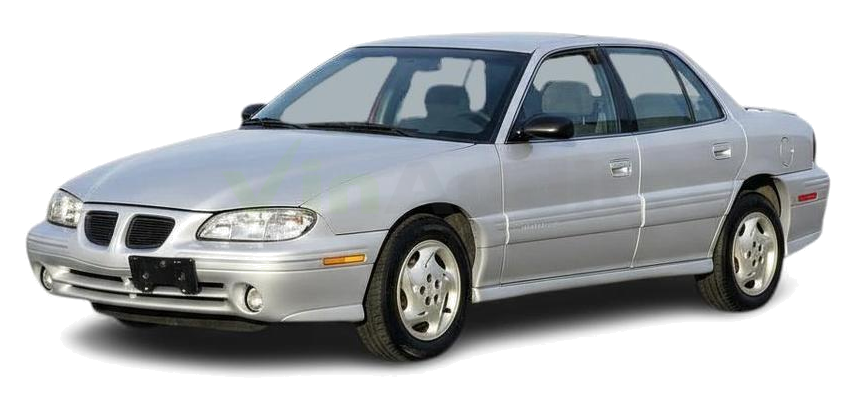
The Good
For emotional buyers, its bold styling and available V6 engine offered a spirited, engaging drive. Practical buyers appreciated its affordability, readily available and inexpensive parts, and decent fuel economy for its class. It delivered a good value proposition as a new car and an extremely economical used vehicle for basic, reliable transportation with a touch of flair.
The Bad
Owners should watch out for common issues like faulty intake manifold gaskets on the 3.1L V6 engine, automatic transmission problems, and temperamental power window regulators. Electrical glitches, premature rust in certain areas, and lower-quality interior plastics were also frequently reported, potentially impacting long-term reliability and ownership experience.
1996 Pontiac Grand Am: Quick Overview
The 1996 Pontiac Grand Am offered a selection of powertrains and features across its trims:
- Engine Options:
- 2.4L "Twin Cam" DOHC Inline-4 (Quad 4): Standard on SE models.
- 3.1L V6 (3100 SFI V6): Optional on SE, standard on GT models.
- Horsepower:
- 2.4L I4: Approximately 150 hp.
- 3.1L V6: Approximately 155 hp.
- Fuel Economy (EPA estimates):
- 2.4L I4 (Automatic): Around 21-23 MPG city / 29-31 MPG highway.
- 3.1L V6 (Automatic): Around 19-21 MPG city / 27-29 MPG highway.
- 0-60 MPH Times (Estimated):
- 2.4L I4: Approximately 9.0-9.5 seconds.
- 3.1L V6: Approximately 8.5-9.0 seconds.
- Towing Capacity:
- Generally not recommended for significant towing; typically rated for light loads, if any, around 1,000 lbs with proper equipment, but not a primary function of this vehicle.
- Trim-Level Features:
- Grand Am SE (Special Edition): The volume seller, featuring standard power steering, power brakes, AM/FM stereo, cloth upholstery, and a driver's side airbag. Optional features included air conditioning, power windows/locks/mirrors, cruise control, a cassette or CD player, and ABS. The 2.4L I4 was standard, with the 3.1L V6 as an upgrade.
- Grand Am GT: The sportier trim, distinguished by more aggressive exterior styling (body cladding, fog lights, unique wheels), a firmer suspension, and the 3.1L V6 engine as standard. Interior amenities often included sportier seats, a leather-wrapped steering wheel, and more standard power accessories like windows, locks, and mirrors, along with air conditioning and cruise control. ABS was typically standard or a common option.
1996 Pontiac Grand Am Specifications
Vehicle Information
| Year | 1996 |
| Make | Pontiac |
| Model | Grand Am |
| Trim | - |
| Style | - |
| Type | Sedan |
| Category | Compact Car |
Manufacturing Details
| Made In | Japan |
| Manufacturing City | LANSING - SOUTH PLANT |
Dimensions
| Doors | 4-Door |
| Curb Weight | 2954 pounds |
| Gross Vehicle Weight Rating | - |
| Overall Height | - |
| Overall Length | - |
| Overall Width | - |
| Wheelbase Length | - |
| Standard Seating | - |
Engine & Performance
| Engine | L82 |
| Engine Size | 2.4L |
| Engine Cylinders | 4 |
| Transmission | - |
| Transmission Type | Manual |
| Transmission Speeds | - |
| Drivetrain | Front-Wheel Drive |
Additional Features
| Anti-Brake System | - |
| Steering Type | - |
Pricing
| Manufacturer Suggested Retail Price (MSRP) | - |
| Invoice Price | - |
| Delivery Charges | - |
Vehicle History Report
Specifications
History
Events
History Check
Check
Check
Check
Check
Listings
Recalls
Check
Analysis
What Problems Does the 1996 Pontiac Grand Am Have?
Another common complaint revolved around the automatic transmissions, specifically the 4T40-E and 4T60-E units. Owners frequently reported rough shifting, solenoid failures, and eventual transmission failure, often around the 100,000-mile mark, depending on maintenance habits.
Electrical problems were also prevalent. Issues included malfunctioning power window regulators, often requiring replacement of the entire assembly, and failures of various sensors (e.g., crank position sensor, mass airflow sensor) leading to drivability issues or "check engine" lights. Interior components like door handles (both inner and outer) were prone to breaking, and the quality of interior plastics could lead to rattling and cracking over time.
Rust was another long-term concern, particularly in areas with road salt. Wheel wells, rocker panels, and sometimes the subframe could show significant corrosion. Steering components, such as power steering pumps and rack-and-pinion units, were also known to develop leaks or require replacement.
Regarding recalls, the 1996 model year had several. One notable recall involved the ignition switch, which could fail, potentially causing the engine to stall or preventing starting. Another recall addressed seat belt buckles that might not properly latch or unlatch. Fuel system components, such as fuel line routing, were also subject to recalls to prevent potential leaks. Prospective buyers should always check a vehicle's VIN for any open recalls.
How long will the 1996 Pontiac Grand Am last?
What Technology & Safety Features are Included?
Built-in Tech and Entertainment:
Standard entertainment typically included an AM/FM stereo. Higher trims or optional packages offered an AM/FM stereo with a cassette player, and for those desiring more modern options, a single-disc CD player was available. Climate control was manually operated, with air conditioning being an option on base models and standard on higher trims. Power accessories such as windows, door locks, and mirrors were available, often standard on the GT trim and optional on the SE. Cruise control was another common convenience option.
Driver-Assistance Features:
Driver-assistance features as we know them today (e.g., lane keeping assist, adaptive cruise control) were non-existent. The primary driver aid was power steering and optional anti-lock brakes (ABS).
Safety Features:
Safety in the 1996 Grand Am included standard dual front airbags (driver and passenger), which was a significant advancement over earlier models that only had a driver's side airbag. Three-point seatbelts were standard for front occupants and outboard rear passengers. Anti-lock brakes (ABS) were available as an option, providing improved stopping capability in emergency situations. Child safety seat tether anchors were not yet universally mandated or integrated as they are in modern vehicles, though standard seatbelts could be used.
Crash-Test Ratings:
For crash-test ratings, the 1996 Pontiac Grand Am was evaluated by the National Highway Traffic Safety Administration (NHTSA). It generally performed acceptably for its class at the time. In frontal impact tests, it received a rating of three out of five stars for the driver's side and three out of five stars for the passenger's side. Side-impact testing was less common or standardized for all vehicles in this period, but it typically received fair to good ratings. It's important to note that these ratings are based on standards from 1996 and would not compare favorably to modern safety standards or vehicles.
What Colors Options are Available?
1996 Pontiac Grand Am Prices and Market Value
1996 Pontiac Grand Am Cost of Ownership
1996 Pontiac Grand Am Fuel Efficiency
1996 Pontiac Grand Am Safety Rating
NHTSA
IIHS
1996 Pontiac Grand Am Recalls & Defects
Steering: Steering Wheel/Handle BAR
Exterior Lighting:hazard Flashing Warning Lights
Interior Lighting
Electrical System:ignition:switch
Fuel System, Gasoline:delivery:fuel Pump
Fuel System, Other:storage:tank Assembly:pressure Relief Devices
1996 Pontiac Grand Am Insurance
reasonable repair costs.
How Does the 1996 Pontiac Grand Am Compare to Other Sedan?
Performance: The Grand Am, especially in GT trim with the 3.1L V6, often offered more spirited acceleration than base Civics or Corollas, putting it on par with or slightly above performance-oriented rivals like the Dodge Neon R/T or Chevrolet Cavalier Z24. Its handling was marketed as "sporty" but wasn't as refined as some imports.
Features: Feature-wise, the Grand Am was competitive. It offered similar basic amenities to its domestic rivals (Cavalier, Escort, Neon) and often included power accessories and A/C as standard on higher trims. However, it generally lagged behind Japanese competitors in terms of perceived interior quality and refinement.
Reliability: This is where the Grand Am often fell short compared to its Japanese counterparts. Honda Civic and Toyota Corolla were renowned for their bulletproof reliability and longevity, requiring minimal unscheduled maintenance. The Grand Am, while decent for a GM product of its era, suffered from more prevalent issues such as intake manifold gasket failures (V6), transmission problems, and various electrical gremlins. Its reliability was more on par with the Ford Escort or Chevrolet Cavalier, which also had their own sets of common issues.
Price: New, the Grand Am was competitively priced with its domestic rivals and generally undercut the Civic and Corolla. In the current used market, it's among the cheapest options, often costing less than an equivalent-year Civic or Corolla due to its lower perceived long-term reliability.
Recommended Alternatives:
- For better reliability: A used 1996 Honda Civic or Toyota Corolla would be superior choices, though they might command slightly higher prices even today.
- For similar performance/value: The 1996 Dodge Neon or Chevrolet Cavalier offered similar "sporty" compact experiences at comparable price points, with similar long-term reliability profiles.
- For modern safety/features: Consider a newer used compact car (e.g., a 2000s Civic, Corolla, or Focus) if budget allows, as they will offer significant advancements in safety, refinement, and technology.
Final Verdict: Is the 1996 Pontiac Grand Am a Good Sedan?
It can be worth buying if you find a well-maintained example, ideally one where common issues like the V6 intake manifold gaskets or transmission work have already been addressed. For the absolute lowest ownership cost, an SE trim with the 2.4L Quad 4 engine might be slightly less prone to the V6's specific gasket issue. However, be prepared for potential electrical glitches and the possibility of significant repairs given its age. It's not for those seeking cutting-edge technology, luxurious comfort, or absolute bulletproof reliability without careful inspection and potential upfront maintenance.

Drew B
Drew is a seasoned automotive expert and contributor to VinCheck.info. With nearly 15 years of experience as a former Porsche technician, he brings a wealth of hands-on knowledge to his writing. Born in North Carolina, a region renowned for its deep-rooted NASCAR culture, Drew developed a passion for cars early in life, often building and working on vehicles from a young age. At VINCheck, Drew leverages his extensive technical background to provide in-depth analyses of various vehicles. His articles often focus on engine performance, reliability, and maintenance insights, offering readers practical information grounded in real-world experience. Some of his notable contributions include reviews on the Mazda CX-5's longevity and detailed examinations of engine options for models like the 2011 Toyota Camry and Tacoma