
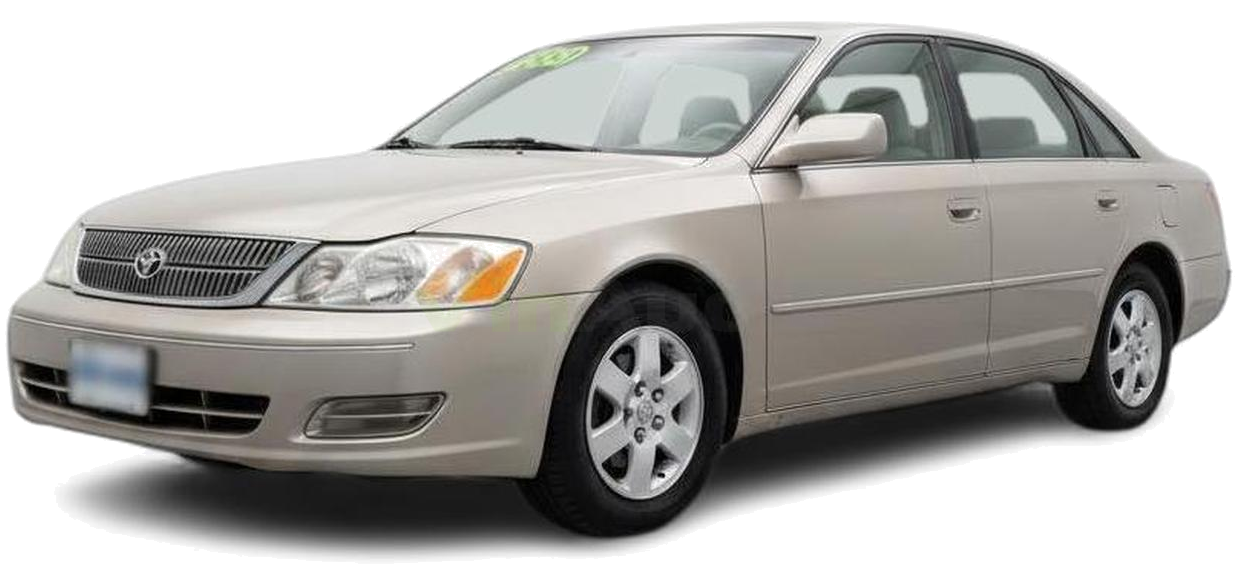
The Good
The 2000 Toyota Avalon excels with its legendary reliability, promising years of trouble-free ownership that appeals to practical buyers. Its exceptionally smooth V6 engine, quiet cabin, and plush ride deliver a luxurious and comforting experience, satisfying emotional desires for serenity. With a spacious interior, refined design, and respectable fuel efficiency for its class, it offers outstanding long-term value, making it a smart and satisfying choice.
The Bad
While highly reliable, the 2000 Toyota Avalon isn't without its considerations. Some owners find its handling uninspired, prioritizing comfort over spirited driving. Over time, expect potential issues like aging suspension components, power steering pump leaks, or dashboard cracks. Its conservative styling may also not appeal to everyone seeking a more modern aesthetic, and routine maintenance like timing belt replacement can be costly.
2000 Toyota Avalon: Quick Overview
The 2000 Toyota Avalon was equipped with a robust and reliable powertrain:
- Engine: 3.0-liter DOHC V6 (1MZ-FE)
- Horsepower: 210 hp @ 5800 rpm
- Torque: 220 lb-ft @ 4400 rpm
- Transmission: 4-speed electronically controlled automatic (ECT-i)
- Fuel Economy (EPA Estimates): Approximately 19 MPG city / 27 MPG highway
- 0-60 MPH: Generally reported in the 7.6 to 8.0 second range, providing brisk acceleration for its class.
- Towing Capacity: While not designed for heavy towing, some sources indicate a light capacity of around 1,000 lbs, primarily for small utility trailers or bike racks.
Trim levels included the well-equipped XL and the more luxurious XLS:
- XL Trim Features:
- Power windows and door locks
- Power mirrors
- Air conditioning
- Cruise control
- Remote keyless entry
- AM/FM/CD stereo system
- Tilt steering wheel
- Full wheel covers
- Cloth upholstery
- XLS Trim Features (adds to XL):
- Automatic climate control
- Premium JBL audio system
- Alloy wheels
- Fog lights
- Woodgrain interior trim
- Auto-dimming rearview mirror
- Power driver's seat (often 8-way adjustable)
- More comprehensive instrumentation
- Available options included leather upholstery, power passenger seat, heated front seats, power sunroof, and traction control.
2000 Toyota Avalon Specifications
Vehicle Information
| Year | 2000 |
| Make | Toyota |
| Model | Avalon |
| Trim | - |
| Style | - |
| Type | Sedan |
| Category | Compact Car |
Manufacturing Details
| Made In | United States |
| Manufacturing City | GEORGETOWN |
Dimensions
| Doors | 4-Door |
| Curb Weight | - |
| Gross Vehicle Weight Rating | - |
| Overall Height | - |
| Overall Length | - |
| Overall Width | - |
| Wheelbase Length | - |
| Standard Seating | - |
Engine & Performance
| Engine | 1MZ-FE |
| Engine Size | 3L |
| Engine Cylinders | 6 |
| Transmission | 4-Speed Automatic |
| Transmission Type | Automatic |
| Transmission Speeds | 4-Speed |
| Drivetrain | Front-Wheel Drive |
Additional Features
| Anti-Brake System | - |
| Steering Type | - |
Pricing
| Manufacturer Suggested Retail Price (MSRP) | - |
| Invoice Price | - |
| Delivery Charges | - |
Vehicle History Report
Specifications
History
Events
History Check
Check
Check
Check
Check
Listings
Recalls
Check
Analysis
What Problems Does the 2000 Toyota Avalon Have?
The 2000 Toyota Avalon, while renowned for its reliability, has a few frequently reported problems and long-term concerns that potential owners should be aware of, especially given its age.
One of the most significant concerns for the 1MZ-FE V6 engine, used in the 2000 Avalon, was the potential for oil sludge buildup. While Toyota later addressed this with extended warranties and revised PCV systems, inconsistent oil change habits and short-trip driving could still exacerbate this issue, leading to engine damage. Prospective buyers should always review maintenance records diligently to ensure regular oil changes were performed.
Other common age-related problems include power steering fluid leaks from hoses and the pump itself, a typical issue for older vehicles. Automatic transmission solenoid failures or rough shifting can also occur at higher mileages, though the transmission is generally robust if maintained. Ignition coil failures are not uncommon and can cause engine misfires, while Mass Air Flow (MAF) sensors and Oxygen (O2) sensors are wear items that can affect engine performance and fuel economy.
Cosmetically, the dashboard in many older Avalons can develop cracks, particularly in regions exposed to intense sunlight. Worn suspension components like struts, shocks, and bushings are also to be expected, impacting ride quality and handling. Less frequent but notable are issues with the starter motor at very high mileage.
Regarding recalls, the 2000 Avalon had a few. NHTSA records show a recall (00V303000) concerning potential master cylinder bore corrosion, which could affect brake performance. Another recall (00V250000) addressed improper headlamp aim. While less common, there was also recall 01V057000 related to the occupant classification system (OCS) module for airbags. It's advisable to check if any applicable recalls have been addressed for any specific vehicle.
How long will the 2000 Toyota Avalon last?
What Technology & Safety Features are Included?
The 2000 Toyota Avalon, while well-equipped for its time, reflects the technological standards of the turn of the millennium rather than today's advanced systems.
For built-in tech and entertainment, standard features included an AM/FM radio with a single-disc CD player, power windows, power locks, and cruise control. The XLS trim elevated this with an automatic climate control system, a premium JBL sound system, and often a more sophisticated display. Optional features across trims could include an in-dash multi-disc CD changer and a power tilt/slide moonroof, enhancing comfort and convenience. Driver information was primarily analog gauges, supplemented by a basic digital clock and odometer.
Driver-assistance features were rudimentary by modern standards. Cruise control was standard, providing basic speed management. The more advanced XLS trim offered optional traction control, which could help maintain stability on slippery surfaces. Features like stability control, blind-spot monitoring, or parking sensors were not available on this vehicle during its production run.
In terms of safety features, the 2000 Avalon came standard with dual front airbags for the driver and passenger, along with anti-lock brakes (ABS) to aid in controlled stopping. For enhanced protection, the XLS trim offered optional front side-impact airbags, a significant safety upgrade for the era. Child seat anchors (LATCH system) were also present.
Crash-test ratings for the 2000 Toyota Avalon were respectable. The National Highway Traffic Safety Administration (NHTSA) awarded it an excellent 5-star rating for both driver and front passenger frontal crash protection. For side-impact protection, NHTSA gave it a 4-star rating for both front and rear occupants. The Insurance Institute for Highway Safety (IIHS) rated the 1999-2004 Avalon "Good" in its moderate overlap frontal crash test, which was a top score for that assessment at the time, underscoring its solid structural integrity.
What Colors Options are Available?
2000 Toyota Avalon Prices and Market Value
When new in 2000, the Toyota Avalon XL typically retailed around $24,800 to $25,500, while the more luxurious XLS trim commanded prices in the $29,500 to $30,500 range, depending on options. As a full-size sedan, it offered significant value at the time.
Today, the used market prices for a 2000 Toyota Avalon vary widely, generally ranging from $2,000 to $6,000 or more. Exceptional, low-mileage examples in pristine condition can sometimes fetch higher prices, becoming almost collector's items for their durability. The depreciation curve for this vehicle has flattened significantly; the vast majority of its value loss occurred within the first decade of its life. Factors heavily influencing its current resale value include overall mechanical and cosmetic condition, documented maintenance history, mileage, and geographical location (rust is a major deterrent). The XLS trim, with its added features like leather and premium audio, usually retains slightly more value. Its enduring reputation for reliability ensures a consistent, albeit modest, demand in the used car market.
2000 Toyota Avalon Cost of Ownership
Owning a 2000 Toyota Avalon is generally considered very economical in the long run. Insurance costs are typically low due to the vehicle's age, solid safety ratings, and non-performance-oriented nature. Fuel costs are reasonable for a full-size V6 sedan, as it runs on regular unleaded gasoline, averaging around 22-23 MPG combined. Routine maintenance is straightforward and affordable, with parts readily available and relatively inexpensive. The most significant maintenance cost will be the timing belt replacement every 90,000-105,000 miles, but this is a scheduled item. Repairs, when they do arise, are usually uncomplicated for most mechanics, further contributing to lower labor costs. Given its remarkable durability and low incidence of major mechanical failures, the 2000 Avalon stands out as an exceptionally economical and cost-effective vehicle to own for many years.
2000 Toyota Avalon Fuel Efficiency
2000 Toyota Avalon Safety Rating
NHTSA
2000 Toyota Avalon Recalls & Defects
Steering
Suspension:rear
2000 Toyota Avalon Insurance
reasonable repair costs.
How Does the 2000 Toyota Avalon Compare to Other Sedan?
The 2000 Toyota Avalon competed in a robust full-size sedan segment against rivals like the Nissan Maxima, Buick LeSabre, Ford Taurus, and even premium alternatives such as the Acura TL. In terms of performance, the Avalon's 210-hp V6 delivered smooth, confident acceleration and a refined ride that prioritized comfort over sportiness. This contrasted with the Nissan Maxima, which often boasted a more powerful V6 and a sportier handling dynamic, appealing to enthusiasts. Domestic rivals like the Buick LeSabre offered a plush ride but often felt less nimble and sometimes less refined in their powertrains.
Regarding features, the Avalon XLS was quite well-equipped with automatic climate control, a premium JBL sound system, and available leather. While the Maxima offered a competitive feature set, the Acura TL generally provided a more upscale and feature-rich experience, bridging the gap towards true luxury. Domestic offerings often focused on different types of comfort or unique options, but perhaps lacked the same material quality or long-term durability perception of the Avalon.
Reliability is where the 2000 Toyota Avalon truly shone, often surpassing most of its competitors. Its reputation for trouble-free ownership was (and still is) legendary, making it a safer long-term bet than many domestic and even some other import rivals. The Honda Accord V6 and Acura TL were strong contenders in reliability, but often the Avalon was perceived as slightly more bulletproof. Ford Taurus and Chrysler Concorde models of this era frequently faced more reported mechanical and electrical issues.
On the price front, the Avalon has historically maintained better resale value than most domestic competitors, though perhaps slightly less than a comparable Acura TL or a very clean Honda Accord. Its current used market price reflects its enduring reliability and demand.
Recommended alternatives that offer similar or potentially better qualities, depending on priorities, include a well-maintained Honda Accord V6 (if a slightly smaller car is acceptable) for comparable reliability and a more engaging drive. For a more luxurious experience with similar underlying reliability, a Lexus ES 300 (which shares some DNA with Toyota platforms) would be an excellent choice. If a sportier feel is paramount, the Nissan Maxima is worth considering, though its long-term reliability might not quite match the Avalon's.
Final Verdict: Is the 2000 Toyota Avalon a Good Sedan?
The 2000 Toyota Avalon is an exceptional choice for specific buyers in today's used car market. It is ideal for individuals prioritizing long-term reliability, a supremely comfortable and quiet ride, and abundant interior space, all within a budget-friendly package. This vehicle shines for commuters, small families, or anyone seeking dependable, no-frills transportation that minimizes unexpected repair costs.
It is absolutely worth buying, but under specific conditions. As a used vehicle, a thorough pre-purchase inspection by an independent mechanic is non-negotiable to assess its mechanical health, especially checking for rust and potential oil sludge issues. Crucially, seek out examples with a well-documented maintenance history, particularly evidence of consistent oil changes. While both XL and XLS trims offer excellent value, the XLS provides a more luxurious experience with features like automatic climate control and premium audio. Avoid vehicles with unknown histories or obvious deferred maintenance. When properly vetted, a 2000 Toyota Avalon represents one of the best "bang for your buck" propositions for an older, supremely durable sedan.

Cathleen V
Cathleen is an exceptional freelance writer covering hot topics in the automotive world from a gearhead's perspective. Her articles delve into various aspects of automotive technology and history, offering readers detailed insights into engine performance, reliability, and maintenance. Through her engaging and informative writing, Cathleen provides valuable information to automotive enthusiasts and consumers alike, helping them make informed decisions about vehicle maintenance and purchases.