
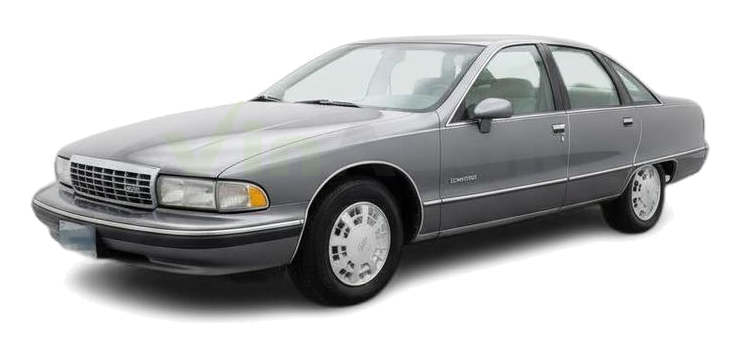
The Good
Its key advantages include a supremely comfortable, plush ride and vast interior space, appealing to practical buyers for family use. The robust V8 engines and body-on-frame construction offer strong reliability and durability. Its distinctive "whale" design provides unique character for emotional buyers, while its low ownership costs and strong aftermarket support represent excellent long-term value.
The Bad
Known weaknesses include the 4L60 (700R4) automatic transmission's propensity for failure if not well-maintained, particularly the 3-4 clutch pack. Rust can be a significant issue in the rear wheel wells and frame, especially in salt-belt regions. Interior plastics can become brittle, and headliners commonly sag. The original 5.0L engine can feel underpowered.
1991 Chevrolet Caprice: Quick Overview
- Engine Options: The 1991 Caprice offered two V8 engine choices:
- 5.0L (305 cu in) L03 V8 with Throttle Body Injection (TBI)
- 5.7L (350 cu in) L05 V8 with Throttle Body Injection (TBI), standard on wagons and the 9C1 police package, optional on sedans.
- Horsepower:
- L03 5.0L V8: Approximately 170 hp
- L05 5.7L V8: Approximately 170-185 hp (depending on specific tune and application)
- Fuel Economy: Expect an average of 15-17 MPG in the city and 20-24 MPG on the highway, varying with driving conditions and engine choice.
- 0-60 MPH Times: Typically ranged from 9 to 11 seconds, with the 5.7L L05 being quicker.
- Towing Capacity: With the optional towing package, the Caprice could tow up to 5,000 lbs, making it capable for light-duty hauling.
- Trim-Level Features:
- Caprice (Base): Included essentials like power steering, power brakes, automatic transmission, cloth upholstery, AM/FM radio, full wheel covers, and often manual windows/locks as standard, though power options were frequently added.
- Caprice Classic: Upped the luxury with features such as velour or optional leather upholstery, woodgrain interior accents, power windows, power door locks, air conditioning, cruise control, tilt steering, upgraded audio, remote trunk release, and chrome exterior brightwork.
- 9C1 Police Package: A heavy-duty variant featuring larger brakes, heavy-duty suspension, extra cooling, a limited-slip differential, calibrated speedometer, and higher output alternator.
- Caprice Wagon: Generally came with the 5.7L V8 standard and often included a roof rack and optional rear-facing third-row seating.
- Optional Features: Across trims, available options included anti-lock brakes (ABS), a driver's side airbag (late 1991 models), a CD player, automatic climate control, and a power driver's seat.
1991 Chevrolet Caprice Specifications
Vehicle Information
| Year | 1991 |
| Make | Chevrolet |
| Model | Caprice |
| Trim | - |
| Style | Classic Wagon RWD 4AT 1.6L I4 |
| Type | Wagon |
| Category | passenger |
Manufacturing Details
| Made In | United States |
| Manufacturing City | YPSILANTI TWP |
Dimensions
| Doors | 4-Door |
| Curb Weight | 3500 pounds |
| Gross Vehicle Weight Rating | - |
| Overall Height | 56 inches |
| Overall Length | 200 inches |
| Overall Width | 74 inches |
| Wheelbase Length | 115 inches |
| Standard Seating | 5 |
Engine & Performance
| Engine | 1.6L I4 |
| Engine Size | 1.6L |
| Engine Cylinders | 4 |
| Transmission | 4-Speed Automatic |
| Transmission Type | Automatic |
| Transmission Speeds | 4-Speed |
| Drivetrain | Rear-Wheel Drive |
Additional Features
| Anti-Brake System | 4-Wheel ABS |
| Steering Type | Rack & Pinion |
Pricing
| Manufacturer Suggested Retail Price (MSRP) | $20,000 |
| Invoice Price | $18,500 |
| Delivery Charges | $800 |
Vehicle History Report
Specifications
History
Events
History Check
Check
Check
Check
Check
Listings
Recalls
Check
Analysis
What Problems Does the 1991 Chevrolet Caprice Have?
Rust is a significant long-term reliability concern, particularly in areas exposed to road salt. Wheel arches, rocker panels, and the frame are common rust spots. Interior longevity is another weak point, with sagging headliners being almost universal. Dashboards can crack from sun exposure, and plastic trim pieces may become brittle and break. Electrical issues are typically minor, such as failing power window motors, erratic fuel gauges, or instrument cluster lighting problems.
For safety, specific recalls for the 1991 model year included a recall for seat belt buckles (NHTSA Campaign ID: 91V140000), a door latch recall (NHTSA Campaign ID: 91V101000), and a recall concerning a rear brake pipe issue (NHTSA Campaign ID: 91V121000). These should be checked to ensure they were addressed. The optional ABS system, if present, can also develop faults over time, often related to wheel speed sensors or the electronic control module. Despite these common issues, the Caprice's simple design and widespread parts availability make most repairs straightforward and relatively inexpensive for its class.
How long will the 1991 Chevrolet Caprice last?
However, the 4L60 (700R4) transmission is often the weak link, typically requiring a rebuild or replacement around 100,000-150,000 miles if not properly maintained. Rust is the vehicle's natural enemy, severely impacting structural integrity and resale value in older age. Suspension components (bushings, ball joints) will wear out, and interior materials like headliners and dash plastics are prone to age-related degradation. Despite these, the vehicle's overall simplicity and parts availability contribute to its remarkable longevity.
What Technology & Safety Features are Included?
Driver-assistance features were rudimentary. Beyond power steering and power brakes, the most significant driver aid was the optional Anti-lock Braking System (ABS), which was a relatively new and important safety innovation for mass-market vehicles at the time. This system enhanced braking stability, particularly in adverse conditions.
In terms of safety, the 1991 Caprice was a transitional model. Driver-side airbags became standard during the 1991 model year's production run, meaning some early 1991 models may not have one, relying solely on passive restraint seatbelts. Passenger-side airbags were introduced in subsequent model years (1992+). All models included 3-point seatbelts, child safety locks for the rear doors, and an energy-absorbing steering column. The car also incorporated side-impact protection beams to meet evolving safety standards. Crash-test ratings from the National Highway Traffic Safety Administration (NHTSA) for this period were not presented as the modern "star" rating system. However, its substantial body-on-frame construction typically afforded decent protection in frontal impacts for its time, due to sheer mass, though it lacked the sophisticated crumple zones and multiple airbags found in contemporary vehicles. Specific detailed crash test data like small overlap or side-impact ratings for the 1991 model are not widely available in comparable formats.
What Colors Options are Available?
1991 Chevrolet Caprice Prices and Market Value
Today, the Caprice has largely completed its depreciation curve. Current used market prices vary significantly based on condition. A running example in fair condition might fetch $1,500 - $4,000. Good, well-maintained drivers range from $4,000 - $8,000. Exceptional, low-mileage, or restored examples, especially wagons or 9C1 police packages, can command $8,000 - $15,000+, demonstrating some appreciation as a burgeoning classic.
Factors affecting resale value include rust-free body condition (paramount), low original mileage, documented maintenance history, originality, and the presence of desirable options like the 5.7L V8 or unique trim (e.g., Caprice Classic LS). The unique "whale" body style has developed a cult following, bolstering value for clean, well-preserved examples.
1991 Chevrolet Caprice Cost of Ownership
Maintenance and repair costs are impressively low. Parts are abundant, inexpensive, and many are interchangeable with other GM B-body platforms. Its simple mechanical design means most repairs are straightforward for DIY enthusiasts or independent mechanics. Provided you start with a well-maintained, rust-free example, the Caprice offers remarkably cheap long-term ownership, with fuel being the main variable cost.
1991 Chevrolet Caprice Fuel Efficiency
1991 Chevrolet Caprice Insurance
reasonable repair costs.
How Does the 1991 Chevrolet Caprice Compare to Other Wagon?
In performance, the Caprice's 5.0L/5.7L TBI V8s offered adequate, smooth power for cruising, but were generally outmatched in refinement and later horsepower figures by Ford's post-1992 Modular V8s. The Caprice's ride comfort was exemplary.
Regarding features, the Caprice offered a solid array of comfort and convenience items for its price point, including available ABS and a driver's airbag. Its GM B-body twins, the Buick Roadmaster and Oldsmobile Custom Cruiser, often came with more standard luxury amenities, plusher interiors, and sometimes more advanced (for the time) tech like digital dashboards.
For reliability, the Caprice's engines and body-on-frame chassis are famously durable. However, the 4L60 (700R4) transmission is a known weak spot. Ford's Panther platform rivals are also renowned for their reliability, especially with the later Modular V8 and 4R70W transmission, often considered slightly more robust in the powertrain department.
In price, the Caprice was generally positioned as a value-oriented full-size sedan. Its Ford rivals were competitively priced, while the Buick and Oldsmobile siblings typically commanded a premium for their upscale positioning.
As alternatives, the Ford Crown Victoria/Mercury Grand Marquis (1992+) offer similar body-on-frame durability, often with more refined engines and transmissions, making them strong contenders. For a more luxurious experience on the same platform, the Buick Roadmaster (1991-1996) is an excellent choice, particularly wagons or those with the later, more powerful LT1 engine (1994-1996). If maximum performance from this platform is desired, the rare 1994-1996 Chevrolet Impala SS is the ultimate alternative, though it commands a much higher premium.
Final Verdict: Is the 1991 Chevrolet Caprice a Good Wagon?
It is definitely worth buying as a used vehicle today, particularly as prices have bottomed out and are starting to appreciate for clean examples. Look for a Caprice in good, rust-free condition with a well-maintained 5.7L V8 (L05) engine. The Caprice Classic trim offers more amenities. Wagons are particularly desirable due to their rarity and utility. Thoroughly inspect the transmission for proper function. While not a fuel miser, its low purchase price, inexpensive parts, and simple mechanics make it an economical long-term ownership proposition, offering a unique blend of vintage charm and surprising practicality.

Simon A
Simon is a contributor to VinCheck, where he provides articles and reviews on various automotive topics. His work focuses on delivering accurate and up-to-date information about used cars, helping readers make informed decisions.