
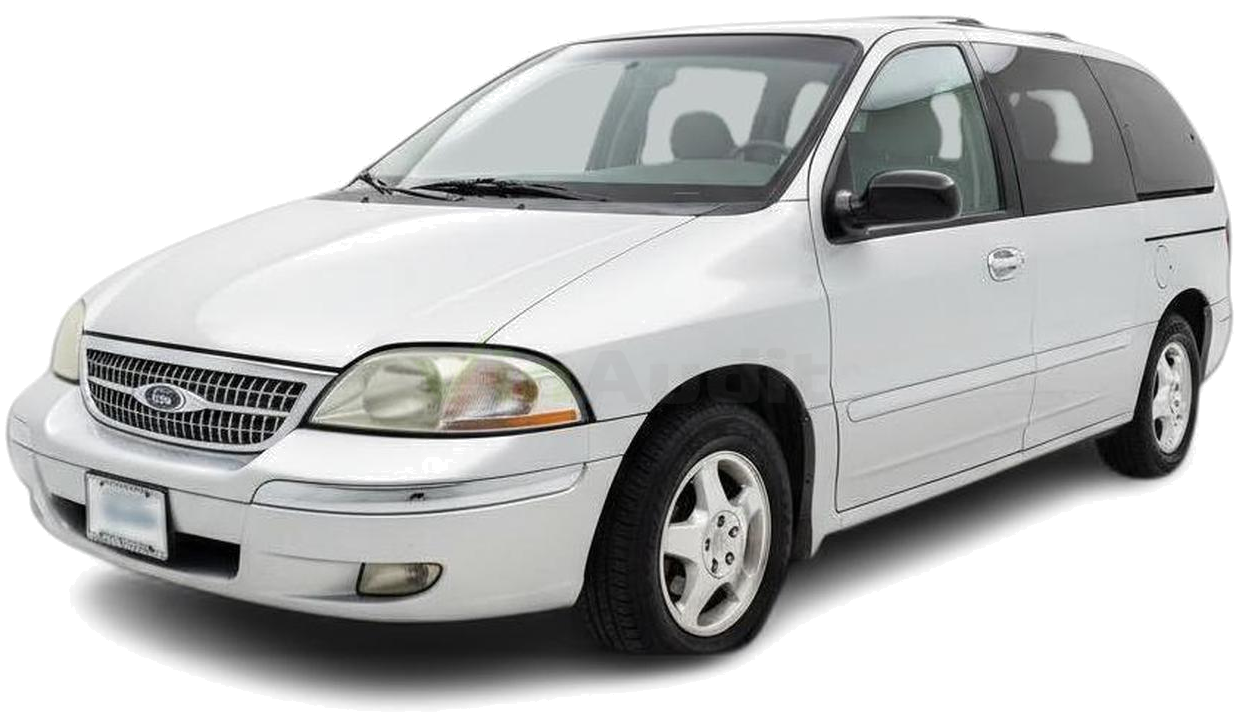
The Good
The 2000 Ford Windstar offered a comfortable ride and a spacious interior, appealing to families seeking practicality and value. Its ample cargo space and user-friendly design made everyday tasks easier, while the smooth handling provided a relaxed driving experience for its era.
The Bad
Potential buyers of the 2000 Ford Windstar should be aware of common issues including transmission problems, particularly with the 3.8L V6 engine, and occasional coolant leaks. Rear axle bearing wear and electrical gremlins, such as faulty power window motors, are also areas to investigate.
2000 Ford Windstar: Quick Overview
- Engine Options: The 2000 Ford Windstar primarily offered two engine options:
- 3.0L OHV Vulcan V6
- 3.8L OHV Essex V6
- Horsepower:
- The 3.0L V6 produced approximately 150 horsepower.
- The 3.8L V6 offered around 200 horsepower.
- Fuel Economy: Fuel economy varied based on the engine and driving conditions. For the 3.8L V6, EPA estimates were typically around 16 MPG city and 22 MPG highway. The 3.0L V6 might have offered slightly better city mileage but less highway performance. These figures are approximate and can vary significantly with usage and maintenance.
- 0-60 Times: With the more powerful 3.8L V6, 0-60 mph times were generally in the mid-to-high 9-second range. The 3.0L V6 would have been notably slower.
- Towing Capacity: The Ford Windstar was not typically marketed as a heavy-duty towing vehicle. If equipped with a towing package, its capacity would have been modest, likely in the range of 2,000 to 3,500 pounds, suitable for small trailers or recreational equipment.
- Trim-Level Features:
- Base Model: Typically included standard features like power steering, power brakes, air conditioning, AM/FM stereo, and seating for seven.
- LX: Added features such as power windows and door locks, cruise control, intermittent wipers, privacy glass, and upgraded interior trim.
- Eddie Bauer: Represented the top trim, often including leather seating, heated front seats, a premium sound system, alloy wheels, and distinctive exterior badging. Optional features across trims could include a rear entertainment system, a power sliding door (introduced later in the Windstar's run, though less common for 2000), and captain's chairs in the second row.
2000 Ford Windstar Specifications
Vehicle Information
| Year | 2000 |
| Make | Ford |
| Model | Windstar |
| Trim | - |
| Style | - |
| Type | Van |
| Category | Cargo Van |
Manufacturing Details
| Made In | Canada |
| Manufacturing City | OAKVILLE |
Dimensions
| Doors | 3-Door |
| Curb Weight | 3719 pounds |
| Gross Vehicle Weight Rating | 5540 pounds |
| Overall Height | 65.60 inches |
| Overall Length | 200.90 inches |
| Overall Width | 75.20 inches |
| Wheelbase Length | 120.70 inches |
| Standard Seating | 2 |
Engine & Performance
| Engine | 3L V6 |
| Engine Size | 3L |
| Engine Cylinders | 6 |
| Transmission | 4-Speed Automatic |
| Transmission Type | Automatic |
| Transmission Speeds | 4-Speed |
| Drivetrain | Front-Wheel Drive |
Additional Features
| Anti-Brake System | 4-Wheel ABS |
| Steering Type | Rack & Pinion |
Pricing
| Manufacturer Suggested Retail Price (MSRP) | $19,910 |
| Invoice Price | $18,046 |
| Delivery Charges | - |
Vehicle History Report
Specifications
History
Events
History Check
Check
Check
Check
Check
Listings
Recalls
Check
Analysis
What Problems Does the 2000 Ford Windstar Have?
Another common area of complaint is related to the cooling system. Leaks from the intake manifold gaskets and heater core have been frequently cited. These leaks can lead to overheating and potential engine damage if not addressed promptly. The rear axle bearing is another component that has shown a tendency to wear out prematurely, leading to noise and potential structural issues with the rear suspension.
Electrical issues are also not uncommon. Problems with power window regulators and motors, power lock actuators, and faulty interior lighting have been reported by numerous owners. Some owners have also experienced issues with the anti-lock braking system (ABS) sensors.
While specific recalls for the 2000 model year should be verified with Ford or the NHTSA, older Windstars have seen recalls related to issues like potential fuel leaks and airbag inflator problems. It is crucial for any prospective buyer to check for any outstanding recalls and ensure they have been addressed.
Long-term reliability for the 2000 Windstar is often considered average at best, with the transmission and cooling system being the primary weak points that can impact its longevity and overall dependability if not meticulously maintained. The 1999-2000 model years are often highlighted for these specific transmission concerns.
How long will the 2000 Ford Windstar last?
What Technology & Safety Features are Included?
Driver-assistance features were minimal by today's standards. Standard equipment typically included power steering and anti-lock brakes (ABS). Cruise control was standard on most trims or an option on the base model.
Safety was a significant consideration. The 2000 Windstar came equipped with front airbags as standard. Depending on the trim and options, side-impact airbags might have been available. Seatbelts for all occupants were standard, with pretensioners for the front seats. Child seat anchors (LATCH system) were also becoming more common.
Crash-test ratings for the 2000 Ford Windstar are available from the National Highway Traffic Safety Administration (NHTSA) and the Insurance Institute for Highway Safety (IIHS). The NHTSA awarded the Windstar four out of five stars for driver and passenger frontal crash protection. For side-impact protection, it generally received three out of five stars, though this could vary slightly depending on specific equipment and testing year. It's important to note that crash test standards and evaluation methods have evolved significantly since 2000, so these ratings should be viewed in the context of the time. Optional features, particularly on the Eddie Bauer trim, could include things like a rear-seat entertainment system with a VCR or DVD player, making it a more engaging experience for younger passengers on long journeys. However, advanced electronic safety aids like stability control or traction control were not widely available or standard on this model year.
What Colors Options are Available?
2000 Ford Windstar Prices and Market Value
Depreciation for minivans of this age is steep. Factors affecting its resale value are primarily driven by its age, mileage, and the documented mechanical history. Buyers are particularly wary of the known transmission and cooling system issues, which can further depress its value. Well-maintained examples with lower mileage and fewer reported problems will command higher prices, but the overall market for this model is limited, often appealing to budget-conscious buyers seeking basic transportation.
2000 Ford Windstar Cost of Ownership
2000 Ford Windstar Fuel Efficiency
2000 Ford Windstar Safety Rating
NHTSA
IIHS
2000 Ford Windstar Recalls & Defects
Suspension:rear:axle:non-Powered Axle Assembly
Structure:frame and Members:underbody Shields
Power Train:axle Assembly
Suspension:front:control ARM
Suspension:rear:axle:non-Powered Axle Assembly
Suspension:rear:axle:non-Powered Axle Assembly
Seat Belts
Electrical System:wiring:interior/Under Dash
Fuel System, Gasoline:delivery
Visibility:glass, Side/Rear
Vehicle Speed Control:accelerator Pedal
Visibility:windshield Wiper/Washer:motor
Equipment:appliance:air Conditioner
Trailer Hitches
Fuel System, Gasoline
Vehicle Speed Control
2000 Ford Windstar Warranty
Basic
Powertrain
Rust
2000 Ford Windstar Insurance
reasonable repair costs.
How Does the 2000 Ford Windstar Compare to Other Van?
Performance: The Windstar's 3.8L V6 offered competitive power for its time, often slightly outperforming the base engines of some rivals. However, its handling was generally softer and less refined than the more car-like feel of the Japanese competitors.
Features: In terms of features, the Windstar, especially in its higher trims like Eddie Bauer, offered a good array of creature comforts and family-oriented options comparable to its peers. However, Honda and Toyota often excelled in interior flexibility and build quality. Chrysler minivans were known for their Stow 'n Go seating (though not in 2000), offering excellent cargo versatility.
Reliability: This is where the Windstar often lagged behind its primary Japanese rivals. The Honda Odyssey and Toyota Sienna built reputations for exceptional long-term reliability and fewer mechanical headaches. The Windstar's known issues with transmissions and cooling systems made it a less dependable choice for those prioritizing longevity and minimal repairs. Chrysler minivans also faced their own reliability challenges.
Price: The Windstar was often priced competitively, sometimes offering more features for the money upfront than its Japanese counterparts. Its lower used market value today reflects its depreciation and reliability concerns.
Alternatives: For those seeking better reliability and overall build quality in a used minivan from this era, the 2000 Honda Odyssey and 2000 Toyota Sienna are highly recommended. While they might have had slightly lower original price points or fewer features in comparable trims, their long-term ownership experience is generally superior. If budget is the absolute primary concern and reliability is less critical, a well-maintained Windstar could be a viable option, but it comes with a higher risk of repair costs compared to its main Japanese competitors.
Final Verdict: Is the 2000 Ford Windstar a Good Van?
Look for models with a documented history of meticulous maintenance, especially regarding transmission fluid and coolant. A pre-purchase inspection by a trusted mechanic is crucial, with a particular focus on the transmission and cooling system. The Eddie Bauer trim might offer more desirable features, but its higher mileage might still present the same mechanical concerns. If you're comfortable with the possibility of needing repairs and have a mechanic you trust, it can serve as an affordable people-mover. However, if reliability is paramount, exploring alternatives like the Honda Odyssey or Toyota Sienna from the same era would be a wiser investment.

Eugene S
Eugene is an automotive enthusiast with over 15 years of experience in the used car market. As a writer at VINCheck.info, he brings deep industry insight and a passion for cars, helping readers make smart, informed decisions. Eugene has written hundreds of used car reviews and is known for breaking down complex automotive topics into clear, actionable advice. Over the years, he has driven and worked on a wide range of vehicles—starting with tuning street cars in his early days and eventually focusing on performance upgrades and reliability improvements. Today, he specializes in evaluating used vehicles through the lens of real-world ownership and enthusiast needs. A longtime fan of Porsche, Eugene especially appreciates vehicles that blend durability with driving enjoyment.