
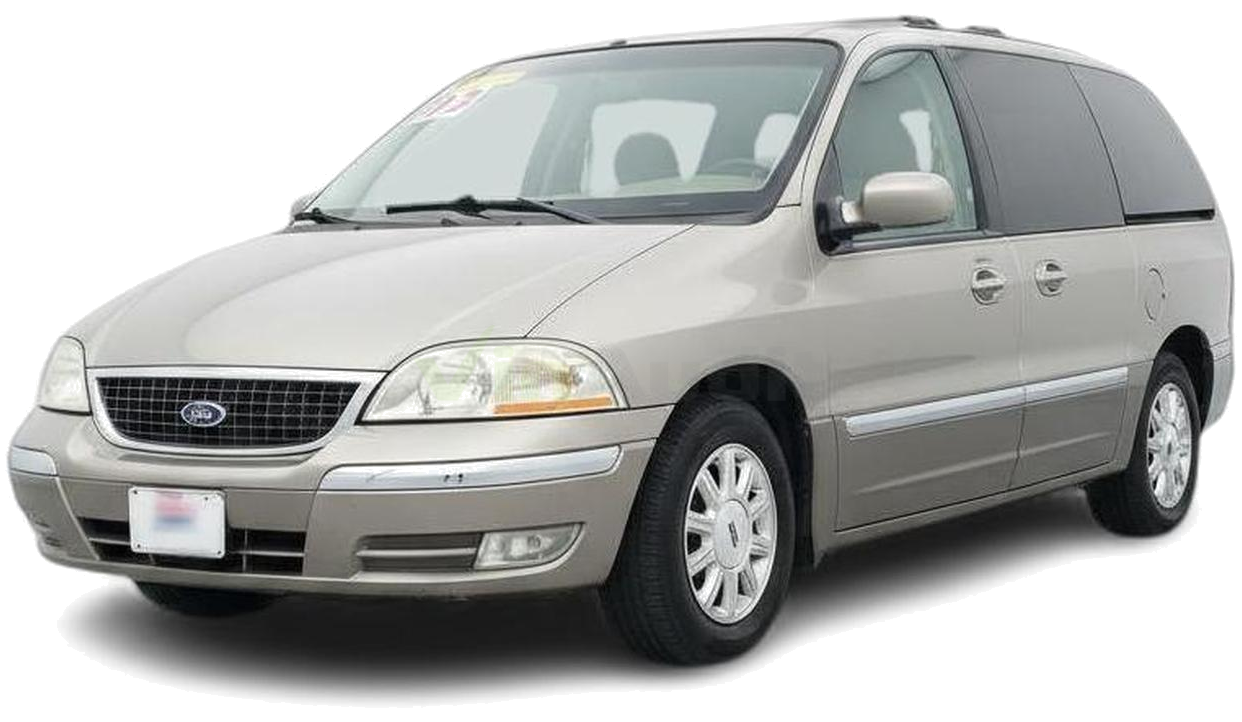
The Good
The 2003 Ford Windstar offered a comfortable, quiet ride and a spacious interior, appealing to families needing practicality. Its powerful V6 engine provided adequate performance, while its competitive pricing presented excellent value. For emotional buyers, it was a reliable family hauler, and for practical buyers, its generous cargo capacity and comfortable seating were major draws.
The Bad
Known weaknesses for the 2003 Ford Windstar include significant transmission reliability issues, especially later in its lifespan, susceptibility to rust on body panels and subframes, and problems with the power sliding doors. Other common concerns are intake manifold gasket leaks and premature brake wear, making pre-purchase inspections crucial.
2003 Ford Windstar: Quick Overview
- Engine Options: The 2003 Ford Windstar was exclusively powered by a 3.8-liter V6 engine.
- Horsepower: This 3.8L V6 engine produced 200 horsepower at 5000 rpm and 235 lb-ft of torque at 3000 rpm, providing ample power for daily driving and highway cruising.
- Fuel Economy: EPA estimates for the 3.8L V6 were around 17 mpg in the city and 23 mpg on the highway, with a combined average of about 19 mpg. These figures were typical for minivans of its era.
- 0-60 Times: The 2003 Windstar typically achieved 0-60 mph acceleration in the range of 9.0 to 10.0 seconds, which was respectable for a family minivan.
- Towing Capacity: When properly equipped with the optional towing package, the 2003 Ford Windstar could tow up to 3,500 pounds, making it suitable for light trailers or small boats.
- Trim-Level Features:
- LX: The base model, featuring standard amenities like air conditioning, power windows, power mirrors, remote keyless entry, and an AM/FM stereo with cassette player.
- SE: Added features such as a sport-tuned suspension, alloy wheels, upgraded cloth upholstery, a CD player, and body-color exterior trim.
- SEL: Elevated comfort with automatic climate control, a power driver's seat, leather-wrapped steering wheel, and available power sliding doors.
- Limited: The top-tier trim offered premium features including leather seating surfaces, a power passenger's seat, heated front seats, a premium audio system, rear-seat entertainment system (optional), and unique exterior styling elements. This trim focused on luxury and convenience for discerning buyers. Many trims also offered optional features like anti-lock brakes, side-impact airbags, and integrated child safety seats.
2003 Ford Windstar Specifications
Vehicle Information
| Year | 2003 |
| Make | Ford |
| Model | Windstar |
| Trim | - |
| Style | - |
| Type | Van |
| Category | Cargo Van |
Manufacturing Details
| Made In | Canada |
| Manufacturing City | OAKVILLE |
Dimensions
| Doors | 3-Door |
| Curb Weight | 3809 pounds |
| Gross Vehicle Weight Rating | 5540 pounds |
| Overall Height | 68.00 inches |
| Overall Length | 200.90 inches |
| Overall Width | 75.20 inches |
| Wheelbase Length | 120.70 inches |
| Standard Seating | 2 |
Engine & Performance
| Engine | 3.8L V6 |
| Engine Size | 3.8L |
| Engine Cylinders | 6 |
| Transmission | 4-Speed Automatic |
| Transmission Type | Automatic |
| Transmission Speeds | 4-Speed |
| Drivetrain | Front-Wheel Drive |
Additional Features
| Anti-Brake System | 4-Wheel ABS |
| Steering Type | Rack & Pinion |
Pricing
| Manufacturer Suggested Retail Price (MSRP) | $21,075 |
| Invoice Price | $19,217 |
| Delivery Charges | $685 |
Vehicle History Report
Specifications
History
Events
History Check
Check
Check
Check
Check
Listings
Recalls
Check
Analysis
What Problems Does the 2003 Ford Windstar Have?
Another common problem is rust, especially in regions with road salt. Owners frequently report rust on rocker panels, wheel wells, and subframes, which can compromise structural integrity and make repairs difficult. Power sliding doors are also a source of frustration, with motors, cables, and sensors failing, leading to intermittent operation or complete malfunction.
Engine-related issues include intake manifold gasket leaks, which can lead to coolant loss and overheating if not addressed. The 3.8L V6 engine itself is generally robust, but these gasket failures are a persistent concern. Front suspension components, such as control arm bushings, ball joints, and tie rods, tend to wear out relatively quickly, requiring frequent replacement. Brake components, including rotors and calipers, also seem to wear out faster than average.
Regarding recalls, the 2003 Windstar had several. A significant recall (NHTSA Campaign ID 03V189000) involved potential loss of power steering fluid and a risk of fire due to a hose rubbing against an engine pulley. Another recall (NHTSA Campaign ID 01V284000) for earlier models in the generation but potentially relevant to some 2003 vehicles involved a rear axle defect that could lead to fracture. These issues highlight potential safety and reliability challenges that prospective owners should be aware of. A thorough pre-purchase inspection focusing on these areas is highly recommended.
How long will the 2003 Ford Windstar last?
Long-term durability is significantly hampered by the notorious transmission issues; many Windstars did not make it past 100,000-120,000 miles without a major transmission overhaul or replacement. Rust is another major weakness that progressively deteriorates the vehicle's structure over time, especially in harsher climates. Regular inspections and timely repairs of suspension components, intake manifold gaskets, and power sliding doors are crucial for extending its lifespan beyond these common failure points. Without diligent care, its service life can be considerably shorter.
What Technology & Safety Features are Included?
Built-in Tech & Entertainment:
Standard tech included an AM/FM stereo with a cassette player, with a single-CD player or a multi-disc CD changer available as options, often integrated into the head unit. Higher trims like the Limited could be equipped with a premium audio system. A notable optional feature was the rear-seat entertainment system, typically a VCR or DVD player with a flip-down screen, offering entertainment for long family trips. Power windows, power door locks with remote keyless entry, and cruise control were standard or optional depending on the trim level.
Driver-Assistance:
Driver-assistance features were minimal. The most significant aid was the optional anti-lock braking system (ABS), which improved braking control in emergency situations. Traction control was also available on some higher trims to prevent wheel spin in slippery conditions. Parking sensors or advanced driver aids like blind-spot monitoring were not available.
Safety Features:
Standard safety equipment included dual front airbags. Side-impact airbags for the front passengers were an important optional safety feature, particularly on higher trim levels, enhancing occupant protection in side collisions. Integrated child safety seats were also an innovative and convenient option for families with young children.
Crash-Test Ratings:
For the 2003 Ford Windstar (and similar model years):
- NHTSA (National Highway Traffic Safety Administration):
- Frontal Driver: 5 Stars
- Frontal Passenger: 5 Stars
- Side Driver: 4 Stars (without side airbags), 5 Stars (with side airbags)
- Side Rear Passenger: 5 Stars
- Rollover: 3 Stars
- IIHS (Insurance Institute for Highway Safety): The IIHS did not conduct its full range of modern tests on vehicles from this era, but older tests generally rated the Windstar as "Acceptable" for moderate overlap front tests.
The strong frontal crash test ratings were a selling point, especially for safety-conscious families.
What Colors Options are Available?
2003 Ford Windstar Prices and Market Value
Minivans, in general, experience rapid depreciation, and the Windstar was no exception. Its "final model year" status of this generation, coupled with known reliability issues, further accelerated its depreciation. Factors severely affecting its current resale value include high mileage, the presence of rust, transmission problems (a major detractor), and general wear and tear. A clean title and a comprehensive service history can help, but the market for these older minivans is primarily driven by budget-conscious buyers seeking basic transportation, so high values are not expected.
2003 Ford Windstar Cost of Ownership
2003 Ford Windstar Fuel Efficiency
2003 Ford Windstar Safety Rating
NHTSA
IIHS
2003 Ford Windstar Recalls & Defects
Suspension:rear:axle:non-Powered Axle Assembly
Structure:frame and Members:underbody Shields
Power Train:axle Assembly
Suspension:front:control ARM
Suspension:rear:axle:non-Powered Axle Assembly
Suspension:rear:axle:non-Powered Axle Assembly
Seats:mid/Rear Assembly
Fuel System, Gasoline
Vehicle Speed Control
2003 Ford Windstar Warranty
Basic
Powertrain
Rust
2003 Ford Windstar Insurance
reasonable repair costs.
How Does the 2003 Ford Windstar Compare to Other Van?
Performance: The Windstar's 3.8L V6 with 200 hp was competitive with the V6 engines found in the Chrysler minivans (often 180-215 hp) and slightly behind the Honda Odyssey (240 hp) and Toyota Sienna (210 hp). Its acceleration was adequate, but its handling was often described as softer than the more refined Odyssey. The Windstar offered a comfortable, if somewhat floaty, ride.
Features: Feature-wise, the Windstar offered a similar range of amenities to its rivals, including available power sliding doors, rear-seat entertainment, and leather seats on higher trims. However, the execution and long-term reliability of these features, especially the power sliding doors, were often inferior to those found in Honda and Toyota.
Reliability: This is where the Windstar significantly lagged. Its notorious transmission problems and susceptibility to rust were major drawbacks. The Honda Odyssey and Toyota Sienna were widely regarded as far more reliable, with fewer widespread mechanical issues. The Chrysler/Dodge minivans also had their share of transmission and electrical issues but were often considered a step above the Windstar in overall longevity for powertrain components.
Price: New, the Windstar was generally priced competitively, often slightly undercutting the Honda and Toyota offerings, making it an attractive value proposition. On the used market, its lower reliability translates to significantly lower resale values compared to the Odysseys and Siennas of the same vintage, which often command higher prices due to their reputation for durability.
Recommended Alternatives:
For a better overall experience in terms of reliability and potentially higher long-term value, the 2003 Honda Odyssey or 2003 Toyota Sienna are significantly better alternatives. While they might be more expensive to purchase used, their reduced likelihood of major mechanical failure often offsets the higher upfront cost. If budget is extremely tight and a minivan is a must, a Chrysler Town & Country or Dodge Grand Caravan from the same year could be considered, but a thorough pre-purchase inspection is paramount for any of these older minivans.
Final Verdict: Is the 2003 Ford Windstar a Good Van?
However, it is only worth buying under very specific and cautious conditions. Given its age and known reliability issues, particularly the transmission, a prospective buyer must ensure an extremely thorough pre-purchase inspection by a trusted mechanic. Focus on transmission health, rust, and the functionality of power sliding doors. It is definitely only worth considering as a used vehicle, likely as a temporary solution, and certainly not as a long-term investment. Specific trims like the Limited offer more features but don't necessarily improve reliability. If you are prepared for potential significant repair costs or are mechanically inclined, it could serve a purpose, but otherwise, better alternatives exist for peace of mind.

Simon A
Simon is a contributor to VinCheck, where he provides articles and reviews on various automotive topics. His work focuses on delivering accurate and up-to-date information about used cars, helping readers make informed decisions.