
Vehicle Transmission Lookup by VIN: Check Type and Specs
Enter the complete 17-character VIN exactly as it appears on the vehicle or its documents.
Use a VIN to identify available transmission details such as automatic, manual, CVT, dual-clutch, direct drive, or another manufacturer-reported style. Results may also include the number of speeds, engine pairing, drivetrain, trim, and model year.
The lookup is free and requires no signup, email, or credit card. Use it as a starting point, then confirm the exact transmission code before ordering parts, choosing fluid, or installing a replacement unit.
On This Page
- What a transmission lookup is
- How the lookup works
- What the result may show
- What a VIN can and cannot confirm
- Which VIN digit identifies transmission
- Transmission types
- How to confirm the exact transmission
- Replacement compatibility
- Fluid and service specifications
- Used-car checks and symptoms
- Hybrid and EV terminology
- Latest U.S. transmission trend
- Sample lookup result
- Official verification sources
- Related vehicle research tools
- Frequently asked questions
Quick answer
What Is a Vehicle Transmission Lookup by VIN?
A vehicle transmission lookup by VIN uses the 17-character Vehicle Identification Number to retrieve available transmission and powertrain details associated with one vehicle.
The result may identify the transmission style, number of forward speeds, engine, drivetrain, trim, model year, and other configuration fields. It can help answer questions such as “What transmission do I have?”, “Is this vehicle automatic or CVT?”, and “Which transmission configuration should I verify before ordering parts?”
A VIN is usually a better starting point than a badge, shifter, seller description, or year-make-model search because the same model year may have several engine, drive, and transmission combinations.
For Vehicle Owners
Identify the original transmission category before reviewing maintenance schedules, fluid requirements, or repair information.
For Used-Car Buyers
Compare the decoded powertrain with the listing, vehicle documents, physical unit, road-test behavior, and service records.
For Parts and Repair Research
Narrow the correct transmission family, then confirm the exact assembly code, production date, electronics, and OEM part number.
How to Run a Free Transmission Lookup by VIN
Find the VIN
Check the driver-side dashboard, certification label, title, registration, insurance card, owner portal, or seller listing.
Enter All 17 Characters
Type the complete modern VIN without spaces or punctuation and double-check every character before submitting it.
Review the Powertrain
Look for transmission style, speed count, engine, drive type, trim, model year, plant, and related configuration fields.
Confirm Before Service
Verify the exact code, fluid, part number, programming, and installed unit with OEM information or physical inspection.
What a Transmission VIN Lookup Result May Show
Transmission Style
Automatic, manual, CVT, DCT, automated manual, direct drive, or another manufacturer-reported description.
Number of Speeds
The reported forward speed count when that variable is available and meaningful for the transmission design.
Engine and Drive
Engine displacement, cylinders, fuel type, FWD, RWD, AWD, 4WD, or electrified powertrain information.
Vehicle Configuration
Year, make, model, trim, series, body class, plant, and other fields that help narrow the correct powertrain.
| Possible field | What it means | What to verify next |
|---|---|---|
| Transmission style | The broad operating design, such as automatic, manual, CVT, DCT, or direct drive. | Confirm the exact family and assembly code before parts or service. |
| Transmission speeds | Reported forward speed count for a stepped transmission. | Do not apply a speed count literally to every CVT, hybrid, or EV drive unit. |
| Transmission model or code | A manufacturer, family, option, sales, or assembly identifier when available. | Compare it with the label, tag, stamping, build record, and OEM catalog. |
| Drive type | FWD, RWD, AWD, or 4WD configuration linked to the vehicle. | Verify output, final drive, transfer case, and axle compatibility. |
| Engine pairing | The engine configuration associated with the decoded vehicle. | Confirm engine code, emissions family, production date, and calibration. |
| Fluid or ratio data | May appear in specialized sources but is not guaranteed in a general decode. | Use OEM service information for fluid specification, capacity, and ratios. |
What a VIN Can and Cannot Confirm About a Transmission
A VIN Lookup Can Help Identify
- Original or manufacturer-reported transmission style
- Reported number of forward speeds
- Engine and drivetrain configuration
- Vehicle year, make, model, trim, and body
- Possible transmission family or code when supplied
- Powertrain fields that narrow the correct service information
A VIN Lookup Cannot Prove
- That the original transmission is still installed
- Current internal condition or remaining service life
- Correct fluid level, pressure, or temperature
- Whether programming or adaptation is current
- Every ratio, fluid specification, or fill capacity
- Guaranteed interchangeability with a replacement unit
Official reference: NHTSA vPIC VIN Decoder.
Which VIN Digit Tells You the Transmission?
There is no single universal VIN digit for transmission type. Manufacturer-defined characters, decoded attributes, and linked build data must be interpreted together.
Positions 1 to 3
The World Manufacturer Identifier identifies the manufacturer and vehicle type at a high level.
Positions 4 to 8
The Vehicle Description Section uses manufacturer-defined codes. It may narrow model, body, engine, drive, or powertrain details, but the pattern is not universal.
Position 9
The check digit helps validate transcription for vehicles subject to the North American rule. It does not identify the transmission.
Position 10
The model-year code helps select the correct decoding table and transmission options.
Position 11
The assembly-plant code may matter when components changed by plant or production run.
Positions 12 to 17
The production sequence identifies the individual vehicle and may allow a manufacturer system to retrieve its build record.
Types of Vehicle Transmissions a VIN Result May Identify
Conventional Automatic
Uses planetary gearsets, hydraulic controls, clutches, and usually a torque converter, with electronic control in modern vehicles.
Manual Transmission
Uses driver-selected gears and a clutch pedal or another driver-operated clutch mechanism.
Continuously Variable Transmission
Changes ratio continuously instead of moving through a fixed set of conventional gears. Designs and terminology vary.
Dual-Clutch Transmission
Uses separate clutch paths for alternating gears and automated shifting. Wet- and dry-clutch designs have different service needs.
Automated Manual
Uses manual-style gearing with automated clutch and shift operation. It should not be assumed to share parts or fluid with a conventional automatic.
Hybrid e-CVT or Power Split
Many hybrid systems use electric motor-generators and a power-split gearset rather than a belt-and-pulley CVT.
Direct Drive or Single Speed
Common in electric vehicles and some specialized designs, using a reduction drive instead of a conventional multi-speed gearbox.
Multi-Speed EV Drive
Some performance-oriented electric vehicles use two or more speeds, so “electric” does not always mean single-speed.
Manufacturer-Specific Name
Terms such as DSG, PDK, Tiptronic, Lineartronic, PowerShift, or TorqShift must be translated into the actual design and transmission family.
Official reference: NHTSA vPIC API Release Notes.
How to Confirm the Exact Transmission
- Decode the VIN. Record the year, model, engine, drivetrain, transmission style, speed count, plant, and production information.
- Check the original window sticker or build sheet. These may identify the factory transmission or option package.
- Inspect the certification, option, or service-parts label. Manufacturers may print transmission, axle, build, or option codes there.
- Find the transmission tag or case stamping. Record the complete code, suffix, barcode, and serial information.
- Use an OEM parts catalog or dealer. Provide both the VIN and physical transmission code before ordering an assembly.
- Review service and programming records. A replacement may use a superseded part number or require module programming.
- Compare the installed hardware. Check pan shape, case, connectors, sensors, mounts, cooler lines, transfer unit, and output configuration.
Replacement Transmission Compatibility Checklist
Use the VIN result to narrow the search, then verify every compatibility point that applies to the vehicle.
Mechanical Match
- OEM transmission family, model, tag, or assembly code
- Engine code, displacement, fuel type, and bellhousing pattern
- FWD, RWD, AWD, or 4WD configuration
- Output shaft, axle, transfer case, differential, and final-drive ratio
- Torque converter, clutch, flywheel, flexplate, mounts, cooler, and lines
- Model year, production date, plant, market, and emissions configuration
Electrical and Software Match
- Connector shape, pin count, sensors, solenoids, valve body, and mechatronics
- Transmission control module location and part number
- ECU, TCM, immobilizer, and network compatibility
- Software version, coding, calibration, adaptation, and relearn requirements
- ABS, transfer-case, speedometer, drive-mode, and driver-assistance integration
- OEM supersessions, service bulletins, and installation procedures
Transmission Fluid, Capacity, Filter, and Service Specifications
Use the VIN lookup to identify the vehicle and transmission, but verify service specifications with OEM information before adding fluid or performing maintenance.
Fluid Specification
Confirm the exact OEM standard, not only a generic label such as ATF, CVT fluid, gear oil, or DCT fluid.
Fill Capacity
Drain-and-fill, pan removal, converter service, overhaul, and dry-fill capacities can differ substantially.
Level Procedure
Some units require a specified temperature, engine state, gear-selection sequence, scan data, or level plug.
Filter and Pan
Filters may be external, internal, integrated with the pan, serviceable only during overhaul, or absent from routine maintenance.
Service Interval
Normal, severe, towing, fleet, track, and commercial schedules may differ. Follow the manufacturer schedule for the exact vehicle.
Do Not Mix by Guess
The wrong fluid can change friction behavior, pressure control, lubrication, cooling, clutch operation, and component life.
Used-Car Transmission Checks After the VIN Lookup
Cold Start
Ask that the vehicle remain cold before inspection. Observe engagement delay, noise, warning lights, leaks, idle quality, and initial shifts.
Road Test
Test low-speed engagement, light and heavy acceleration, coast-down, manual mode, reverse, hills, parking maneuvers, and highway operation when safe.
Scan All Modules
Read current, pending, history, and manufacturer-specific powertrain codes and review live transmission data.
Inspect Fluid and Leaks
Follow the correct level procedure and inspect the pan, seals, cooler lines, transfer unit, differential, and surrounding components.
Review Repair Records
Look for rebuilds, replacements, software updates, valve-body work, clutch service, fluid changes, towing use, and warranty claims.
Independent Inspection
Use a qualified shop with no financial connection to the seller and request written findings and estimates.
Symptoms a VIN Lookup Cannot Diagnose
| Symptom | What the driver may notice | Why diagnosis is still needed |
|---|---|---|
| Slipping or flare | Engine speed rises without a matching increase in vehicle speed. | Possible clutch, pressure, fluid, converter, software, or internal causes. |
| Delayed engagement | Drive or reverse takes too long to engage. | May involve fluid level, pressure loss, seals, valve body, or control issues. |
| Harsh or erratic shifts | Shifts bang, hunt, hesitate, skip, or occur unexpectedly. | Mechanical, electrical, sensor, adaptation, or engine problems can overlap. |
| Shudder or vibration | Vibration during launch, cruise, or gear changes. | Converter, clutch, CVT, mount, driveline, engine, tire, or software causes are possible. |
| Noise or overheating | Whine, growl, rattle, burnt odor, temperature warning, or reduced power. | Prompt inspection is needed to prevent further damage or unsafe operation. |
Hybrid and Electric Vehicle Transmission Terminology
Hybrid e-CVT
Often uses a power-split device and electric motor-generators. It should not automatically be treated like a belt-type CVT.
Dedicated Hybrid Transmission
May combine clutches, gears, motors, and control electronics in a manufacturer-specific transaxle.
EV Single-Speed Drive
Many EVs use a fixed reduction gear and differential integrated with the motor or drive unit.
Multi-Speed EV
Some electric vehicles use more than one speed for performance or efficiency.
Direct Drive
A decoder may use this term for a system without a conventional stepped gearbox. Verify the manufacturer definition.
Service Safety
Hybrid and EV drive units may involve high voltage, specialized fluids, isolation procedures, and manufacturer-specific training.
Latest available federal trend data
Modern Transmission Designs Are Increasingly Diverse
The EPA’s 2025 Automotive Trends Report, published in February 2026 and based on model year 2024 production, shows why a broad label such as “automatic” is often not specific enough for parts or service research.
of model year 2024 new vehicles used an 8-speed transmission.
The report also notes that battery-electric vehicles generally use a single-speed design, while a limited number of high-performance EVs use two-speed transmissions. This growing variety makes VIN-linked identification and physical confirmation increasingly important.
Source: 2025 EPA Automotive Trends Report, transmission section for model year 2024.
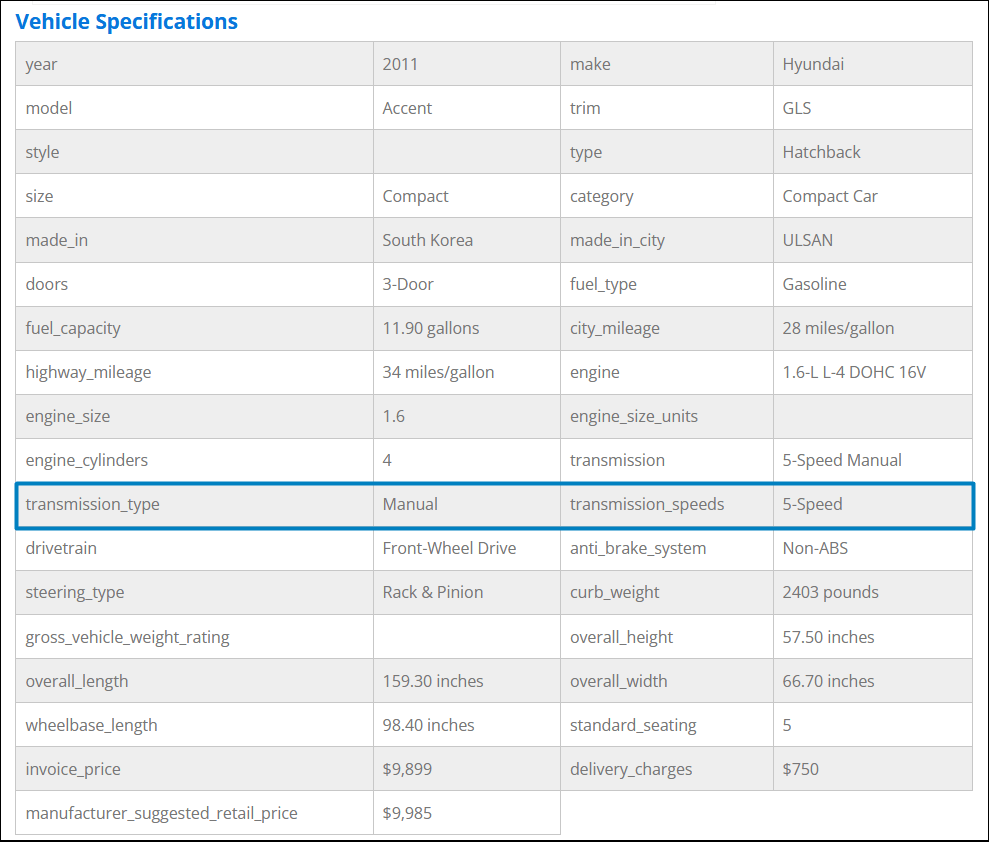
Sample Transmission Lookup Report
The sample below shows where transmission details may appear in a VIN-based vehicle specifications view. The exact fields depend on the VIN, manufacturer, model year, vehicle type, and data coverage.
Official Transmission and VIN Verification Sources
NHTSA vPIC VIN Decoder
Review manufacturer-reported vehicle identity, transmission style, transmission speeds, engine, drivetrain, plant, and other available fields.
Manufacturer Build Records
Use an owner portal, original window sticker, build sheet, VIN decode letter, option-code list, or dealer configuration printout.
Ask the manufacturer or an authorized dealer when a decoded field is missing or inconsistent.
OEM Parts and Service Information
Verify assembly codes, part supersessions, fluids, capacities, programming, installation procedures, and service bulletins.
Use the vehicle manufacturer’s official parts or service system.
EPA Vehicle Configuration Search
EPA explains that its used-vehicle fuel economy label tool can be searched by model year, make, model, engine, and transmission options.
NHTSA Recall Lookup
After confirming the VIN, check for unrepaired safety recalls. A recall lookup does not replace transmission diagnosis.
Physical Transmission Identification
Compare the tag, barcode, case stamping, pan, connectors, output, mounts, and installed unit with OEM diagrams and catalogs.
Related VIN and Vehicle Research Tools
Free VIN Decoder
Decode available year, make, model, engine, drivetrain, body, plant, and other VIN-linked details.
Vehicle Specs by VIN
Review a broader set of powertrain, fuel, body, dimension, weight, and safety specifications.
Build Sheet by VIN
Research available original factory options, packages, codes, colors, equipment, and configuration details.
Free VIN Check and Vehicle History
Review available title brands, theft, salvage, accidents, mileage, sales, recalls, value, and other history.
Free License Plate Lookup
Start with a U.S. plate when the VIN is not shown, then continue with the associated VIN when a match is available.
Free Carfax Report Alternative
Review available free vehicle-history information before deciding whether another report is needed.
VIN Recall Check
Check available safety recall information after confirming the complete VIN.
Car Warranty Check by VIN
Research available factory warranty and powertrain coverage context before major repairs.
Vehicle Transmission Lookup by VIN FAQs
What transmission do I have by VIN?
Enter the complete 17-character VIN into the lookup. When transmission data is available, the result may identify the transmission style, number of speeds, drivetrain, engine pairing, and other vehicle specifications. Confirm the exact assembly code before ordering parts.
Is the VinCheck.info transmission lookup free?
Yes. You can start a vehicle transmission lookup by VIN without creating an account or entering an email address or credit card.
Can a VIN show the exact transmission model or code?
Sometimes, but not for every vehicle. A lookup may show a transmission family, model, code, style, or speed count when the source provides it. Exact assembly identification may still require a build sheet, option label, physical tag, OEM parts catalog, or dealer record.
Which VIN digit tells me the transmission?
There is no universal transmission digit that works across all manufacturers. Positions 4 through 8 are manufacturer-defined vehicle-description characters and may help identify the powertrain, but their meaning changes by brand, model year, vehicle type, and market.
Can the NHTSA VIN decoder show transmission information?
It can when manufacturer-reported data includes it. NHTSA's vPIC decoder has variables for Transmission Style and Transmission Speeds, but those fields may be blank for a valid VIN.
Can a VIN lookup tell automatic, manual, CVT, or DCT apart?
Often. Available results may distinguish a conventional automatic, manual, continuously variable transmission, dual-clutch transmission, automated manual, direct drive, or another manufacturer-reported style.
Can a transmission VIN lookup show the number of gears?
It may show the number of forward speeds when that field is available. A missing speed count does not mean the transmission has no gears; it means the source did not return that variable.
Can the lookup identify transmission fluid type and capacity?
Not reliably for every vehicle. Use the lookup to identify the vehicle and transmission, then verify the exact fluid specification, service procedure, and fill capacity in OEM service information or the owner's manual.
Can a VIN tell whether the transmission was replaced?
No. A VIN-based specification result usually describes the original or manufacturer-reported configuration. Service records, invoices, programming records, physical identification tags, and inspection are needed to confirm a replacement.
Can a transmission lookup diagnose slipping or hard shifting?
No. The lookup identifies available specifications; it does not test fluid pressure, clutch condition, solenoids, sensors, software, internal wear, or fault codes. A scan and mechanical diagnosis are required.
Is a VIN enough to order a replacement transmission?
It is a strong starting point but should not be the only compatibility check. Confirm the transmission code, engine, drivetrain, production date, connectors, control module, transfer case, output configuration, calibration, and OEM part number.
Why does my VIN return no transmission information?
The manufacturer may not have reported that field, the VIN may be mistyped, the vehicle may be older or imported, the model year may be ambiguous, or the source may identify the vehicle without returning a transmission-specific value.
Can I find a transmission using a license plate instead of a VIN?
A license plate is not a transmission identifier. You may first use a license plate lookup to find an associated VIN when a match is available, then use that VIN for transmission research.
Does the VIN identify an e-CVT in a hybrid?
It may identify a continuously variable or hybrid transmission style, but terminology varies. Many hybrid e-CVT systems use a power-split gearset rather than the belt-and-pulley design common in conventional CVTs.
What does direct drive mean in a VIN result?
Direct drive may describe a propulsion system with no conventional multi-speed gearbox, such as a single-speed electric drive unit or another manufacturer-defined direct-drive configuration.
Can I decode a transmission on a pre-1981 vehicle?
Coverage is limited because older vehicles may use shorter, manufacturer-specific serial numbers instead of the modern standardized 17-character VIN. Use manufacturer records, data plates, casting numbers, service manuals, and specialist archives.
Run a Free Vehicle Transmission Lookup by VIN
Enter the complete 17-character VIN, review the available transmission and powertrain fields, and verify the exact code before ordering parts, selecting fluid, or beginning repairs.
Check Transmission by VIN