The 1998 Ford E-450 is a versatile full-size van known for its robust construction and adaptability. Part of Ford's E-Series van lineup, which saw production from 1961 to 2021, the E-450 represents a heavy-duty variant. It primarily came in cutaway and chassis cab configurations, designed for upfitting. Popular trims often revolved around chassis specifications and engine choices rather than distinct trim levels. Its popularity stems from its reliability as a workhorse vehicle, forming the foundation for numerous commercial applications like RVs, ambulances, and delivery vehicles.

The Good
The 1998 Ford E-450 excels in practical terms with its legendary reliability and potent performance for heavy-duty tasks. Its durable design offers peace of mind, while its spacious interior (in passenger van configurations) provides functional comfort for its intended use. This van offers exceptional value as a dependable workhorse.
The Bad
When considering a 1998 Ford E-450, potential buyers should watch out for potential rust issues, especially in the frame and body panels, given its age. Older transmission components can also be a concern, and aging fuel system parts may require attention. Engine wear and tear are also common considerations for a vehicle of this vintage.
1998 Ford E-450: Quick Overview
- Engine Options: The 1998 Ford E-450 was primarily equipped with two robust engine options:
- 4.6L Triton V8
- 5.4L Triton V8
- Horsepower:
- 4.6L V8: Approximately 215 horsepower
- 5.4L V8: Approximately 230-255 horsepower (depending on specific tuning)
- Fuel Economy:
Fuel economy for a vehicle of this class and era is generally not a strong suit and varies significantly based on configuration (chassis cab, cutaway, passenger van), load, and driving conditions. Expect figures in the range of 10-14 MPG city and 12-16 MPG highway. Precise EPA estimates are difficult to find for these specific configurations. - 0-60 Times:
Specific 0-60 mph times are not typically published for commercial van configurations like the E-450, as performance is geared towards torque and hauling capacity rather than acceleration. Estimates would place it in the 12-18 second range, heavily dependent on the engine and load. - Towing Capacity:
Towing capacity is a significant strength of the E-450. Depending on the specific configuration, axle ratio, and trailer brake setup, the towing capacity could range from approximately 7,000 lbs to over 10,000 lbs, making it suitable for substantial towing needs. - Trim-Level Features:
The E-450 did not typically feature traditional 'trim levels' like passenger cars. Instead, features were often dictated by the intended upfitting purpose and optional packages. Common features included:- Power steering and brakes
- Rear-wheel drive
- Available options like air conditioning, cruise control, power windows/locks (more common on passenger versions), and various audio systems.
- Chassis cab and cutaway versions were designed with a basic driver's cab and a bare chassis behind, ready for custom bodies.
- Passenger versions offered seating for multiple occupants and basic interior amenities.
1998 Ford E-450 Specifications
Vehicle Information
| Year | 1998 |
| Make | Ford |
| Model | E-450 |
| Trim | - |
| Style | - |
| Type | Van Stripped |
| Category | Medium Truck |
Manufacturing Details
| Made In | United States |
| Manufacturing City | - |
Dimensions
| Doors | - |
| Curb Weight | - |
| Gross Vehicle Weight Rating | 16000 pounds |
| Overall Height | - |
| Overall Length | - |
| Overall Width | - |
| Wheelbase Length | - |
| Standard Seating | - |
Engine & Performance
| Engine | - |
| Engine Size | - |
| Engine Cylinders | - |
| Transmission | - |
| Transmission Type | - |
| Transmission Speeds | - |
| Drivetrain | Rear-Wheel Drive |
Additional Features
| Anti-Brake System | - |
| Steering Type | - |
Pricing
| Manufacturer Suggested Retail Price (MSRP) | - |
| Invoice Price | - |
| Delivery Charges | - |
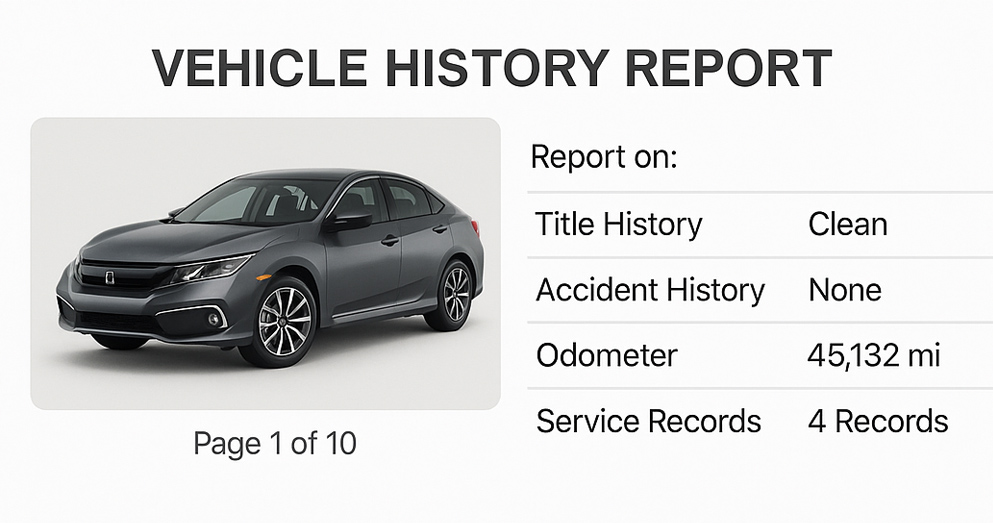
Vehicle History Report
Vehicle
Specifications
Specifications
Ownership
History
History
All History
Events
Events
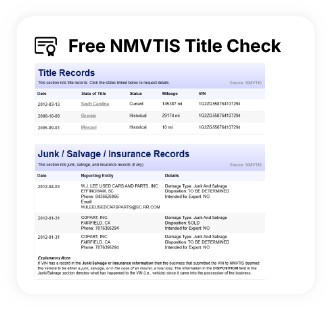
NMVTIS Title
History Check
History Check
Salvage/Rebuilt
Check
Check
Accident
Check
Check
Theft
Check
Check
Open Lien
Check
Check
Past Sale
Listings
Listings
Safety
Recalls
Recalls
Odometer
Check
Check
Market Price
Analysis
Analysis
What Problems Does the 1998 Ford E-450 Have?
The 1998 Ford E-450, being part of the long-running E-Series, shares some common concerns with its siblings, especially as it ages. One frequently reported issue is related to the transmission. Over time, the automatic transmissions (typically the 4R70W or E4OD) can develop issues such as slipping, harsh shifting, or failure to engage gears, often due to worn internal components or solenoid problems. Regular fluid changes and timely maintenance are crucial to mitigate this.
Cooling system issues are also noted, with radiator leaks, water pump failures, and hose degradation being common over many years of service. Overheating can lead to more severe engine problems, so monitoring coolant levels and the condition of the system is vital.
Rust is a significant concern for vehicles of this age, particularly in areas with harsh winters or coastal climates. The frame, body panels, and suspension components are susceptible to corrosion, which can compromise structural integrity and lead to costly repairs. Regular washing and undercoating can help, but thorough inspection is essential for used models.
Some owners have reported issues with the fuel pump and associated components failing prematurely. This can manifest as hard starting, stalling, or a complete inability to start the engine.
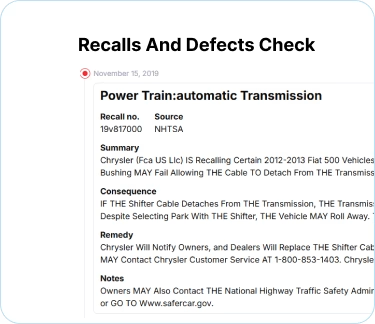
While specific recalls for the 1998 model year that are distinct from the broader E-Series range are not extensively documented, it's always advisable to check the National Highway Traffic Safety Administration (NHTSA) database for any applicable recalls that might have been issued later or are part of broader campaigns. For long-term reliability, the E-450 is generally considered robust if well-maintained, with the Triton V8 engines proving quite durable. However, the sheer age of a 1998 model means that component wear is inevitable, and buyers should be prepared for potential repairs on various systems.
Cooling system issues are also noted, with radiator leaks, water pump failures, and hose degradation being common over many years of service. Overheating can lead to more severe engine problems, so monitoring coolant levels and the condition of the system is vital.
Rust is a significant concern for vehicles of this age, particularly in areas with harsh winters or coastal climates. The frame, body panels, and suspension components are susceptible to corrosion, which can compromise structural integrity and lead to costly repairs. Regular washing and undercoating can help, but thorough inspection is essential for used models.
Some owners have reported issues with the fuel pump and associated components failing prematurely. This can manifest as hard starting, stalling, or a complete inability to start the engine.
While specific recalls for the 1998 model year that are distinct from the broader E-Series range are not extensively documented, it's always advisable to check the National Highway Traffic Safety Administration (NHTSA) database for any applicable recalls that might have been issued later or are part of broader campaigns. For long-term reliability, the E-450 is generally considered robust if well-maintained, with the Triton V8 engines proving quite durable. However, the sheer age of a 1998 model means that component wear is inevitable, and buyers should be prepared for potential repairs on various systems.
How long will the 1998 Ford E-450 last?
Based on owner data and typical usage, a well-maintained 1998 Ford E-450 can realistically achieve between 200,000 to 300,000 miles, and in some cases, even more. These vehicles were built for commercial use, emphasizing durability. Long-term durability is largely dependent on the owner's commitment to regular maintenance, including timely oil changes, transmission fluid flushes, and coolant checks. Weaknesses that tend to emerge over time include potential rust formation on the frame and body, especially in harsh climates. The transmission, while generally robust, can require attention after extensive mileage. However, the core powertrain components, like the Triton V8 engines, are known for their longevity when properly cared for.
What Technology & Safety Features are Included?
The 1998 Ford E-450 is a utilitarian vehicle, and its technology, entertainment, driver-assistance, and safety features reflect its era and purpose. Built-in tech was minimal by today's standards. Expect a basic AM/FM radio, possibly with a cassette player, as the primary entertainment system. Higher-end options might have included a CD player, though this was less common in base commercial configurations. USB ports, Bluetooth connectivity, or touchscreen infotainment systems were non-existent.
Driver-assistance features were also extremely limited. Features like anti-lock braking system (ABS) were available, primarily for safety and control during heavy braking situations. Cruise control was an option for highway driving comfort. Backup cameras, lane departure warnings, or adaptive cruise control were not part of the E-450's offerings in 1998.
Safety features were focused on passive systems. Standard safety equipment typically included seatbelts for all occupants and front airbags for the driver and front passenger. The robust body-on-frame construction provided a degree of inherent structural safety.
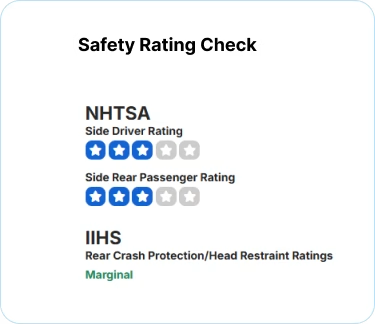
Crash-test ratings for commercial vans like the E-450 from this period are not as readily available or as comprehensive as those for passenger vehicles. Ford conducted internal testing, but public release of detailed crash-test data comparable to modern NHTSA or IIHS ratings is scarce. However, the E-450 was engineered to meet commercial vehicle safety standards of the time, prioritizing occupant protection in frontal impacts and providing a stable platform. For specialized upfits like RVs or ambulances, additional safety equipment relevant to those applications would have been integrated by the upfitter.
Driver-assistance features were also extremely limited. Features like anti-lock braking system (ABS) were available, primarily for safety and control during heavy braking situations. Cruise control was an option for highway driving comfort. Backup cameras, lane departure warnings, or adaptive cruise control were not part of the E-450's offerings in 1998.
Safety features were focused on passive systems. Standard safety equipment typically included seatbelts for all occupants and front airbags for the driver and front passenger. The robust body-on-frame construction provided a degree of inherent structural safety.
Crash-test ratings for commercial vans like the E-450 from this period are not as readily available or as comprehensive as those for passenger vehicles. Ford conducted internal testing, but public release of detailed crash-test data comparable to modern NHTSA or IIHS ratings is scarce. However, the E-450 was engineered to meet commercial vehicle safety standards of the time, prioritizing occupant protection in frontal impacts and providing a stable platform. For specialized upfits like RVs or ambulances, additional safety equipment relevant to those applications would have been integrated by the upfitter.
What Colors Options are Available?
1998 Ford E-450 Prices and Market Value
When new, the 1998 Ford E-450's price varied significantly depending on its configuration (cutaway, chassis cab) and optional equipment. Base chassis cab models likely started in the range of $25,000 to $30,000, with fully upfitted versions (like RV chassis or specialized work trucks) costing considerably more.
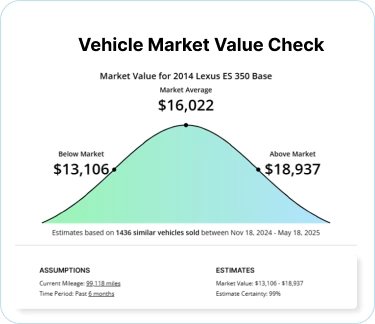
Currently, used market prices for a 1998 Ford E-450 range broadly from $3,000 to $10,000+, heavily dependent on mileage, condition, and the quality of any upfitting. A well-maintained chassis with low miles could command a higher price than a project vehicle.
Depreciation for such a utilitarian vehicle is steep in the first few years, but after a decade or more, the depreciation curve flattens considerably. Factors affecting resale value include mechanical condition, body rust, maintenance records, and the utility of its existing upfit. For conversions, the quality and desirability of the conversion are paramount. Simple utility and reliability are key drivers for its remaining value.
Currently, used market prices for a 1998 Ford E-450 range broadly from $3,000 to $10,000+, heavily dependent on mileage, condition, and the quality of any upfitting. A well-maintained chassis with low miles could command a higher price than a project vehicle.
Depreciation for such a utilitarian vehicle is steep in the first few years, but after a decade or more, the depreciation curve flattens considerably. Factors affecting resale value include mechanical condition, body rust, maintenance records, and the utility of its existing upfit. For conversions, the quality and desirability of the conversion are paramount. Simple utility and reliability are key drivers for its remaining value.
1998 Ford E-450 Cost of Ownership
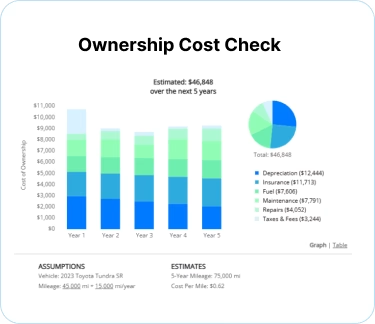
Owning a 1998 Ford E-450 can be a mixed bag in terms of cost. Insurance premiums will vary based on its classification (commercial vs. personal use, if converted) and your driving record. Fuel costs are generally high due to its V8 engines and substantial weight, expect modest MPG. Maintenance costs are moderate for routine services, but repairs can become significant as the vehicle ages, particularly for transmission or significant rust remediation. Parts availability is generally good, but specialized components for conversions can be costly. Overall, while initial purchase prices are low, the long-term ownership can be moderately costly due to potential repairs and fuel consumption. It's not an economical vehicle in terms of running costs, but its value lies in its capability and durability if maintained.
1998 Ford E-450 Fuel Efficiency
Fuel Type
-
Fuel Capacity
-
City Mileage
-
Highway Mileage
-
1998 Ford E-450 Insurance
Insurance for a 1998 Ford E-450 is moderately priced, reflecting its status as a Van Stripped with strong safety ratings and
reasonable repair costs.
How Does the 1998 Ford E-450 Compare to Other Van Stripped?
The 1998 Ford E-450 competed primarily against other heavy-duty vans from its era, notably the Chevrolet Express 3500/4500 and the Dodge Ram Van 3500.
In terms of performance, the E-450, especially with the 5.4L Triton V8, offered robust power and torque suitable for hauling and towing, often matching or slightly exceeding its Chevrolet and Dodge counterparts in raw capability, though specific engine choices and configurations varied.
Features were generally basic across all these vans in 1998. None offered advanced tech. Ford's advantage often lay in its widespread dealer network and the availability of numerous upfitting options for the E-450 chassis. Chevrolet's Express shared similar utilitarian interiors and optional features. Dodge's Ram Van was known for its simpler design and often a lower initial price point.
Reliability is where the Ford E-Series, including the E-450, historically held a strong reputation, often considered a benchmark for durability and longevity, especially the powertrains. While all vans of this age can suffer from rust and wear, the E-Series was generally perceived as a workhorse that could endure substantial mileage with proper care. Chevrolet also had a decent reputation for reliability, while Dodge vans from this period sometimes faced more varied reliability reports.
Price-wise, all three were positioned as heavy-duty work vehicles. New prices were competitive, and on the used market, they depreciate significantly. The 1998 E-450 would likely be found at comparable price points to similar year Express and Ram vans, with condition and mileage being the primary determinants.
Alternatives: For a similar utilitarian purpose, one might also consider heavy-duty pickup trucks if cargo bed utility is paramount, though they lack the enclosed space of a van. If seeking a more modern van with better safety and tech, newer models of the Ford Transit (which replaced the E-Series) or Mercedes-Benz Sprinter would be options, though at a significantly higher price point, especially used. For someone specifically looking for a reliable, older heavy-duty van, a well-maintained 1998 E-450 is a solid choice within its competitive set.
In terms of performance, the E-450, especially with the 5.4L Triton V8, offered robust power and torque suitable for hauling and towing, often matching or slightly exceeding its Chevrolet and Dodge counterparts in raw capability, though specific engine choices and configurations varied.
Features were generally basic across all these vans in 1998. None offered advanced tech. Ford's advantage often lay in its widespread dealer network and the availability of numerous upfitting options for the E-450 chassis. Chevrolet's Express shared similar utilitarian interiors and optional features. Dodge's Ram Van was known for its simpler design and often a lower initial price point.
Reliability is where the Ford E-Series, including the E-450, historically held a strong reputation, often considered a benchmark for durability and longevity, especially the powertrains. While all vans of this age can suffer from rust and wear, the E-Series was generally perceived as a workhorse that could endure substantial mileage with proper care. Chevrolet also had a decent reputation for reliability, while Dodge vans from this period sometimes faced more varied reliability reports.
Price-wise, all three were positioned as heavy-duty work vehicles. New prices were competitive, and on the used market, they depreciate significantly. The 1998 E-450 would likely be found at comparable price points to similar year Express and Ram vans, with condition and mileage being the primary determinants.
Alternatives: For a similar utilitarian purpose, one might also consider heavy-duty pickup trucks if cargo bed utility is paramount, though they lack the enclosed space of a van. If seeking a more modern van with better safety and tech, newer models of the Ford Transit (which replaced the E-Series) or Mercedes-Benz Sprinter would be options, though at a significantly higher price point, especially used. For someone specifically looking for a reliable, older heavy-duty van, a well-maintained 1998 E-450 is a solid choice within its competitive set.
Final Verdict: Is the 1998 Ford E-450 a Good Van Stripped?
The 1998 Ford E-450 is ideally suited for businesses or individuals needing a robust, no-frills platform for heavy-duty work, custom conversions (like RVs, camper vans, or specialized service vehicles), or for hauling substantial loads. It is worth buying if you prioritize proven durability and capability over modern amenities and are prepared for potential age-related maintenance. Buying this vehicle is best done on the used market, as new models are no longer produced. Focus on chassis cab or cutaway versions if you plan a custom build. Thorough mechanical inspection, paying close attention to rust and transmission health, is crucial. For those seeking a reliable, cost-effective foundation for a project or a workhorse that can withstand demanding use, the 1998 E-450 remains a viable option under the right conditions and with diligent upkeep.