
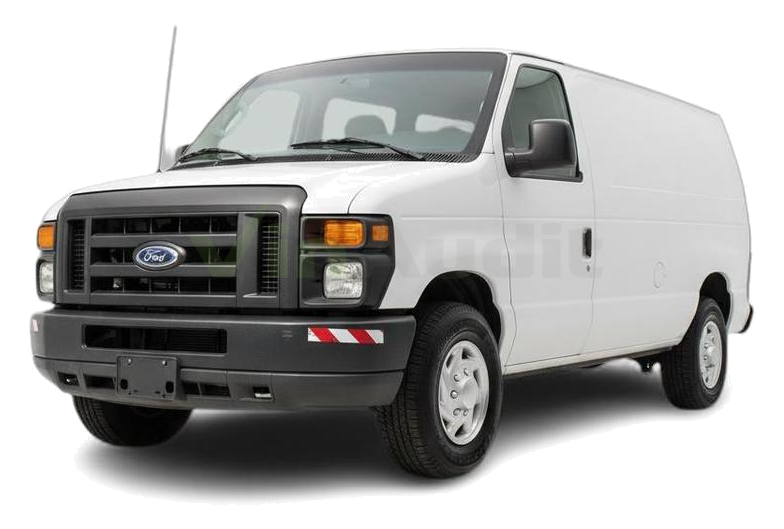
The Good
The 2014 E-250 boasts impressive towing and hauling prowess, coupled with a reputation for rugged reliability. Its spacious interior offers practical utility and a surprisingly comfortable ride for its class. Emotionally, it represents dependable freedom for projects and adventures, while practically, it's a cost-effective, long-lasting asset.
The Bad
Potential owners should be aware of its dated interior design and less refined handling compared to modern vans. Fuel economy is a significant drawback, and some owners report issues with transmission and rear axle components over time, especially with heavy use.
2014 Ford E-250: Quick Overview
- Engine Options: The 2014 Ford E-250 was primarily offered with two robust gasoline V8 engine options.
- 4.6L Triton V8: This engine provided a solid balance of power and was a popular choice for general use. Horsepower typically ranged around 225 hp, with torque figures in the vicinity of 286 lb-ft.
- 5.4L Triton V8: For those requiring more grunt, the larger 5.4L V8 offered increased horsepower, usually around 255 hp, and significantly more torque (approximately 350 lb-ft), making it ideal for heavier loads and towing.
- 4.6L Triton V8: This engine provided a solid balance of power and was a popular choice for general use. Horsepower typically ranged around 225 hp, with torque figures in the vicinity of 286 lb-ft.
- Horsepower: Approximately 225 hp for the 4.6L V8 and 255 hp for the 5.4L V8.
- Fuel Economy: As a large, heavy-duty van, fuel economy was not a strong suit. Expect figures in the range of 11-14 mpg combined city/highway, depending on the engine and load.
- 0-60 Times: Precise 0-60 mph times are rarely officially published for commercial vans. However, estimations place it in the 9-11 second range for unloaded configurations, with a noticeable increase when laden.
- Towing Capacity: The E-250 was designed for towing. Depending on the configuration (e.g., wheelbase, axle ratio, engine), towing capacity could range from approximately 7,000 lbs to over 10,000 lbs, making it highly capable for commercial or recreational hauling.
- Trim-Level Features: The E-250 was less about distinct 'trims' in the traditional sense and more about configuration packages and options. Key features often included:
- Body Styles: Available in standard and extended wheelbases for both cargo and passenger configurations.
- Seating: Cargo vans were basic, often with just two front seats. Passenger wagons could seat up to 15 people depending on the configuration.
- Optional Packages: Many features were optional, including upgraded audio systems, air conditioning, power windows/locks, cruise control, and various work-focused upfits for cargo versions (e.g., shelving, partitions).
- Safety Features: Standard safety features typically included anti-lock brakes (ABS), airbags, and stability control.
- Body Styles: Available in standard and extended wheelbases for both cargo and passenger configurations.
2014 Ford E-250 Specifications
Vehicle Information
| Year | 2014 |
| Make | Ford |
| Model | E-250 |
| Trim | - |
| Style | - |
| Type | Van |
| Category | Cargo Van |
Manufacturing Details
| Made In | United States |
| Manufacturing City | AVON LAKE |
Dimensions
| Doors | 3-Door |
| Curb Weight | 5376 pounds |
| Gross Vehicle Weight Rating | 8900 pounds |
| Overall Height | 85.00 inches |
| Overall Length | 236.40 inches |
| Overall Width | 79.40 inches |
| Wheelbase Length | 138.00 inches |
| Standard Seating | 2 |
Engine & Performance
| Engine | 4.6L V8 |
| Engine Size | 4.6L |
| Engine Cylinders | 8 |
| Transmission | 4-Speed Automatic |
| Transmission Type | Automatic |
| Transmission Speeds | 4-Speed |
| Drivetrain | Rear-Wheel Drive |
Additional Features
| Anti-Brake System | 4-Wheel ABS |
| Steering Type | Recirculating |
Pricing
| Manufacturer Suggested Retail Price (MSRP) | $31,420 |
| Invoice Price | $28,985 |
| Delivery Charges | $995 |
Vehicle History Report
Specifications
History
Events
History Check
Check
Check
Check
Check
Listings
Recalls
Check
Analysis
What Problems Does the 2014 Ford E-250 Have?
Another area that sometimes raises concerns is the rear axle. While generally durable, issues such as differential noise or leaks have been noted, particularly on higher-mileage vehicles. The braking system can also require attention; premature wear of brake pads and rotors is not uncommon, especially given the van's weight.
Electrical gremlins, while less pervasive, have also been reported. These can range from minor issues like faulty power window motors or door locks to more significant problems with the instrument cluster or interior lighting. Alternator failures have also been noted, which can lead to a range of electrical issues and leave the vehicle stranded.
Regarding recalls, specific to the 2014 model year, Ford issued recalls for various potential issues across their vehicle lines. For the E-Series vans, common recalls have historically addressed things like potential fuel leaks, issues with the steering system, or airbag inflator concerns. It's essential for any potential buyer to check the VIN against the NHTSA database for any outstanding recalls that may not have been addressed.
Long-term reliability is generally considered good if the vehicle has been well-maintained. The E-250 is built with commercial use in mind, meaning its components are often over-engineered for durability. However, it's critical to look for a history of regular maintenance, especially concerning fluid changes for the engine, transmission, and differential. A well-maintained E-250 can serve its owner for many years and hundreds of thousands of miles, but the potential for transmission issues should be a key consideration during inspection.
How long will the 2014 Ford E-250 last?
What Technology & Safety Features are Included?
Driver-assistance features were minimal to non-existent for the 2014 E-250. Features like lane departure warning, adaptive cruise control, or automatic emergency braking were not part of its technological suite. The primary safety focus was on passive systems. Standard safety features included front airbags for the driver and passenger, anti-lock braking system (ABS) for improved stopping power, and a rearview camera was available as an option on some models, particularly helpful for parking and maneuvering in tight spaces. Stability control was also a notable safety feature, helping to prevent rollovers, especially when the van was loaded.
Optional features were more geared towards enhancing the work or passenger experience. These could include air conditioning, power windows and locks (on some configurations), cruise control for easier highway driving, and upgraded interior materials for passenger wagons. For cargo vans, Ford offered various upfit packages, including shelving, dividers, and work lighting, which were crucial for many commercial users.
Crash-test ratings for commercial vans like the E-250 are not as extensively published or standardized as they are for passenger cars by organizations like the NHTSA or IIHS. However, the E-Series vans generally performed adequately for their intended purpose, with a focus on structural integrity to protect occupants in the event of a collision. The sturdy body-on-frame construction provided a solid foundation. While specific detailed ratings for the 2014 model year might be scarce, earlier models indicated good performance in frontal and side-impact tests, though side-impact testing on vans with multiple rows of seating can vary.
What Colors Options are Available?
2014 Ford E-250 Prices and Market Value
2014 Ford E-250 Cost of Ownership
2014 Ford E-250 Fuel Efficiency
2014 Ford E-250 Safety Rating
IIHS
2014 Ford E-250 Recalls & Defects
Equipment Adaptive/Mobility
Equipment Adaptive/Mobility
Fuel System, Other:storage
Equipment Adaptive/Mobility
Equipment Adaptive/Mobility
Equipment Adaptive/Mobility
Equipment Adaptive/Mobility
Equipment Adaptive/Mobility
Equipment Adaptive/Mobility
Equipment Adaptive/Mobility
Seats
2014 Ford E-250 Warranty
Basic
Powertrain
Rust
2014 Ford E-250 Insurance
reasonable repair costs.
How Does the 2014 Ford E-250 Compare to Other Van?
When it comes to features and interior refinement, the E-250 was generally considered more utilitarian and less advanced than some competitors. The Mercedes-Benz Sprinter, though pricier, offered a more modern interior, better fuel efficiency (with its diesel engine), and a more car-like driving experience. The Chevrolet Express was also somewhat dated in its interior design, but both it and the E-250 focused on straightforward functionality.
Reliability is where the E-250, alongside the Express/Savana, generally shines in terms of ruggedness and simplicity. While both can have transmission issues, their V8 engines are known for longevity when properly maintained. The Sprinter, while offering advanced technology and efficiency, could sometimes be more expensive to repair due to its European origin and more complex systems.
Price-wise, the 2014 E-250 was typically positioned as a very competitive value proposition, often undercutting the Sprinter significantly. The Chevrolet Express 2500 was usually similarly priced.
Alternatives to Consider:
- Chevrolet Express 2500 / GMC Savana 2500 (2014-2019): These are the most direct rivals, offering similar V8 performance, towing, and commercial utility. They are essentially the same vehicle and often come down to local availability and price.
- Mercedes-Benz Sprinter (2014-2019): If fuel efficiency, more modern amenities, and a higher payload are priorities, and budget allows, the Sprinter is a superior option, especially with its diesel engine. However, it comes at a higher purchase price and potentially higher repair costs.
- Ford Transit (2015+): While slightly newer, the Ford Transit replaced the E-Series and offers a more modern platform, better fuel economy (especially with its EcoBoost engines), and improved driving dynamics. It's an excellent successor if looking for something slightly newer with more advanced features.
Final Verdict: Is the 2014 Ford E-250 a Good Van?

Jovan
Jovan specializes in interpreting vehicle records and making sense of VIN data. With over 10 years of experience in the automotive data industry, his work ensures that every report is clear, accurate, and useful for car buyers.