
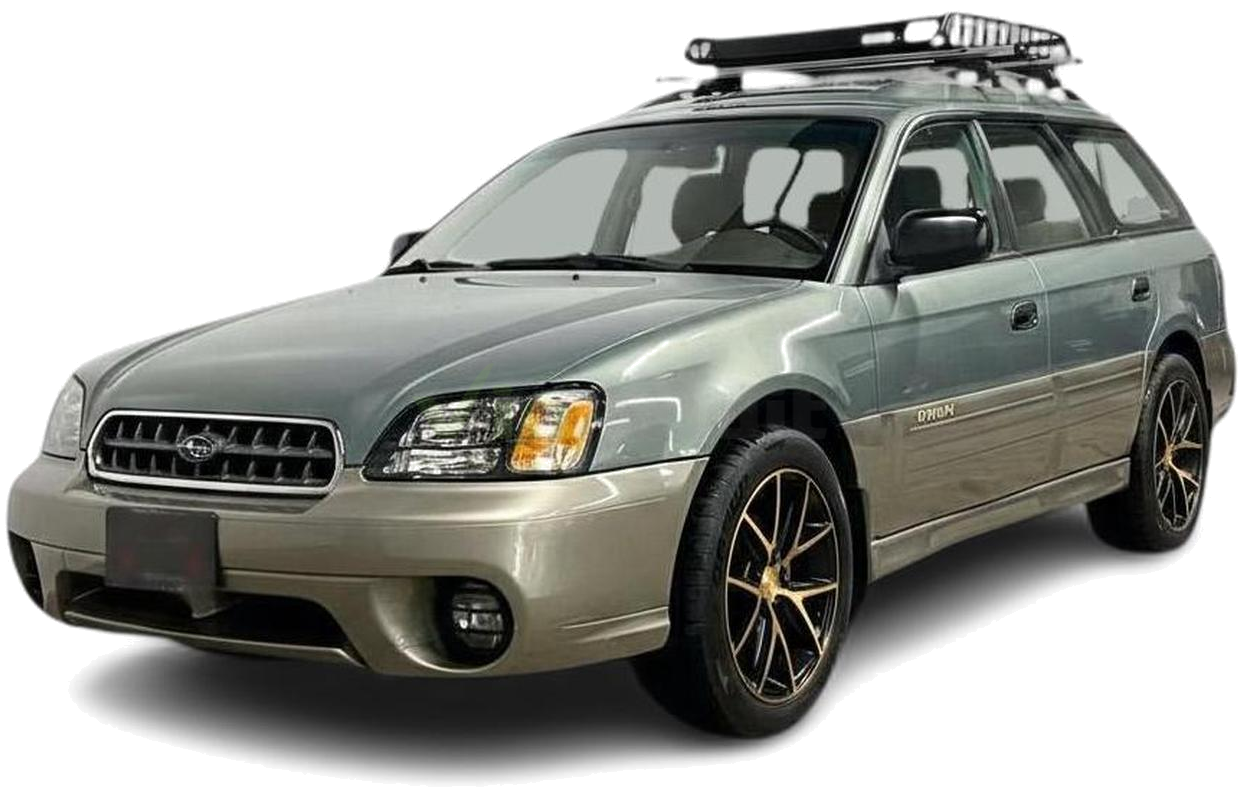
The Good
The 2003 Subaru Outback offers legendary Symmetrical All-Wheel Drive for unmatched traction and confidence in all conditions, appealing to adventurous spirits and safety-conscious families alike. Its robust design provides ample cargo space and a comfortable ride. Known for strong reliability when maintained, it represents excellent long-term value, balancing rugged performance with everyday practicality and decent fuel economy for an AWD vehicle.
The Bad
Potential buyers should be aware of known issues such as head gasket failures, particularly on the 2.5L engine, requiring costly repair. Timing belt maintenance is crucial. Other concerns include potential rust in salt-belt regions, aging suspension components, and some owners report issues with automatic transmissions and wheel bearings over time.
2003 Subaru Outback: Quick Overview
- Engine Options:
2.5-liter SOHC 16-valve H4 — (EJ25)
3.0-liter DOHC 24-valve H6 — (EZ30) - Horsepower:
2.5L H4: 165 hp @ 5,600 rpm
3.0L H6: 212 hp @ 6,000 rpm - Fuel Economy (EPA Estimated):
2.5L H4 (Manual): 20 MPG City / 26 MPG Highway
2.5L H4 (Automatic): 20 MPG City / 26 MPG Highway
3.0L H6 (Automatic): 18 MPG City / 24 MPG Highway - 0-60 MPH Acceleration:
2.5L H4: Approximately 9-10 seconds (varies with transmission)
3.0L H6: Approximately 8-9 seconds - Towing Capacity:
Up to 2,000-2,400 lbs (with proper equipment and trailer brakes, depending on engine/transmission) - Trim-Level Features:
Base: Standard Symmetrical All-Wheel Drive, air conditioning, power windows, locks, and mirrors, AM/FM stereo with CD player, roof rails, 16-inch steel wheels.
Limited: Adds leather-trimmed upholstery, power driver's seat, heated front seats, heated exterior mirrors, upgraded audio system, fog lights, 16-inch alloy wheels, and often a moonroof.
H6-3.0: Features the more powerful 3.0L flat-six engine, often equipped with features similar to the Limited trim, including automatic climate control and upgraded braking system.
L.L.Bean Edition: A premium package with unique two-tone exterior paint, specific interior trim with L.L.Bean badging, premium audio, larger moonroof, and typically includes most Limited features.
VDC (Vehicle Dynamic Control): The top-tier trim, exclusive to the H6 engine, featuring Subaru's Vehicle Dynamic Control stability system, a specialized automatic transmission (VTD-AWD), premium McIntosh audio system, and often includes all available luxury and safety features.
2003 Subaru Outback Specifications
Vehicle Information
| Year | 2003 |
| Make | Subaru |
| Model | Outback |
| Trim | - |
| Style | - |
| Type | Wagon |
| Category | Mid-Size Station Wagon |
Manufacturing Details
| Made In | United States |
| Manufacturing City | LAFAYETTE |
Dimensions
| Doors | 4-Door |
| Curb Weight | 3490 pounds |
| Gross Vehicle Weight Rating | - |
| Overall Height | 63.30 inches |
| Overall Length | 187.40 inches |
| Overall Width | 68.70 inches |
| Wheelbase Length | 104.30 inches |
| Standard Seating | 5 |
Engine & Performance
| Engine | 3L H6 |
| Engine Size | 3L |
| Engine Cylinders | 6 |
| Transmission | 4-Speed Automatic |
| Transmission Type | Automatic |
| Transmission Speeds | 4-Speed |
| Drivetrain | All-Wheel Drive |
Additional Features
| Anti-Brake System | 4-Wheel ABS |
| Steering Type | Rack & Pinion |
Pricing
| Manufacturer Suggested Retail Price (MSRP) | $26,995 |
| Invoice Price | $24,451 |
| Delivery Charges | $525 |
Vehicle History Report
Specifications
History
Events
History Check
Check
Check
Check
Check
Listings
Recalls
Check
Analysis
What Problems Does the 2003 Subaru Outback Have?
Another critical maintenance item for the 2.5L engine is the timing belt, which needs replacement every 105,000 miles along with the water pump, idlers, and tensioner. Failure to do so can result in catastrophic engine damage. The 3.0-liter H6 engine (EZ30) generally avoids the head gasket issues of its four-cylinder sibling and uses a timing chain, which does not require routine replacement.
Other common long-term concerns include automatic transmission shuddering or erratic shifting, particularly as mileage increases. Wheel bearings, especially the front ones, are known to fail and can be a recurring expense. Owners also frequently report issues with power steering pump leaks or noise, and premature catalytic converter failure.
Rust is a significant concern for vehicles in regions with road salt. Areas to watch out for include the rear subframe, brake lines, fuel lines, and body panels. As the vehicle ages, electrical gremlins can surface, such as issues with O2 sensors, check engine lights, and dashboard illumination. While specific widespread safety recalls for the 2003 model year were relatively minor (e.g., related to front lower control arms or brake lamp switches), the aforementioned mechanical issues are more characteristic long-term reliability concerns for this generation.
How long will the 2003 Subaru Outback last?
Its long-term durability is a testament to Subaru's engineering, particularly the robust Symmetrical All-Wheel Drive system and generally sturdy chassis. However, this longevity hinges critically on addressing known weaknesses. The infamous head gasket issue on the 2.5L engine, if properly repaired with improved multi-layer steel gaskets, allows the engine to continue for many more miles. Weaknesses that emerge over time include increased susceptibility to rust, especially in the subframe and suspension components in areas exposed to road salt, leading to costly repairs. Aging suspension bushings and worn struts also become common, impacting ride comfort and handling.
What Technology & Safety Features are Included?
Driver-assistance features were less common compared to modern vehicles but included key elements for its time. Anti-lock Braking System (ABS) was standard across all trims, providing improved stopping power in emergency situations. The top-tier VDC (Vehicle Dynamic Control) trim, and some H6 models, incorporated Subaru's early form of stability control, which actively monitors vehicle movement and applies individual brakes or reduces engine power to help maintain control during skids.
Safety features were a strong point for the Outback. Dual front airbags were standard, along with front seatbelt pretensioners. Side-impact airbags for the front occupants were optional on some base models but standard on most Limited, H6-3.0, L.L.Bean, and VDC trims, significantly enhancing occupant protection. LATCH (Lower Anchors and Tethers for Children) child seat anchors were also included, making it easier and safer to install child restraints. The standard Symmetrical All-Wheel Drive system itself contributes significantly to active safety by providing superior traction and stability.
In terms of crash test ratings, the 2003 Outback performed well. The Insurance Institute for Highway Safety (IIHS) awarded it a "Good" rating for its frontal offset crash test. For side-impact tests, it received an "Acceptable" rating when equipped with optional side airbags. The National Highway Traffic Safety Administration (NHTSA) generally gave it 5 stars for driver frontal impact and 4 stars for passenger frontal impact. Side impact ratings were typically 4 to 5 stars, depending on whether it was equipped with side airbags.
What Colors Options are Available?
2003 Subaru Outback Prices and Market Value
Today, in the used market (2024), prices for a 2003 Outback are highly dependent on condition, mileage, and maintenance history. A decent example can typically be found for $2,000 to $6,000, though pristine, low-mileage vehicles with documented major service (like head gaskets) might command slightly more.
Depreciation has been substantial, as expected for a two-decade-old vehicle. However, Outbacks tend to hold their value better than many peers due to their renowned AWD capability and reputation for longevity. Factors significantly affecting current resale value include documented head gasket replacement (for 2.5L models), proof of timing belt service, absence of significant rust, overall mechanical health, and interior/exterior condition. High mileage is less of a deterrent if maintenance records are impeccable.
2003 Subaru Outback Cost of Ownership
However, maintenance and repair costs can be significant. The notorious 2.5L head gasket issue and mandatory timing belt service are substantial expenses. Other common repairs include wheel bearings, rust mitigation, and aging suspension components. Parts can be more expensive than some domestic counterparts. If these major issues have already been addressed, it can be economical to own. Otherwise, it can quickly become costly, requiring careful budgeting for preventative and corrective maintenance.
2003 Subaru Outback Fuel Efficiency
2003 Subaru Outback Safety Rating
NHTSA
IIHS
2003 Subaru Outback Recalls & Defects
Fuel System, Gasoline:delivery:fuel Pump
AIR Bags
AIR Bags:frontal:passenger Side:inflator Module
AIR Bags:frontal:passenger Side:inflator Module
AIR Bags:frontal:passenger Side:inflator Module
AIR Bags:frontal:passenger Side:inflator Module
AIR Bags:frontal:passenger Side:inflator Module
AIR Bags:frontal:passenger Side:inflator Module
AIR Bags:frontal:passenger Side:inflator Module
Power Train:automatic Transmission
Wheels
Engine and Engine Cooling:cooling System
Suspension:rear
Suspension:front
Vehicle Speed Control:cables
2003 Subaru Outback Warranty
Basic
Powertrain
Rust
2003 Subaru Outback Insurance
reasonable repair costs.
How Does the 2003 Subaru Outback Compare to Other Wagon?
In terms of Performance, the Outback's Symmetrical All-Wheel Drive system is a standout, offering superior traction and light off-road capability compared to the often FWD-biased or less sophisticated AWD systems in some rivals (e.g., CR-V, Escape). The H6 engine provided competitive power, though the Highlander's V6 might have felt more robust to some. The Outback's wagon-like handling offered a good balance between car and SUV.
For Features, the Outback was competitive. Higher trims like the L.L.Bean and VDC offered amenities like leather, heated seats, and premium audio, aligning with or exceeding the offerings of mid-trim Highlanders or CR-Vs. The Volvo V70 XC, however, generally provided a more luxurious cabin experience and advanced safety features for its time.
Reliability is where the Outback faces a significant caveat. While mechanically robust overall, the 2.5L engine's head gasket issues and timing belt service are major concerns that many rivals (particularly the Toyota Highlander and Honda CR-V) largely avoided. The 3.0L H6 Outback generally boasts better engine reliability. Honda and Toyota models typically held a slight edge in overall long-term powertrain durability, often requiring less specialized, costly engine work.
Regarding Price, new, the Outback was competitively positioned. In the used market today, a well-maintained Outback holds its value reasonably well due to its AWD and utility, though examples needing head gasket work will be significantly cheaper.
Alternatives:
- Toyota Highlander (1st Gen, 2001-2007): Offers a more traditional SUV feel, often with a highly reliable V6. A great alternative if ultimate long-term reliability is paramount and you prefer a slightly larger vehicle.
- Honda CR-V (2nd Gen, 2002-2006): A smaller, more car-like crossover with excellent fuel economy and Honda's reputation for reliability. Its AWD system is less robust than Subaru's but sufficient for light snow and slippery roads.
- Volvo V70 XC/Cross Country (2001-2007): For those seeking a more luxurious, safety-focused, and premium wagon experience. Maintenance can be pricier, but they offer a distinct driving feel.
Final Verdict: Is the 2003 Subaru Outback a Good Wagon?
It is absolutely worth buying in the used market, but under very specific conditions. A pre-purchase inspection by a trusted Subaru specialist is non-negotiable, focusing on the engine (especially for head gasket leaks on 2.5L models), transmission, and potential rust in the subframe. Prioritize examples with documented evidence of major maintenance, particularly head gasket and timing belt replacements. The 3.0L H6 models (H6-3.0, L.L.Bean, VDC) are often preferred for their increased power and immunity to the common head gasket issue. A well-maintained 2003 Outback can be an incredibly reliable, versatile, and economical long-term companion, offering exceptional value for its capable performance at a very affordable used price point.

Cathleen V
Cathleen is an exceptional freelance writer covering hot topics in the automotive world from a gearhead's perspective. Her articles delve into various aspects of automotive technology and history, offering readers detailed insights into engine performance, reliability, and maintenance. Through her engaging and informative writing, Cathleen provides valuable information to automotive enthusiasts and consumers alike, helping them make informed decisions about vehicle maintenance and purchases.