by VIN, Year, Make, Model by License Plate

2004 Chevrolet Express Overview, Reviews, Ratings & Specs

Rating: 0.00
Based on 0 Owner Reviews
Eugene S | September 24, 2025
The 2004 Chevrolet Express is a stalwart in the full-size van segment, part of its third generation which began in 2003. Available as both cargo and passenger variants, it's known for its robust, utilitarian body-on-frame design. Key trims typically included the base Cargo Van, and LS or LT for Passenger models, offering varying levels of seating and amenities. New, prices ranged roughly from $20,000 to $35,000 depending on configuration. This vehicle stands out for its immense versatility, powerful V8 engine options, and cavernous interior space, making it a popular choice for businesses, large families, and custom conversion projects seeking a dependable workhorse.
The Good

The 2004 Chevrolet Express offers compelling advantages for both practical and emotional buyers. Practically, its powerful V8 engine options deliver exceptional towing and hauling capabilities, making it an ideal work vehicle. Its simple, durable design translates to straightforward maintenance and readily available, affordable parts. For emotional buyers, the vast, customizable interior appeals to those looking for a blank canvas for RV conversions, mobile workshops, or shuttle services. Its proven reliability and strong utility provide peace of mind and excellent long-term value, serving as a dependable partner for various needs.

The Bad

While durable, the 2004 Chevrolet Express does have known weaknesses. Owners often report its significant fuel consumption, particularly with the V8 engines, which can be a substantial running cost. The ride quality can be firm and truck-like, and the interior design feels dated compared to contemporary vehicles, lacking modern creature comforts. Braking performance, especially when heavily loaded, can be less than inspiring. Potential rust on the chassis and body panels is also a watch-out for older models, as are some electrical gremlins.

2004 Chevrolet Express: Quick Overview


Key Specifications for the 2004 Chevrolet Express:

  • Engine Options:
    • 4.3L Vortec V6: Offers a balance of power and efficiency for lighter duties.
    • 4.8L Vortec V8: A popular choice, providing more power for moderate hauling.
    • 5.3L Vortec V8: A strong, reliable option with ample power for most tasks.
    • 6.0L Vortec V8: The most powerful gasoline engine, designed for heavy-duty towing and hauling.
  • Horsepower:
    • 4.3L V6: Approximately 195 hp
    • 4.8L V8: Approximately 275 hp
    • 5.3L V8: Approximately 285 hp
    • 6.0L V8: Approximately 300 hp
  • Fuel Economy (estimated, varies by engine/configuration):
    • V6 models: Around 14-15 MPG city / 18-20 MPG highway.
    • V8 models: Around 11-13 MPG city / 15-17 MPG highway. (These are rough estimates, actual mileage will vary significantly with load and driving conditions).
  • 0-60 MPH Times:
    • Performance is not a primary focus for these utility vans. Estimates generally range from 8.5 to 11 seconds depending on the engine and load, with V8s being quicker.
  • Towing Capacity (estimated, varies by engine/configuration):
    • Generally ranges from 5,000 lbs (V6) up to a substantial 10,000 lbs (6.0L V8, heavy-duty chassis), making it a formidable towing platform.
  • Trim-Level Features:
    • Cargo Van: Basic work-oriented interior, typically featuring vinyl seats, rubberized flooring, AM/FM radio, manual windows/locks. Designed for maximum cargo space and utility. Available in 1500, 2500, and 3500 series for varying load capacities.
    • Passenger Van (LS, LT): Offers seating for 8, 12, or 15 passengers. Features include cloth upholstery, carpeting, air conditioning (front and rear often optional), AM/FM CD player, power windows/locks (often optional), and sometimes cruise control. LT models added more convenience features like upgraded stereo, chrome accents, and enhanced interior trim.
    • Common Chassis Options: Available in standard and extended wheelbase versions, as well as 1500, 2500, and 3500 series to cater to different payload and towing requirements.

2004 Chevrolet Express Specifications

Vehicle Information
Year 2004
Make Chevrolet
Model Express
Trim -
Style Cargo Van
Type Van
Category Passenger Van
Manufacturing Details
Made In United States
Manufacturing City WENTZVILLE
Dimensions
Doors 3-Door
Curb Weight 5593 pounds
Gross Vehicle Weight Rating 7200 pounds
Overall Height 81.60 inches
Overall Length 224.10 inches
Overall Width 79.40 inches
Wheelbase Length 135.00 inches
Standard Seating 8
Engine & Performance
Engine 5.3-L V-8 OHV 16V
Engine Size 5.3L
Engine Cylinders 8
Transmission 4-Speed Automatic
Transmission Type Automatic
Transmission Speeds 4-Speed
Drivetrain All-Wheel Drive
Additional Features
Anti-Brake System 4-Wheel ABS
Steering Type Rack & Pinion
Pricing
Manufacturer Suggested Retail Price (MSRP) $29,600
Invoice Price $25,900
Delivery Charges $775

Vehicle History Report

Vehicle
Specifications
Ownership
History
All History
Events
NMVTIS Title
History Check
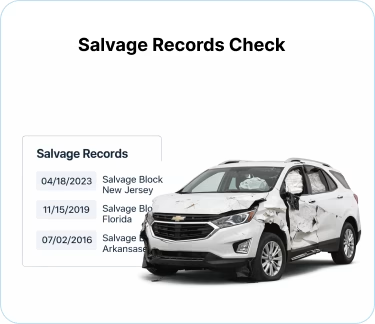
Salvage/Rebuilt
Check
Accident
Check
Theft
Check
Open Lien
Check
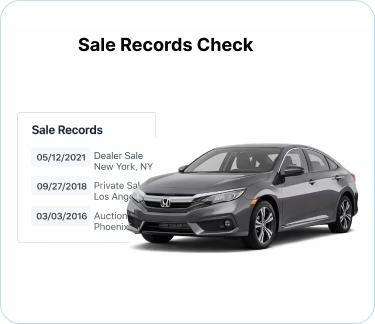
Past Sale
Listings
Safety
Recalls
Odometer
Check
Market Price
Analysis

What Problems Does the 2004 Chevrolet Express Have?

The 2004 Chevrolet Express, despite its robust nature, has several frequently reported problems and long-term reliability concerns that potential owners should be aware of. A common issue revolves around the 4L60E automatic transmission, particularly in the 1500 and 2500 series. While generally durable, it can be prone to premature failure, especially if the vehicle has been regularly used for heavy towing or hauling without adequate maintenance. Symptoms include delayed shifts, slipping, or complete failure. The larger 3500 series often uses the stronger 4L80E transmission, which is less problematic but not immune.

Another pervasive problem involves fuel pump failure. These pumps are located inside the fuel tank and can fail without warning, leading to a no-start condition. The labor involved in replacing a fuel pump on a full-size van can be significant, adding to repair costs.

Intake manifold gasket leaks, especially on the Vortec V8 engines, are also a common complaint. This can lead to coolant loss, engine overheating, or a rough idle. Similarly, ignition switch issues, leading to intermittent power loss or no-start conditions, have been reported across various GM models of this era.

Owners frequently report issues with power window regulators and motors failing over time, requiring replacement. Furthermore, due to its age and construction, rust is a significant concern. It can appear on body panels, fender wells, rocker panels, and even the frame, especially in regions exposed to road salt.

Braking system wear, including rotors and calipers, tends to be accelerated due to the vehicle's weight and potential for heavy loads. Owners should also inspect steering components like tie rods and ball joints, as these can wear out over years of service.

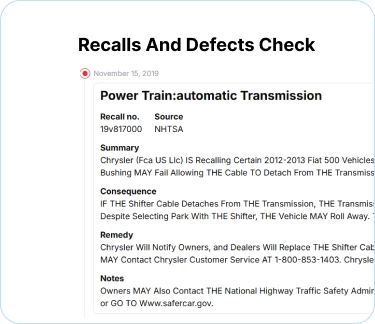
Regarding recalls, for the 2004 model year Express, there were recalls for issues such as the ignition switch (potential for key to move out of the "run" position), which was part of a much larger GM recall campaign. There were also recalls concerning certain passenger sensing systems for the front passenger airbag. Always check the NHTSA website for specific VIN-related recalls. While the platform is generally reliable, these common issues highlight the importance of thorough pre-purchase inspections and diligent maintenance.

How long will the 2004 Chevrolet Express last?

The 2004 Chevrolet Express is renowned for its potential for impressive longevity, often reaching 200,000 to 300,000 miles or more with proper maintenance. Many owners report these vans continuing to perform reliably well into their second decade of service. Key to this durability is the robust V8 engine lineup and a sturdy body-on-frame construction. However, reaching these high mileages depends heavily on consistent maintenance habits, including regular oil changes, transmission fluid flushes, and cooling system care.

Over time, weaknesses tend to emerge in components like the transmission (especially the 4L60E), fuel pump, power steering system, and suspension components (ball joints, tie rods). Rust can also become a significant long-term durability concern, particularly in northern climates. While the core engine and chassis are tough, ancillary parts and electrical systems will likely require attention as the vehicle ages. Investing in preventative maintenance is crucial to maximize its years of service.

What Technology & Safety Features are Included?

The 2004 Chevrolet Express, being a utilitarian vehicle of its era, featured relatively basic built-in technology, entertainment, and safety features compared to modern standards. Its primary focus was on functionality and durability rather than high-tech amenities.

Built-in Tech & Entertainment:
Standard equipment on most models included an AM/FM stereo. An optional upgrade was often an AM/FM stereo with a CD player. Some higher-trim passenger models (LT) might have offered additional speakers. Connectivity options like Bluetooth or auxiliary inputs were non-existent at this time. Power windows and door locks were often optional, especially on cargo van variants, with manual operations being standard for base models. Air conditioning was typically standard on passenger vans and optional on cargo vans. Cruise control was another common option found on both types of vans.

Driver-Assistance Features:
Advanced driver-assistance systems (ADAS) like blind-spot monitoring, lane-keeping assist, or adaptive cruise control were not available on the 2004 Express. The primary "driver assistance" came in the form of power steering and, on some models, rear anti-lock brakes (ABS). Rear parking sensors were not offered.

Safety Features:
Standard safety equipment included dual front airbags for the driver and front passenger. Anti-lock brakes (ABS) were standard on some models, particularly the 2500 and 3500 series, and optional on others. Traction control or electronic stability control systems were not standard and generally not available on this model year. The heavy-duty frame provided inherent structural integrity.

Crash-Test Ratings:
Official comprehensive crash-test ratings for full-size vans of this vintage, especially by organizations like the IIHS (Insurance Institute for Highway Safety), are often limited or not fully comparable to modern passenger vehicles. The NHTSA (National Highway Traffic Safety Administration) may have performed some frontal impact tests, but detailed star ratings across multiple categories were less common for commercial vehicles back then. Generally, these vans relied on their large size and robust construction for occupant protection rather than advanced crumple zones or a plethora of airbags. Always check specific government safety records for any available data.

What Colors Options are Available?

We’re working on this section!
In the meantime, feel free to explore the other sections for more content.

2004 Chevrolet Express Prices and Market Value

When new, the 2004 Chevrolet Express had a varied pricing structure depending on its configuration. A base Cargo Van could start around $20,000 to $23,000, while well-equipped Passenger Vans (LS or LT trims) or heavy-duty 3500 series models with larger engines and options could push the MSRP closer to $30,000 to $35,000.

In today's used market, prices for a 2004 Chevrolet Express vary dramatically. A high-mileage cargo van in fair condition might fetch anywhere from $3,000 to $7,000. Well-maintained passenger vans or those with lower mileage can command $8,000 to $15,000, and custom conversions or exceptionally clean examples might even exceed that.

Depreciation was steep in its early years, typical for commercial vehicles. However, for a 2004 model, significant depreciation has long since occurred. The Express now holds its value relatively well as a used utility vehicle due to its enduring demand for work, conversion, and hauling. Factors affecting resale value include overall condition, mileage, engine type, whether it's a cargo or passenger variant, and regional demand. A clean title and comprehensive maintenance records significantly boost its appeal and value.

2004 Chevrolet Express Cost of Ownership

Owning a 2004 Chevrolet Express entails a mix of economical and potentially costly aspects. Insurance costs are generally moderate, comparable to other large utility vehicles, and can vary based on whether it's registered for personal or commercial use. The biggest ongoing expense is typically fuel, as its V8 engines deliver poor fuel economy (often 10-15 MPG), making it costly to run, especially with rising gas prices.

Maintenance costs for routine items like oil changes, tires, and brakes are relatively low due to widely available and affordable parts. However, repair costs can escalate for major components like transmissions or fuel pumps. While parts are common, the labor involved in accessing some components can be significant. Long-term ownership is economical in terms of parts accessibility and durability of the core components, but the high fuel consumption means it's not an "economical" vehicle in the modern sense. It's a workhorse with workhorse running costs.

2004 Chevrolet Express Fuel Efficiency

Fuel Type Gasoline
Fuel Capacity 31.00 gallons
City Mileage 14 miles/gallon
Highway Mileage 18 miles/gallon

2004 Chevrolet Express Safety Rating

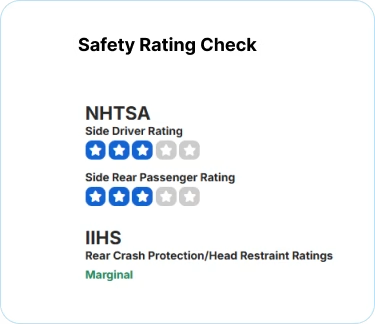
NHTSA
Side Driver Rating
Frontal Passenger Rating
Rollover Rating
Side Rear Passenger Rating
Frontal Driver Rating
IIHS
Rear Crash Protection/Head Restraint Ratings Not Tested
Moderate Overlap Front Test Results Not Tested
Side Impact Test Results Not Tested

2004 Chevrolet Express Warranty

Basic
Original warranty 36 months / 36,000 miles
Estimated remaining Expired
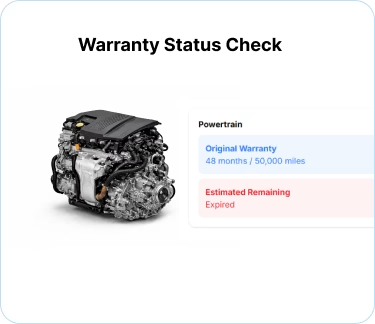
Powertrain
Original warranty 36 months / 36,000 miles
Estimated remaining Expired
Rust
Original warranty 72 months / 100,000 miles
Estimated remaining Expired

2004 Chevrolet Express Insurance

Insurance for a 2004 Chevrolet Express is moderately priced, reflecting its status as a Van with strong safety ratings and
reasonable repair costs.

How Does the 2004 Chevrolet Express Compare to Other Van?

The 2004 Chevrolet Express competes primarily with its long-standing rivals: the Ford E-Series (Econoline) and the GMC Savana (which is mechanically identical to the Express).

In terms of performance, all three offered similar large V8 engine options, providing robust towing and hauling capabilities. The Express and Savana shared GM's Vortec V8s (4.8L, 5.3L, 6.0L), while the E-Series countered with Ford's Triton V8s (4.6L, 5.4L, 6.8L V10). All provided ample power, with marginal differences in raw acceleration, focusing more on torque. Ride quality was similarly truck-like across the board, prioritizing utility over comfort.

Features were also quite comparable – all were designed as utilitarian work vehicles. None offered extensive advanced tech or luxurious interiors. Basic amenities like AM/FM radios, optional CD players, manual or power windows/locks, and air conditioning were common across all three. The passenger versions offered various seating configurations. There was little to differentiate them on advanced features, as that wasn't their market segment.

Reliability is another area where they were closely matched. All three are known for their strong, durable body-on-frame construction and generally reliable powertrains when maintained. Common issues like transmission wear (especially with heavy use), fuel pump failures, and rust were prevalent across the class. The Ford E-Series had its own set of common issues, such as spark plug ejection on some Triton engines, which wasn't an issue for the GM vans. Conversely, GM's 4L60E transmission could be a weak point compared to Ford's offerings.


Regarding price, new and used, the Express, Savana, and E-Series have historically been very competitive. Used market prices today remain similar, heavily influenced by condition, mileage, and specific configuration (cargo vs. passenger, engine size).

Alternatives: For someone seeking a similar workhorse from the same era, the 2004 GMC Savana is an identical twin and an equally good alternative. The 2004 Ford E-Series (Econoline) is also a very strong competitor, offering similar utility and durability with different engine options. The choice often comes down to brand preference, specific engine choices, or finding the best-conditioned example in a desired configuration. For those needing something more modern, newer generation vans like the Ford Transit, Ram ProMaster, or Mercedes-Benz Sprinter offer better fuel economy, more refined rides, and modern features, but at a significantly higher price point, especially if looking at later model years.

Final Verdict: Is the 2004 Chevrolet Express a Good Van?

The 2004 Chevrolet Express is an excellent choice for specific buyers and conditions. It's ideal for tradespeople who need reliable transport for tools and materials, or who require significant towing capacity. It's also perfect for large families on a tight budget seeking maximum passenger capacity, and an outstanding platform for DIY van conversions into campers or mobile workshops due to its vast, open interior and robust chassis.

Is it worth buying? Absolutely, but with caveats. It is definitively a used purchase, as new models are long gone. It's worth buying if you prioritize utility, raw capability, and a low acquisition cost over modern conveniences, fuel efficiency, or a refined ride.

The optimal conditions for purchase involve finding a model with a comprehensive maintenance history, especially regarding transmission service. A pre-purchase inspection by a trusted mechanic is non-negotiable to assess potential rust, engine health, and transmission condition. For heavy-duty use, opt for the 2500 or 3500 series with the 5.3L or 6.0L V8 engine for superior longevity and capability. Avoid examples that show signs of severe neglect or have major structural rust. When properly vetted, the 2004 Express offers exceptional value as a durable, versatile workhorse or family hauler.

2004 Chevrolet Express Owner Reviews

0.00
Consumer Rating, Based on 0 Consumer Reviews
Overall rating
Cancel
Thank You for Your Review!

We truly appreciate the time and effort you took to share your experience with us.

Uh oh!

Something went wrong, please try again later.

Author Image
Eugene S

Eugene is an automotive enthusiast with over 15 years of experience in the used car market. As a writer at VINCheck.info, he brings deep industry insight and a passion for cars, helping readers make smart, informed decisions. Eugene has written hundreds of used car reviews and is known for breaking down complex automotive topics into clear, actionable advice. Over the years, he has driven and worked on a wide range of vehicles—starting with tuning street cars in his early days and eventually focusing on performance upgrades and reliability improvements. Today, he specializes in evaluating used vehicles through the lens of real-world ownership and enthusiast needs. A longtime fan of Porsche, Eugene especially appreciates vehicles that blend durability with driving enjoyment.