
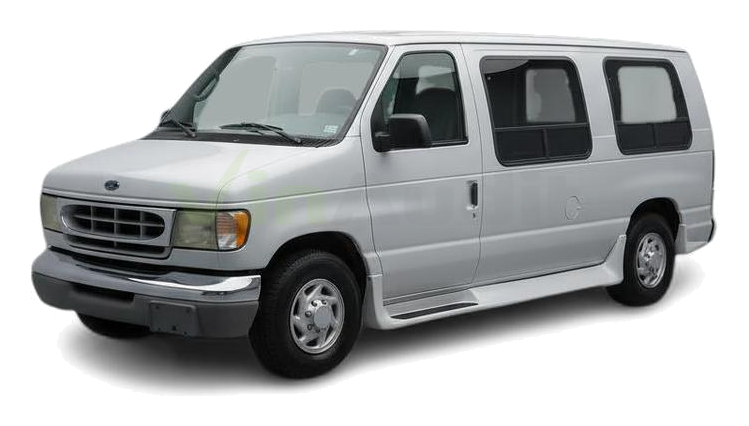
The Good
The 1999 Ford E-150 offers strong performance for its class, renowned reliability that translates to peace of mind, and a surprisingly comfortable ride for passengers. Its practical, utilitarian design maximizes cargo space, while its value proposition remains strong, appealing to both budget-conscious buyers and those seeking a dependable workhorse.
The Bad
Common concerns for the 1999 Ford E-150 include potential transmission issues, particularly with the electronic overdrive, and rust on the frame and body, especially in harsher climates. Fuel economy is a notable drawback for many, and interior materials may show wear over time.
1999 Ford E-150: Quick Overview
- Engine Options: The 1999 Ford E-150 was primarily offered with a choice of V8 engines.
- 4.6L Triton V8
- 5.4L Triton V8
- Horsepower:
- 4.6L Triton V8: Approximately 215 horsepower
- 5.4L Triton V8: Approximately 235 horsepower
- Fuel Economy: Fuel economy varied significantly based on engine, drivetrain (RWD/4WD), and load. Expect around 12-15 MPG in combined city/highway driving for most configurations. Specific EPA estimates are not readily available for this older model year, but real-world results are generally in this range.
- 0-60 Times: Official 0-60 mph times were not typically published for commercial vans. However, loaded E-150s would likely be in the 9-12 second range, depending on the engine and configuration.
- Towing Capacity: Towing capacity was a strong suit for the E-150, depending on the axle ratio and engine. Properly equipped E-150 models could tow upwards of 7,000 to 10,000 pounds.
- Trim-Level Features:
- XL Trim: This was the base model, typically featuring vinyl seating, manual windows and locks, and a basic AM/FM stereo. It focused on utility and durability.
- XLT Trim: The XLT offered more amenities, often including upgraded cloth seats, power windows and locks, cruise control, a cassette player or CD player, and sometimes power mirrors. Optional packages could add features like air conditioning (standard on some configurations), a rear heater, and upgraded interior trim.
- Common Features Across Trims: Standard features generally included power steering, anti-lock brakes (ABS), and driver and passenger airbags. Options could include rear air conditioning, different axle ratios, and various upfits for cargo or passenger configurations.
- XL Trim: This was the base model, typically featuring vinyl seating, manual windows and locks, and a basic AM/FM stereo. It focused on utility and durability.
1999 Ford E-150 Specifications
Vehicle Information
| Year | 1999 |
| Make | Ford |
| Model | E-150 |
| Trim | - |
| Style | - |
| Type | Van |
| Category | Cargo Van |
Manufacturing Details
| Made In | United States |
| Manufacturing City | LORAIN |
Dimensions
| Doors | 3-Door |
| Curb Weight | 4660 pounds |
| Gross Vehicle Weight Rating | 6050 pounds |
| Overall Height | 80.70 inches |
| Overall Length | 211.90 inches |
| Overall Width | 79.30 inches |
| Wheelbase Length | 138.00 inches |
| Standard Seating | 2 |
Engine & Performance
| Engine | 4.6L V8 |
| Engine Size | 4.6L |
| Engine Cylinders | 8 |
| Transmission | 4-Speed Automatic |
| Transmission Type | Automatic |
| Transmission Speeds | 4-Speed |
| Drivetrain | Rear-Wheel Drive |
Additional Features
| Anti-Brake System | 4-Wheel ABS |
| Steering Type | Recirculating |
Pricing
| Manufacturer Suggested Retail Price (MSRP) | $19,705 |
| Invoice Price | $17,239 |
| Delivery Charges | - |
Vehicle History Report
Specifications
History
Events
History Check
Check
Check
Check
Check
Listings
Recalls
Check
Analysis
What Problems Does the 1999 Ford E-150 Have?
Engine-related issues can also arise. While the Triton V8 engines are generally robust, some owners have reported issues like intake manifold leaks, spark plug ejection (though more prevalent in later Triton V8s), and oil leaks. Cooling system components, such as radiators and water pumps, may also need replacement over time. Suspension and steering components, including ball joints, tie rods, and wheel bearings, can wear out, leading to clunking noises, imprecise steering, or uneven tire wear.
Regarding recalls, it's essential to check the National Highway Traffic Safety Administration (NHTSA) database for specific campaigns related to the 1999 E-150. While no major widespread recalls for this specific model year stand out prominently in general discussions, smaller safety-related recalls for components like airbags, brakes, or fuel systems can occur across various model years. For long-term reliability, the E-150's durability is heavily dependent on its maintenance history and how it was used. A well-maintained E-150 can achieve high mileage, but potential buyers should be vigilant about inspecting for rust and signs of transmission trouble. The 1999 model year is part of a generation that, while generally solid, had its share of common wear-and-tear issues.
How long will the 1999 Ford E-150 last?
What Technology & Safety Features are Included?
Entertainment: Standard entertainment was typically limited to an AM/FM radio. Higher trims or optional packages could include a cassette player or a single-disc CD player. Speaker quality was utilitarian, designed for basic audio playback. There were no advanced connectivity options like Bluetooth or USB ports available.
Driver-Assistance Features: Driver-assistance technology was virtually non-existent in the 1999 E-150. Features common today, such as lane departure warnings, adaptive cruise control, or blind-spot monitoring, were not offered. The focus was on mechanical robustness and driver control.
Safety Features: Standard safety features included driver and front-passenger airbags, a crucial safety advancement for the time. Anti-lock brakes (ABS) were also standard, providing improved stopping power and control during emergency braking situations. Seatbelts were provided for all occupants. Some optional safety equipment might have included a limited-slip differential for improved traction.
Optional Features: Beyond entertainment, optional features often focused on comfort and utility. These could include air conditioning (which was a significant comfort upgrade), a rear heater for passenger comfort in colder climates, power windows and locks (more common on XLT trims), cruise control, and various upfitting options for cargo management or passenger seating configurations.
Crash-Test Ratings: Specific crash-test ratings for the 1999 Ford E-150 from organizations like the NHTSA or IIHS are not readily available in the detailed format we see for modern vehicles. However, as a heavy-duty full-size van, its sheer mass provided a degree of passive safety in frontal impacts. The inclusion of airbags and ABS were the primary active safety advancements for this model year. The structural integrity was generally considered robust for its class, though the lack of modern crumple zones and advanced restraint systems means its performance in severe modern crash scenarios would likely be lower compared to contemporary vehicles.
What Colors Options are Available?
1999 Ford E-150 Prices and Market Value
1999 Ford E-150 Cost of Ownership
1999 Ford E-150 Fuel Efficiency
1999 Ford E-150 Safety Rating
NHTSA
IIHS
1999 Ford E-150 Recalls & Defects
Latches/Locks/Linkages:doors:latch
Fuel System, Gasoline:storage:tank Assembly
Equipment Adaptive/Mobility
Vehicle Speed Control
Vehicle Speed Control:cruise Control
Vehicle Speed Control
1999 Ford E-150 Warranty
Basic
Powertrain
Rust
1999 Ford E-150 Insurance
reasonable repair costs.
How Does the 1999 Ford E-150 Compare to Other Van?
Performance: The E-150's available V8 engines provided competitive power and towing capability, often matching or slightly exceeding rivals like the Express/Savana. The Dodge Ram Van was known for its potent V8 options as well. In terms of acceleration and hauling, the E-150 held its own.
Features: By 1999 standards, the E-150 offered a functional interior with available basic amenities like power windows/locks and cruise control. The Chevrolet Express/GMC Savana also offered similar feature sets, often with slightly more modern interior styling. The Dodge Ram Van was generally considered more utilitarian and less refined in its interior features and design.
Reliability: Ford's E-Series has a long-standing reputation for durability, and the 1999 E-150 generally lived up to this. However, all vans of this era could experience transmission issues, and rust was a common enemy. The Chevrolet Express/GMC Savana twins also had a reputation for reliability, though specific engine options sometimes had their own quirks. The Dodge Ram Van, in its later years, was known for being mechanically robust but often lagged in terms of technology and refinement.
Price: The E-150 was competitively priced when new, often offering good value for its capability. Used, the 1999 E-150 is typically found at a similar or slightly lower price point than comparable Chevrolet Express/GMC Savana models, reflecting its market position. The Dodge Ram Van, due to its age and impending discontinuation, might be found at even lower prices.
Recommendations: For those seeking a comparable alternative with potentially slightly more modern styling or features, a 1999-2002 Chevrolet Express or GMC Savana would be a strong contender. They offer similar utility and often come with comparable engine options. If ultimate simplicity and robust mechanicals are the priority and rust is less of a concern, a late-model Dodge Ram Van could be considered, though it's less common to find in good condition. However, if proven longevity and a vast aftermarket support network are key, the 1999 Ford E-150 remains a solid choice within its class.
Final Verdict: Is the 1999 Ford E-150 a Good Van?

Simon A
Simon is a contributor to VinCheck, where he provides articles and reviews on various automotive topics. His work focuses on delivering accurate and up-to-date information about used cars, helping readers make informed decisions.