
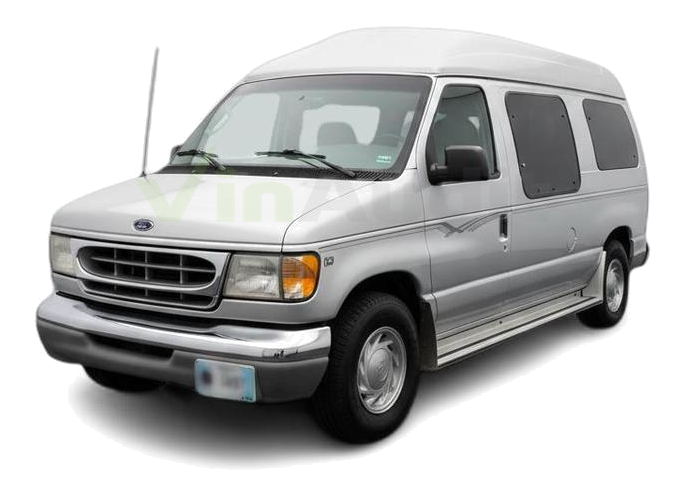
The Good
The 2002 Ford E-150 offers impressive towing and hauling capabilities, coupled with a proven track record of reliability. Its spacious interior provides ample comfort for passengers and cargo, while its durable design ensures longevity. For practical buyers, its value proposition is strong, and for emotional buyers, it evokes a sense of capability and dependable service.
The Bad
Potential buyers of the 2002 Ford E-150 should watch out for common issues such as transmission problems, particularly with the 4R70W. Other concerns include potential rust, especially in the rocker panels and wheel wells, and wear and tear on suspension components due to its heavy-duty nature.
2002 Ford E-150: Quick Overview
- Engine Options: The 2002 Ford E-150 was offered with a range of V8 engines. Standard was typically a 4.2L V6, but more commonly found were the 4.6L Triton V8 and the larger 5.4L Triton V8.
- Horsepower:
- 4.2L V6: Approximately 202 horsepower.
- 4.6L Triton V8: Around 215-225 horsepower.
- 5.4L Triton V8: Approximately 235-260 horsepower. - Fuel Economy: Fuel economy varied significantly with engine choice and whether it was a cargo or passenger van, and rear-wheel drive (RWD) or all-wheel drive (AWD). Expect figures in the range of 10-14 MPG combined for most V8 configurations.
- 0-60 Times: Due to its size and weight, acceleration was not a strong suit. 0-60 mph times typically ranged from 9 to 11 seconds, depending on the engine and load.
- Towing Capacity: Towing capacity was a significant strong point. Depending on the configuration (axle ratio, engine, trailer package), the E-150 could tow upwards of 7,000 to 10,000 pounds.
- Trim-Level Features:
XL: This was the base trim, typically focused on utility. Features included vinyl flooring, manual windows and locks, a basic AM/FM stereo, and a more utilitarian interior. Essential for commercial use.
XLT: This trim offered more comfort and convenience features. It often included cloth seating, power windows and locks, cruise control, a tilt steering wheel, a better stereo system, and sometimes upgraded interior trim. Passenger versions in XLT often had more creature comforts for families.
2002 Ford E-150 Specifications
Vehicle Information
| Year | 2002 |
| Make | Ford |
| Model | E-150 |
| Trim | - |
| Style | - |
| Type | Truck |
| Category | Cargo Van |
Manufacturing Details
| Made In | United States |
| Manufacturing City | LORAIN |
Dimensions
| Doors | 3-Door |
| Curb Weight | 4823 pounds |
| Gross Vehicle Weight Rating | 6700 pounds |
| Overall Height | 80.70 inches |
| Overall Length | 211.90 inches |
| Overall Width | 79.30 inches |
| Wheelbase Length | 138.00 inches |
| Standard Seating | 2 |
Engine & Performance
| Engine | 4.6L V8 |
| Engine Size | 4.6L |
| Engine Cylinders | 8 |
| Transmission | 4-Speed Automatic |
| Transmission Type | Automatic |
| Transmission Speeds | 4-Speed |
| Drivetrain | Rear-Wheel Drive |
Additional Features
| Anti-Brake System | 4-Wheel ABS |
| Steering Type | Recirculating |
Pricing
| Manufacturer Suggested Retail Price (MSRP) | $21,530 |
| Invoice Price | $18,971 |
| Delivery Charges | - |
Vehicle History Report
Specifications
History
Events
History Check
Check
Check
Check
Check
Listings
Recalls
Check
Analysis
What Problems Does the 2002 Ford E-150 Have?
Another area of concern is the cooling system. Radiator leaks, heater core issues, and water pump failures have been noted. Given the age and mileage of many 2002 E-150s, these components may be nearing the end of their service life.
Rust is also a considerable issue, especially in regions with harsh winters and road salt. The rocker panels, wheel wells, and frame are particularly susceptible to corrosion. Thorough inspection for rust is crucial when considering a used E-150.
Electrical gremlins are not uncommon, with issues like faulty fuel pumps, alternator problems, and dashboard warning lights appearing. Some owners have also reported issues with the power steering system, including leaks and noise.
While there might not be specific model-year-wide recalls that stand out dramatically for the 2002 E-150, it's always advisable to check Ford's official recall database for any outstanding safety campaigns. Long-term reliability is often tied to how well the vehicle has been maintained. Neglecting fluid changes, particularly transmission and coolant, can significantly shorten the lifespan of these components and the vehicle as a whole.
How long will the 2002 Ford E-150 last?
Long-term durability is a hallmark of the E-Series platform, known for its robust construction. However, weaknesses emerge over time, primarily related to wear and tear on the transmission, suspension components, and the potential for rust in certain climates. Regular fluid changes, especially for the transmission and coolant, are critical. Addressing minor issues like exhaust leaks or suspension squeaks promptly can prevent more significant and costly problems down the road, contributing to a longer service life.
What Technology & Safety Features are Included?
Technology and Entertainment: Standard features typically included an AM/FM radio with a cassette player. An optional upgrade was a CD player, and for higher trims like the XLT, a more sophisticated audio system might have been available. Basic climate controls were standard, with optional air conditioning in some configurations. Power windows and door locks were often optional on lower trims but standard on the XLT. Cruise control was also an option, enhancing driver comfort on longer journeys.
Driver-Assistance Features: Driver-assistance features were virtually non-existent in the 2002 E-150. Anti-lock Braking System (ABS) was typically standard on all models, a crucial safety feature for its time, aiding in controlled braking during emergency situations. Beyond ABS, electronic stability control or traction control systems were not commonly offered, if at all, on this model year.
Safety Features: Standard safety equipment included front airbags for the driver and passenger. Seatbelts were, of course, standard. The E-150's construction provided a substantial metal cage around occupants.
Crash-Test Ratings: Specific crash-test ratings for the 2002 Ford E-150 from agencies like the NHTSA or IIHS can be difficult to find for this particular model year, as data collection and reporting standards have evolved significantly. However, vans of this type generally performed moderately in frontal impacts due to their size, but side-impact protection could be a weaker point. The heavy-duty nature of the vehicle offered a degree of inherent passive safety due to its mass.
What Colors Options are Available?
2002 Ford E-150 Prices and Market Value
Currently, used market prices for a 2002 Ford E-150 vary widely based on condition, mileage, trim level, and location. Expect to find them ranging from around $2,000 to $7,000 for models in average condition with typical mileage. Pristine examples or specialized configurations might fetch more.
Depreciation on the E-150 has been significant, as is typical for most vans. Its resale value is heavily influenced by its mechanical condition, the presence of rust, and whether it has been maintained regularly. Vans with a clear maintenance history, lower mileage, and in good cosmetic shape will hold their value best. Commercial use can sometimes detract from resale value if the van shows signs of heavy wear and tear.
2002 Ford E-150 Cost of Ownership
2002 Ford E-150 Fuel Efficiency
2002 Ford E-150 Safety Rating
NHTSA
2002 Ford E-150 Recalls & Defects
Vehicle Speed Control
Vehicle Speed Control:cruise Control
Vehicle Speed Control
2002 Ford E-150 Warranty
Basic
Powertrain
Rust
2002 Ford E-150 Insurance
reasonable repair costs.
How Does the 2002 Ford E-150 Compare to Other Truck?
Performance: The E-150, particularly with its optional 5.4L Triton V8, offered strong towing and hauling capabilities, often comparable to or exceeding the Chevrolet/GMC offerings. Dodge's Ram Van also provided capable V8 options. Fuel economy was generally in the same ballpark for all these large vans, with no clear winner in terms of efficiency; they were all thirsty.
Features: Ford's E-Series, especially in the XLT trim, offered a decent array of comfort and convenience features for its time, including available power amenities and better interior trim. The Chevrolet Express and GMC Savana were also competitive, often featuring similar options. The Dodge Ram Van was sometimes seen as more utilitarian in its interior design and feature availability.
Reliability: The Ford E-150 generally enjoyed a reputation for good overall reliability, especially with its powertrains. However, transmission issues (4R70W) were a notable weakness, as were potential rust problems. The Chevy Express/GMC Savana also had their share of reported issues, often related to electrical components and fuel systems. Dodge's Ram Van had its own set of common problems, often concerning suspension and exhaust systems.
Price: Both new and used, the E-150 typically offered competitive pricing, providing good value for its capabilities.
Alternatives:
- Similar: The Chevrolet Express and GMC Savana (1996-2002 models) are very similar in their ruggedness and utility. If you find one in good condition with lower mileage, they are strong contenders.
- Alternative: For those prioritizing a slightly more modern feel and potentially better features in a used van from this era, a later model year E-150 (post-2003 facelift) or even a converted minivan could be considered for passenger duty, though they wouldn't match the raw hauling/towing prowess. For pure commercial use, the E-150 remains a solid, cost-effective choice if well-maintained.
Final Verdict: Is the 2002 Ford E-150 a Good Truck?
It is generally worth buying, but primarily on the used market, given its age. For buyers, a thorough pre-purchase inspection is essential, focusing on transmission health, rust, and overall mechanical condition. The XL and XLT trims offer different levels of utility and comfort, so choose based on your primary need. Avoid examples that show signs of neglect or extensive commercial abuse. If you find a well-maintained E-150, it can still offer significant value and reliable service for many years to come.

Eugene S
Eugene is an automotive enthusiast with over 15 years of experience in the used car market. As a writer at VINCheck.info, he brings deep industry insight and a passion for cars, helping readers make smart, informed decisions. Eugene has written hundreds of used car reviews and is known for breaking down complex automotive topics into clear, actionable advice. Over the years, he has driven and worked on a wide range of vehicles—starting with tuning street cars in his early days and eventually focusing on performance upgrades and reliability improvements. Today, he specializes in evaluating used vehicles through the lens of real-world ownership and enthusiast needs. A longtime fan of Porsche, Eugene especially appreciates vehicles that blend durability with driving enjoyment.