
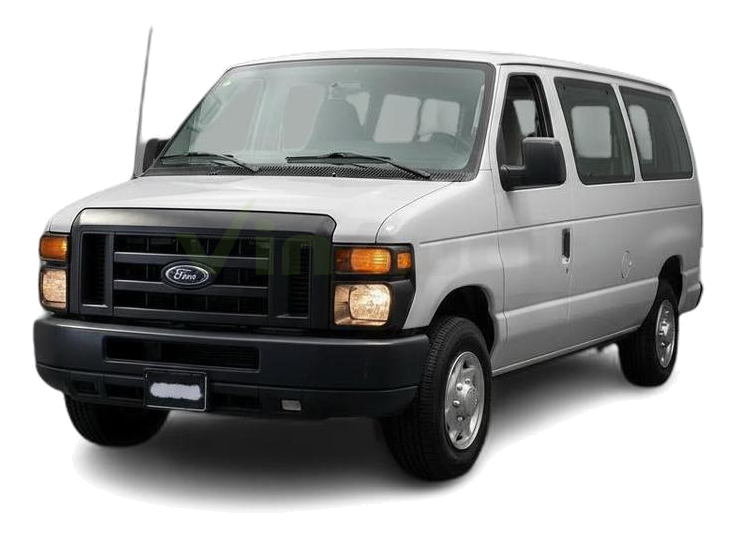
The Good
The 2012 E-150 offers impressive towing and hauling prowess, embodying a trusted workhorse for demanding tasks. Its durable build ensures long-term reliability, while the spacious interior provides surprising comfort for its class. The value proposition is strong, delivering dependable transportation for families and businesses alike.
The Bad
Potential buyers should be aware of its dated interior design and technology compared to modern vehicles. Fuel economy is a significant drawback, and some owners report issues with transmission and brake wear over time, especially with heavy use. Ride quality can be truck-like.
2012 Ford E-150: Quick Overview
- Engine Options: The 2012 Ford E-150 was primarily offered with two V8 engine options:
- 4.6L Triton V8
- 5.4L Triton V8
- Horsepower:
- The 4.6L V8 typically produced around 225-240 horsepower.
- The 5.4L V8 offered approximately 300-310 horsepower.
- The 4.6L V8 typically produced around 225-240 horsepower.
- Fuel Economy:
- Fuel economy was not a strong suit for the E-150, with figures generally ranging from 10-14 MPG city and 14-17 MPG highway, heavily dependent on engine choice and driving conditions.
- 0-60 Times:
- Specific 0-60 times were rarely published for these work-oriented vans. However, with the larger V8, expect acceleration to be in the mid-to-high 7-second range for lighter configurations, and significantly slower for heavily loaded cargo versions.
- Towing Capacity:
- Towing capacity varied greatly based on configuration (GVWR, axle ratio, engine). Properly equipped E-150 models could tow upwards of 10,000 pounds, making it highly capable for substantial loads.
- Trim-Level Features:
- XL Trim: This was the base trim, typically featuring essential amenities for work purposes. It often included vinyl seats, basic interior trim, power windows and locks (on some models), and a simple audio system. Focus was on durability and functionality.
- XLT Trim: The XLT offered more comfort and convenience features. This could include upgraded cloth or vinyl seats, enhanced interior trim, cruise control, a better sound system, and potentially more power accessories. For passenger versions, the XLT often came with more seating rows and amenities for occupants.
- XL Trim: This was the base trim, typically featuring essential amenities for work purposes. It often included vinyl seats, basic interior trim, power windows and locks (on some models), and a simple audio system. Focus was on durability and functionality.
2012 Ford E-150 Specifications
Vehicle Information
| Year | 2012 |
| Make | Ford |
| Model | E-150 |
| Trim | - |
| Style | - |
| Type | Minivan |
| Category | Passenger Van |
Manufacturing Details
| Made In | United States |
| Manufacturing City | AVON LAKE |
Dimensions
| Doors | 3-Door |
| Curb Weight | 5757 pounds |
| Gross Vehicle Weight Rating | 8520 pounds |
| Overall Height | 82.10 inches |
| Overall Length | 216.70 inches |
| Overall Width | 79.40 inches |
| Wheelbase Length | 138.00 inches |
| Standard Seating | 8 |
Engine & Performance
| Engine | 5.4L V8 |
| Engine Size | 5.4L |
| Engine Cylinders | 8 |
| Transmission | 4-Speed Automatic |
| Transmission Type | Automatic |
| Transmission Speeds | 4-Speed |
| Drivetrain | Rear-Wheel Drive |
Additional Features
| Anti-Brake System | 4-Wheel ABS |
| Steering Type | Recirculating |
Pricing
| Manufacturer Suggested Retail Price (MSRP) | $28,760 |
| Invoice Price | $26,554 |
| Delivery Charges | $995 |
Vehicle History Report
Specifications
History
Events
History Check
Check
Check
Check
Check
Listings
Recalls
Check
Analysis
What Problems Does the 2012 Ford E-150 Have?
Another area that sometimes requires attention is the braking system. Reports of premature wear on brake pads and rotors, as well as potential issues with calipers or brake lines, are not uncommon, especially if the van has been used for hauling or towing regularly. The suspension components, such as ball joints and tie rods, can also experience wear over time, leading to clunking noises or steering looseness.
The powertrain control module (PCM) has also been cited in some instances, leading to various drivability issues or check engine lights. Electrical gremlins, though less frequent, can also surface, affecting things like power windows, door locks, or the instrument cluster.
Regarding recalls, it's always advisable to check the National Highway Traffic Safety Administration (NHTSA) database for any specific campaigns related to the 2012 E-150. Ford has issued recalls for various vehicle components over the years, and while many might not apply to this specific year or have been addressed, it's a critical step for any potential buyer. Long-term reliability is generally considered good for the E-150 due to its robust, body-on-frame construction and proven V8 engines, provided it has been maintained diligently. However, neglect or abuse will accelerate wear on these components, leading to more frequent and potentially costly repairs.
How long will the 2012 Ford E-150 last?
What Technology & Safety Features are Included?
Driver-assistance features were minimal in the modern sense. Standard safety equipment included front airbags and anti-lock brakes (ABS). Depending on the configuration and options, some E-150s could be equipped with side-curtain airbags for added occupant protection in passenger versions. Electronic Stability Control (ESC) was generally available, enhancing stability during evasive maneuvers. Rear parking sensors were sometimes offered as an optional feature, particularly on models configured for cargo hauling or with higher trim levels, aiding in low-speed maneuvering.
Crash-test ratings for commercial vans like the E-150 are often evaluated differently than passenger cars. While specific NHTSA or IIHS crash test data for the 2012 E-150 passenger van might be limited, Ford generally aimed to meet or exceed industry safety standards for its vehicles. The robust construction of the E-150 provided a good foundation for occupant protection. However, buyers should consider that the technology and driver aids present in newer vehicles were largely absent, meaning the driver bears more responsibility for situational awareness and accident avoidance. The focus was on fundamental safety systems and structural integrity.
What Colors Options are Available?
2012 Ford E-150 Prices and Market Value
2012 Ford E-150 Cost of Ownership
2012 Ford E-150 Fuel Efficiency
2012 Ford E-150 Safety Rating
NHTSA
IIHS
2012 Ford E-150 Recalls & Defects
Equipment
Fuel System, Other:delivery:hoses, Lines/Piping, and Fittings
Equipment Adaptive/Mobility
Equipment Adaptive/Mobility
Fuel System, Other:delivery:hoses, Lines/Piping, and Fittings
Fuel System, Other:storage
Equipment Adaptive/Mobility
Equipment Adaptive/Mobility
2012 Ford E-150 Warranty
Basic
Powertrain
Rust
2012 Ford E-150 Insurance
reasonable repair costs.
How Does the 2012 Ford E-150 Compare to Other Minivan?
Reliability is a strong suit for the E-150, with its proven mechanicals contributing to a reputation for longevity, often matching or exceeding the Chevrolet offerings. The Ram ProMaster, being a unibody front-wheel-drive design with a more European influence, offered different strengths like maneuverability and fuel efficiency but lacked the rugged, body-on-frame construction of the E-150. Price-wise, the E-150 offered competitive pricing when new, and its used market value is often dictated by its robust nature.
When considering alternatives, the Chevrolet Express and GMC Savana are very similar in concept and capability, offering comparable V8 power and durability. If modern technology, better fuel economy, and a more car-like driving experience are priorities, then the Ram ProMaster (introduced for the 2014 model year) or even a Ford Transit Connect (for smaller cargo needs) might be considered. However, for sheer workhorse capability and proven ruggedness in the 2012 model year, the E-150 remained a very strong contender against its direct rivals.
Final Verdict: Is the 2012 Ford E-150 a Good Minivan?

Drew B
Drew is a seasoned automotive expert and contributor to VinCheck.info. With nearly 15 years of experience as a former Porsche technician, he brings a wealth of hands-on knowledge to his writing. Born in North Carolina, a region renowned for its deep-rooted NASCAR culture, Drew developed a passion for cars early in life, often building and working on vehicles from a young age. At VINCheck, Drew leverages his extensive technical background to provide in-depth analyses of various vehicles. His articles often focus on engine performance, reliability, and maintenance insights, offering readers practical information grounded in real-world experience. Some of his notable contributions include reviews on the Mazda CX-5's longevity and detailed examinations of engine options for models like the 2011 Toyota Camry and Tacoma