
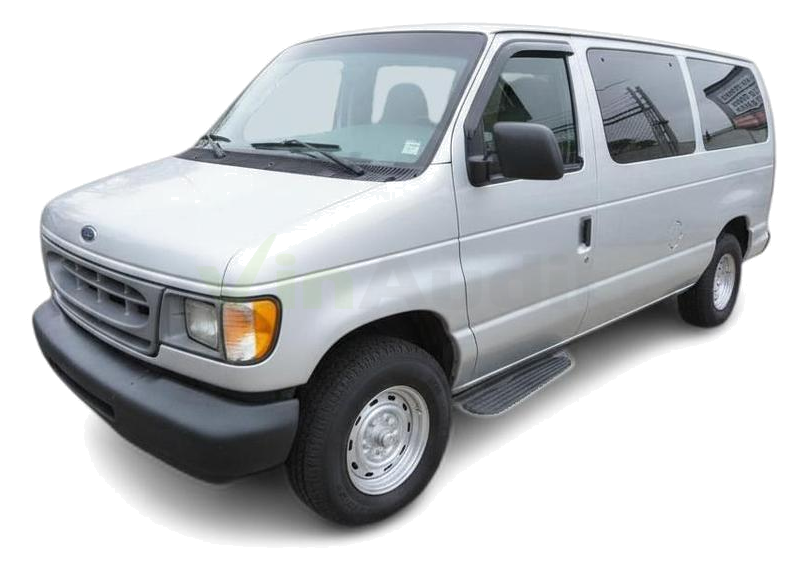
The Good
The 2002 Ford Econoline offers immense practicality with its spacious interior and strong towing/hauling capabilities, appealing to practical buyers needing a reliable work vehicle or large family transporter. Emotionally, its rugged, no-nonsense design and proven V8 power instill confidence. It boasts dependable, easily serviceable components and offers significant value on the used market, despite modest fuel efficiency, making it an economical choice for heavy-duty tasks.
The Bad
Common weaknesses for the 2002 Ford Econoline include notorious spark plug ejection issues in Triton V8 engines, exhaust manifold leaks, and fuel pump failures. Its large size can make parking and maneuvering cumbersome, and fuel economy is notably poor. Interior comfort and technology are basic, reflecting its utility-first design, and suspension components wear over time, affecting ride quality.
2002 Ford Econoline: Quick Overview
Here is a summary of key specifications for the 2002 Ford Econoline:
- Engine Options:
- 4.2L V6: Standard on E-150, offering a balance of power and efficiency for lighter duties.
- 4.6L Triton V8: Available on E-150 and E-250, a popular choice for increased power.
- 5.4L Triton V8: Standard on E-350, optional on E-150/E-250, ideal for heavier loads and towing.
- 7.3L Power Stroke Turbodiesel V8: Available on E-250/E-350, highly sought after for its exceptional torque and durability for severe-duty applications.
- Horsepower:
- 4.2L V6: Approximately 205 hp
- 4.6L V8: Approximately 220 hp
- 5.4L V8: Approximately 255 hp
- 7.3L Power Stroke Diesel: Approximately 215 hp (but with significantly higher torque, around 425 lb-ft)
- Fuel Economy (Estimated City/Highway MPG):
- V6: ~14/19 MPG
- V8 (Gas): ~11/15 MPG
- 7.3L Diesel: ~14/17 MPG (Varies significantly with load and driving conditions)
- 0-60 MPH Times:
- Not a performance vehicle; generally slow. Estimates range from 10-14 seconds depending on engine and configuration. These vehicles are designed for hauling, not acceleration.
- Towing Capacity:
- E-150: Up to ~6,800 lbs
- E-250: Up to ~8,400 lbs
- E-350: Up to ~10,000 lbs (with proper equipment and the 5.4L V8 or 7.3L Diesel)
- Trim-Level Features:
- Econoline (Cargo Van): Basic vinyl interior, AM/FM radio, manual windows/locks. Designed for maximum utility.
- Econoline XL (Passenger Van/Club Wagon): Adds basic seating for 8-15 passengers, cloth upholstery, air conditioning, and possibly power windows/locks.
- Econoline XLT (Passenger Van/Club Wagon): Includes upgraded cloth upholstery, better interior trim, cruise control, power mirrors, alloy wheels, and more convenience features like a CD player.
- Cutaway Chassis: A bare chassis for custom upfitting (e.g., ambulances, box trucks, RVs).
2002 Ford Econoline Specifications
Vehicle Information
| Year | 2002 |
| Make | Ford |
| Model | Econoline |
| Trim | - |
| Style | - |
| Type | Truck |
| Category | Cargo Van |
Manufacturing Details
| Made In | United States |
| Manufacturing City | LORAIN |
Dimensions
| Doors | - |
| Curb Weight | - |
| Gross Vehicle Weight Rating | - |
| Overall Height | - |
| Overall Length | - |
| Overall Width | - |
| Wheelbase Length | - |
| Standard Seating | - |
Engine & Performance
| Engine | 6.8L V10 |
| Engine Size | 6.8L |
| Engine Cylinders | 10 |
| Transmission | - |
| Transmission Type | - |
| Transmission Speeds | - |
| Drivetrain | Rear-Wheel Drive |
Additional Features
| Anti-Brake System | - |
| Steering Type | - |
Pricing
| Manufacturer Suggested Retail Price (MSRP) | - |
| Invoice Price | - |
| Delivery Charges | - |
Vehicle History Report
Specifications
History
Events
History Check
Check
Check
Check
Check
Listings
Recalls
Check
Analysis
What Problems Does the 2002 Ford Econoline Have?
Fuel pump failures are another regular occurrence, typically presenting as stalling or an inability to start, especially when the fuel tank is low. Steering and suspension components, such as ball joints, tie rods, and bushings, are prone to wear and tear due to the vehicle's heavy curb weight and often arduous duty cycles, leading to loose steering or clunking noises. Transmission issues, while not universal, can arise, particularly in vehicles that have seen heavy towing or consistent overloading without proper maintenance.
For the 2002 model year specifically, there were a few recalls. One notable recall involved the speed control deactivation switch, which could corrode and potentially overheat, leading to a fire. This issue affected millions of Ford vehicles across several model years, including the Econoline. Another recall addressed potential issues with certain aftermarket accessories or modifications, though this was less widespread. Owners should always check for open recalls by VIN. While the 7.3L Power Stroke diesel engine is generally celebrated for its longevity, it's not immune to issues; injectors, turbocharger components, and high-pressure oil pump (HPOP) leaks can occur over time. Overall, diligent maintenance is crucial for extending the life of these vans and mitigating these known issues.
How long will the 2002 Ford Econoline last?
What Technology & Safety Features are Included?
Driver-assistance features were virtually non-existent beyond the fundamental power steering and power brakes. There were no integrated navigation systems, backup cameras, parking sensors, or advanced stability control systems like those found in contemporary vehicles. The interior design was utilitarian, prioritizing durability and ease of cleaning over ergonomic sophistication or digital displays.
In terms of safety, the 2002 Econoline came standard with dual front airbags. Anti-lock brakes (ABS) were typically an optional feature on most models or standard on higher trim levels. Side airbags or sophisticated traction/stability control systems were not available. The robust body-on-frame construction offered a degree of passive safety in impacts, but modern crash structures and crumple zones have significantly advanced since then.
Crash test ratings for full-size vans of this vintage are less comprehensive than for passenger cars. The National Highway Traffic Safety Administration (NHTSA) typically conducted front-impact tests. For the 2002 Ford Econoline, NHTSA ratings generally showed:
- Frontal Driver: 4 out of 5 stars
- Frontal Passenger: 3 or 4 out of 5 stars (depending on specific test results and vehicle configuration)
What Colors Options are Available?
2002 Ford Econoline Prices and Market Value
2002 Ford Econoline Cost of Ownership
2002 Ford Econoline Fuel Efficiency
2002 Ford Econoline Safety Rating
NHTSA
2002 Ford Econoline Recalls & Defects
Fuel System, Gasoline:storage
Vehicle Speed Control:cruise Control
Exterior Lighting:headlights
Exterior Lighting
2002 Ford Econoline Warranty
Basic
Powertrain
Rust
2002 Ford Econoline Insurance
reasonable repair costs.
How Does the 2002 Ford Econoline Compare to Other Truck?
Performance: The Econoline offered a strong range of gasoline V8s (4.6L, 5.4L) and, crucially, the highly revered 7.3L Power Stroke diesel. This diesel option gave it a significant advantage in towing and heavy hauling over the GM vans, which offered a 6.5L Detroit Diesel (less popular) and the Dodge, which had no diesel option. Gasoline engine performance was comparable across the board, with each offering a V6 and multiple V8 options.
Features: All three vans were quite basic in terms of features, prioritizing utility. The Econoline's interior was functional but spartan, similar to the Express/Savana. The Dodge Ram Van, while robust, often felt a bit older in its interior design by 2002, nearing the end of its production run. None offered significant "tech" by today's standards; power accessories and basic audio were the extent.
Reliability: The Econoline generally held a reputation for robust durability, particularly with the 7.3L diesel. However, the Triton V8 spark plug issues are a known Achilles' heel. The GM vans (Express/Savana) were also considered very reliable, often praised for their Vortec gasoline engines, which typically didn't suffer from the same spark plug issues. Dodge Ram Vans were mechanically simple but parts availability can be more challenging for older models. In the long run, the 7.3L diesel Econoline arguably offered the best potential for extreme longevity.
Price: New, prices were competitive across the segment. On the used market today, all three offer tremendous value. The 7.3L Power Stroke Econolines hold their value exceptionally well due to demand, often commanding higher prices than comparable gas models or rivals. Chevrolet Express/GMC Savana models are also strong contenders for value, especially gas V8 versions. Dodge Ram Vans are typically the most affordable.
Alternatives: For someone needing serious towing and durability, a 2002 Ford Econoline with the 7.3L Power Stroke diesel is often the preferred choice. If diesel isn't essential, a 2002-2003 Chevrolet Express or GMC Savana with the 5.3L or 6.0L Vortec V8 is an excellent, similarly reliable alternative, often with fewer notorious engine quirks than the Triton V8s. For budget-conscious buyers, a well-maintained gasoline Econoline remains a strong contender, but due diligence on engine history is critical.
Final Verdict: Is the 2002 Ford Econoline a Good Truck?

Eugene S
Eugene is an automotive enthusiast with over 15 years of experience in the used car market. As a writer at VINCheck.info, he brings deep industry insight and a passion for cars, helping readers make smart, informed decisions. Eugene has written hundreds of used car reviews and is known for breaking down complex automotive topics into clear, actionable advice. Over the years, he has driven and worked on a wide range of vehicles—starting with tuning street cars in his early days and eventually focusing on performance upgrades and reliability improvements. Today, he specializes in evaluating used vehicles through the lens of real-world ownership and enthusiast needs. A longtime fan of Porsche, Eugene especially appreciates vehicles that blend durability with driving enjoyment.