
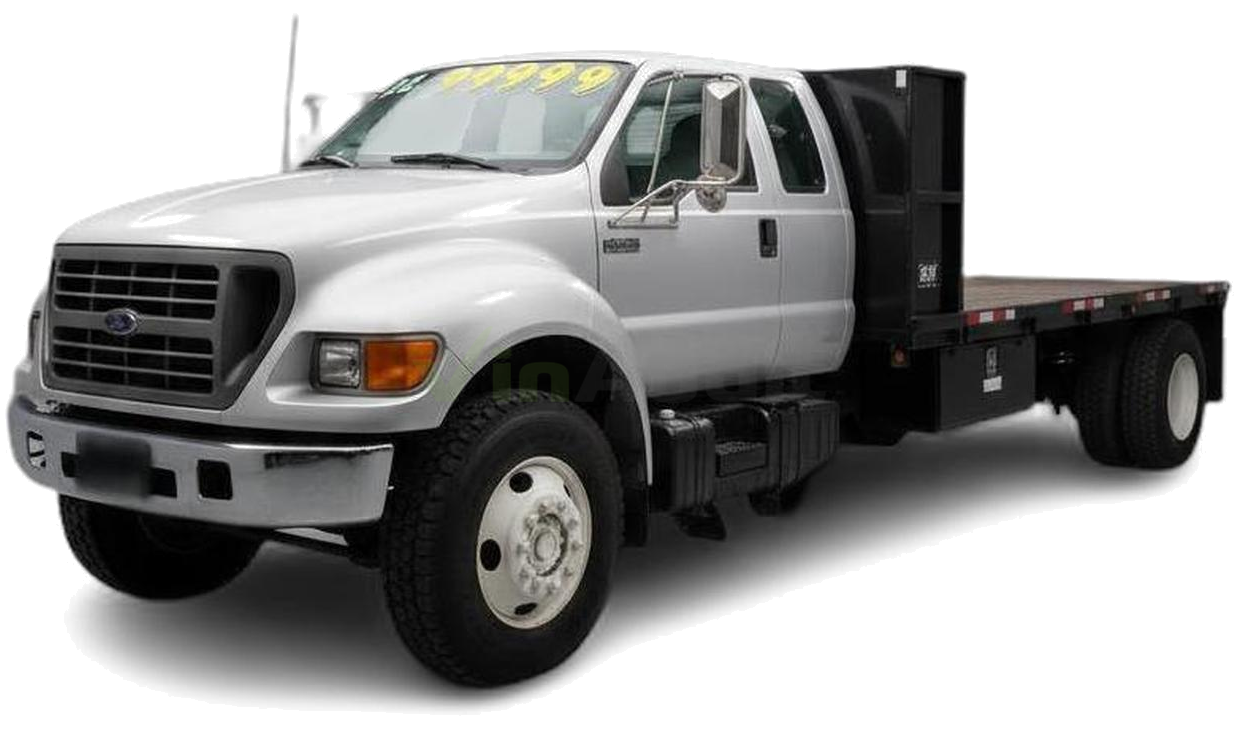
The 2000 Ford F-750 is a heavy-duty commercial truck built for demanding vocational tasks. As part of Ford's Super Duty line, it offered robust capabilities from its inception. Primarily available as a chassis cab, it was designed for customization with various upfits like dump beds, service bodies, and tow trucks. Its model years extend over a significant period, reflecting its enduring design. Key trims often revolved around engine and drivetrain configurations, rather than luxury. New pricing varied widely based on configuration, but its reputation for ruggedness and versatility made it a popular choice for businesses needing a workhorse.
The Good
The 2000 Ford F-750 excels in raw power and unwavering reliability for tough jobs, appealing to practical needs. Its substantial build inspires confidence, while its utilitarian design prioritizes function, offering strong value for businesses demanding a durable, work-ready platform that can tackle heavy loads and extensive use.
The Bad
Potential weaknesses for the 2000 Ford F-750 often relate to its age and heavy-duty nature. Common concerns include wear and tear on transmission and suspension components due to strenuous use, potential for rust in certain climates, and the need for specialized maintenance. Fuel efficiency is also a significant drawback for many operators.
2000 Ford F-750: Quick Overview
- Engine Options: The 2000 Ford F-750 was primarily offered with robust diesel engines. Common options included the 7.3L Power Stroke V8 diesel, known for its torque and durability, and various John Deere or Caterpillar diesel engines depending on specific vocational applications and configurations.
- Horsepower: Horsepower varied significantly based on the specific engine chosen. The 7.3L Power Stroke typically produced in the range of 215-275 horsepower. Other available diesel engines could offer higher outputs, often exceeding 300 horsepower, especially in specialized applications.
- Fuel Economy: Fuel economy is not a strong suit for the F-750. As a heavy-duty commercial vehicle designed for work rather than efficiency, owners could expect single-digit miles per gallon (MPG), often in the 5-9 MPG range, heavily dependent on load, terrain, and driving conditions.
- 0-60 Times: 0-60 mph times are largely irrelevant and not a practical metric for a vehicle of this class. The F-750 is built for pulling and hauling, not acceleration. When loaded, acceleration would be very gradual.
- Towing Capacity: The F-750 boasts substantial towing and hauling capabilities. Gross Vehicle Weight Ratings (GVWR) could range from 26,000 lbs to over 50,000 lbs, depending on the configuration and axle options. This translates to very high towing capacities, often in the tens of thousands of pounds, suitable for large trailers, equipment, and heavy payloads.
- Trim-Level Features: The F-750 was not typically offered in traditional luxury trims. Features were geared towards functionality and operator comfort for long hours. Standard features would include basic instrumentation, manual windows and locks (though power options might be available), durable vinyl or cloth seating, and a robust HVAC system. Optional features might include upgraded radios, air brakes, and various specialized upfitter interfaces. The primary 'trims' were dictated by the powertrain and chassis configuration designed for specific vocational uses.
2000 Ford F-750 Specifications
Vehicle Information
| Year | 2000 |
| Make | Ford |
| Model | F-750 |
| Trim | - |
| Style | Regular Cab 2WD |
| Type | Pickup Truck |
| Category | Heavy Truck |
Manufacturing Details
| Made In | Mexico |
| Manufacturing City | CUAUTITLAN |
Dimensions
| Doors | - |
| Curb Weight | - |
| Gross Vehicle Weight Rating | - |
| Overall Height | - |
| Overall Length | - |
| Overall Width | - |
| Wheelbase Length | - |
| Standard Seating | - |
Engine & Performance
| Engine | 7.2L I6 |
| Engine Size | 7.2L |
| Engine Cylinders | 6 |
| Transmission | w/out Automatic trans. |
| Transmission Type | Automatic |
| Transmission Speeds | - |
| Drivetrain | Rear-Wheel Drive |
Additional Features
| Anti-Brake System | - |
| Steering Type | - |
Pricing
| Manufacturer Suggested Retail Price (MSRP) | - |
| Invoice Price | - |
| Delivery Charges | - |
Vehicle History Report
Vehicle
Specifications
Specifications
Ownership
History
History
All History
Events
Events
NMVTIS Title
History Check
History Check
Salvage/Rebuilt
Check
Check
Accident
Check
Check
Theft
Check
Check
Open Lien
Check
Check
Past Sale
Listings
Listings
Safety
Recalls
Recalls
Odometer
Check
Check
Market Price
Analysis
Analysis
What Problems Does the 2000 Ford F-750 Have?
The 2000 Ford F-750, like many heavy-duty trucks of its era, can encounter specific issues related to its demanding operational environment and age. One of the most frequently reported concerns, particularly with the popular 7.3L Power Stroke diesel engine, involves the **camshaft position sensor** and the **IDM (Ignition Control Module)**. Failures in these components can lead to intermittent starting problems or complete inability to start the engine. Another common area of attention is the **transmission**, especially the automatic units. Heavy use, towing, and inadequate fluid maintenance can accelerate wear on clutches and torque converters, leading to slipping or rough shifting. The **fuel injection system** can also be a point of concern, with potential issues arising from the **HEUI (Hydraulically Actuated Electronic Unit Injection)** system, which can be costly to repair if injectors or the high-pressure oil pump fail. For models equipped with air brakes, **air system leaks** are not uncommon and require regular inspection and maintenance. On the chassis side, **suspension components** such as leaf springs and bushings will naturally wear over time, especially when subjected to heavy loads. **Rust and corrosion** can be significant issues, particularly in regions with harsh winters or coastal environments, affecting frame rails, body panels, and brake lines. While specific recalls for the 2000 model year might be limited, it's crucial to check the National Highway Traffic Safety Administration (NHTSA) database for any outstanding safety recalls pertaining to this vehicle or its specific powertrains. Long-term reliability hinges heavily on consistent and diligent maintenance. Owners who adhere to recommended service intervals for oil changes, fuel filters, and transmission fluid, and who address minor issues promptly, often find the F-750 to be an exceptionally durable vehicle. However, neglected maintenance can quickly turn manageable wear into expensive repairs, impacting its long-term reliability significantly.
How long will the 2000 Ford F-750 last?
The 2000 Ford F-750 is built for longevity, and with proper, consistent maintenance, many of these trucks can easily surpass 250,000 miles, with some reaching well over 500,000 miles in vocational service. The powertrain, particularly the 7.3L Power Stroke diesel, is known for its robust construction. However, the actual lifespan and mileage achieved are highly dependent on the owner's maintenance habits and the severity of the tasks performed. Weaknesses that emerge over time often relate to wear and tear on components like the transmission, suspension, and exhaust systems due to constant heavy use. Regular fluid changes, diligent lubrication, and addressing minor issues promptly are crucial for maximizing its service life and ensuring its long-term durability. Neglect can significantly shorten its useful service life, leading to premature component failures.
What Technology & Safety Features are Included?
The 2000 Ford F-750, being a commercial work truck, prioritized functionality and durability over advanced technology. Built-in tech and entertainment features were generally rudimentary, reflecting its primary purpose. Standard entertainment typically consisted of an AM/FM radio, with optional upgrades sometimes including a CD player. The focus was on essential controls and instrumentation for operating heavy machinery. Driver-assistance features, as we understand them today, were virtually non-existent. Advanced systems like adaptive cruise control, lane departure warning, or blind-spot monitoring were not part of the F-750's offerings. The emphasis was on direct driver control and feedback. Safety features were also basic, focusing on the fundamentals. Standard safety equipment would include seatbelts, heavy-duty brakes (often air brakes on larger configurations), and robust lighting. Optional safety features might include things like a passenger-side mirror for better visibility or more advanced braking systems tailored to specific vocational uses. The F-750 was not subjected to the same type of crash-test ratings as passenger vehicles by organizations like the IIHS or NHTSA. Its robust, heavy-duty construction was designed to withstand significant forces, and its safety was more about its inherent structural integrity and the operational safety protocols surrounding its use in commercial settings, rather than occupant protection in typical collision scenarios. The design philosophy leaned towards creating a vehicle that could withstand challenging conditions and perform its intended tasks reliably and safely within its operational context.
What Colors Options are Available?
2000 Ford F-750 Prices and Market Value
When new, the 2000 Ford F-750's price varied dramatically based on engine, drivetrain, and vocational upfits, with base chassis configurations likely starting in the $50,000-$70,000 range and quickly escalating to well over $100,000 when equipped with specialized bodies and options. Due to its commercial nature and age, depreciation is significant. However, the used market for a 2000 F-750 is more about utility and capability than luxury. Prices currently range widely from $10,000 to $30,000+ for well-maintained or particularly well-equipped examples. Resale value is heavily influenced by overall condition, mileage, the type and quality of the upfit (e.g., a well-maintained dump body or service truck), maintenance history, and the presence of desirable engine options. Trucks with fewer miles and in excellent mechanical and cosmetic condition will command higher prices.
2000 Ford F-750 Cost of Ownership
Owning a 2000 Ford F-750 is generally costly, especially for individual operators or small businesses. Insurance premiums will be higher than for light-duty vehicles due to its classification and potential for extensive damage. Fuel costs are substantial, with its powerful diesel engine consuming significant amounts of fuel, often in the single digits MPG. Maintenance and repair costs can be high; while the truck is durable, parts for heavy-duty components can be expensive, and specialized diesel mechanics are often required. Routine maintenance, while necessary for longevity, adds to the overall expense. It is not an economical vehicle to own, but its value is derived from its work capacity and durability.
2000 Ford F-750 Fuel Efficiency
Fuel Type
Diesel
Fuel Capacity
-
City Mileage
-
Highway Mileage
-
2000 Ford F-750 Recalls & Defects
Parking Brake
Recall date
1999-09-27
Recall no.
99v267000
Source
NHTSA
Summary
Vehicle Description: Medium Duty Trucks Equipped With Hydromax Hydraulic Brake Systems. THE Park Brake Warning Lamp Circuitry Does NOT Include A Provision FOR A Park Brake Warning Lamp Check Function. Therefore, These Vehicles DO NOT Comply With THE Requirements OF Fmvss NO. 105, "hydraulic Brake Systems."
Consequence
THE Check Lamp Function OF THE Park Brake Warning Lamp IS Intended TO Illuminate THE Lamp When THE Igntion KEY IS Turned TO THE RUN Position. THE Park Brake Warning Lamp Check Function WAS NOT Incorporated Into THE Module Which Controls This Feature.
Remedy
Dealers Will Install A Revised Module Which Incorporates THE Park Brake Check Lamp Function.
Notes
Owner Notification IS Expected TO Begin During November 1999.owners WHO Take Their Vehicles TO AN Authorized Dealer ON AN Agreed Upon Service Date and DO NOT Receive THE Free Remedy Within A Reasonable Time Should Contact Ford AT 1-800-392-3673. Also Contact THE National Highway Traffic Safety Administration's Auto Safety Hotline AT 1-888-dash-2-dot (1-888-327-4236).
Power Train:automatic Transmission
Recall date
2000-08-18
Recall no.
00v229002
Source
NHTSA
Summary
Trucks Equipped With Allison 1000 or 2400 Series Transmissions. These Transmissions CAN Experience Park Pawl TO Rear Cover Interference DUE TO AN OUT OF Flatness Condition.
Consequence
This Could Cause Non-Engagement OF THE Park Pawl When THE Transmission Shift Selector IS Moved TO THE Park Position, Resulting IN Unintended Vehicle Movement and A Vehicle Crash Without Prior Warning.
Remedy
Allison Transmission IS Conducting THE Owner Notification and Remedy FOR This Campaign. Dealers Will Remove THE Transmission From THE Vehicle, Replace THE Park Pawl, and Reinstall THE Transmission IN THE Vehicle. Owner Notification IS Expected TO Begin During September 2000. Owners WHO Take Their Vehicles TO AN Authorized Dealer ON AN Agreed Upon Service Date and DO NOT Receive THE Free Remedy Within A Reasonable Time Should Contact Allison AT 1-800-252-5283 or Ford AT 1-800-392-3673.
Notes
Also Contact THE National Highway Traffic Safety Administration's Auto Safety Hotline AT 1-888-Dash-2-dot (1-888-327-4236).
Service Brakes, Air:antilock
Recall date
2000-09-21
Recall no.
00v232007
Source
NHTSA
Summary
Vehicle Description: Heavy Duty Trucks Built With Bendix AIR ABS With AN Ec-17 1030r Electronic Control Unit (Ecu), There Have Been Reports OF Unwanted ABS Activation AT Low Speeds Caused BY 1) Chafed ABS Wheel Speed Sensor Wires ON Rotating Parts or 2) A Damaged Component AT THE Wheel END That Generates A Certain Type OF Erratic Sensor Signal.
Consequence
This Condition Could Cause THE ABS ECU TO Exhaust THE AIR AT THE AIR Brake Modulators FOR ONE or More OF THE Wheels. This Could Result IN Extended Braking Distances and A Possible Crash.
Remedy
Dealers Will Replace THE ABS Ecu. Owner Notification Began March 20, 2001. Owners WHO Take Their Vehicles TO AN Authorized Dealer ON AN Agreed Upon Service Date and DO NOT Receive THE Free Remedy Within A Reasonable Time Should Contact Ford AT 1-800-392-3673.
Notes
Also Contact THE National Highway Traffic Safety Administration's Auto Safety Hotline AT 1-888-Dash-2-dot (1-888-327-4236).
Visibility:windshield Wiper/Washer:motor
Recall date
2001-08-08
Recall no.
01v258000
Source
NHTSA
Summary
Vehicle Description: Passenger Cars, Sport Utility Vehicles, and Light and Medium Duty Pickup Trucks. A Switch Located IN THE Plastic Cover OF THE Wiper Motor Gear Case Could Malfunction and Overheat, Potentially Resulting IN Loss OF Intermittent Wiper Function, Loss OF Wiper Park Function, Complete Loss OF Wiper Function, or Ignition OF THE Plastic Cover Material. Switch Malfunction IS Most Likely TO Occur When THE Intermittent Setting OF THE Wipers IS Being Used, or When Snow or ICE Obstructs THE Blades From Returning TO THE "parked" Position AT THE Bottom OF THE Windshield. These Vehicles Were Built AT THE Following Assembly Plants: Atlanta Plant From 2/11/00 Through 7/31/00; Chicago Plant From 2/14/00 Through 8/4/00; Kansas City Plant From 2/26/00 TO 9/4/00; Kentucky Truck Plant From 2/18/00 TO 8/31/00; Michigan Truck Plant From 2/23/00 Through 8/3/00; Norfolk Plant From 2/21/00 Through 7/27/00; Wayne Stamping and Assembly Plant From 2/25/00 Through 8/15/00; and Wixom Plant From 2/15/00 Through 8/8/00.
Consequence
Loss OF Visibility While Driving Increases THE Risk OF A Crash.
Remedy
Dealers Will Inspect THE Date Code ON THE Wiper Motor. Motors Built With THE Suspect Time Frame Will Have THE Wiper Motor Gear Case Cover Replaced. Owner Notification Began August 20, 2001. Owners WHO Take Their Vehicles TO AN Authorized Dealer ON AN Agreed Upon Service Date and DO NOT Receive THE Free Remedy Within A Reasonable Time Should Contact Ford AT 1-866-436-7332.
Notes
Also Contact THE National Highway Traffic Safety Administration's Auto Safety Hotline AT 1-888-Dash-2-dot (1-888-327-4236).
Steering:linkages:drag:link:connection
Recall date
2001-05-11
Recall no.
01v044011
Source
NHTSA
Summary
Vehicle Description: Trucks Equipped With Drag Link Assemblies Containing 24-Dl Model Ball Sockets and Manufactured BY Trw. Certain OF THE TIE ROD Ball-Socket Bearings Have A Below-specification Case Depth And/Or Hardness, Which CAN Lead TO Premature Wear OF THE Socket.
Consequence
IF This Condition Occurs, THE Driver CAN Lose Partial Control OF THE Right Front Wheel, Possibly Resulting IN A Crash.
Remedy
Dealers Will Replace THE Defective Drag Links. Owner Notification Began June 12, 2001. Owners WHO Take Their Vehicles TO AN Authorized Dealer ON AN Agreed Upon Service Date and DO NOT Receive THE Free Remedy Within A Reasonable Time Should Contact Ford AT 1-800-392-3673 or TRW Customer Service AT 1-866-280-3287.
Notes
Also Contact THE National Highway Traffic Safety Administration's Auto Safety Hotline AT 1-888-Dash-2-dot (1-888-327-4236).
Service Brakes, Air:supply:hoses, Lines/Piping, and Fittings
Recall date
2002-01-18
Recall no.
02v024000
Source
NHTSA
Summary
Certain Medium Duty Pickup Trucks Equipped With AIR Brakes That Include THE Optional Trailer Package Fail TO Comply With THE Requirements OF Fmvss NO. 121, "air Brake Systems." THE AIR Brake Lines Connected TO THE Tractor Protection Valve ARE Misrouted.
Consequence
A Leak IN THE Primary AIR Circuit or Secondary AIR Circuit Could Result IN A Reduction or Loss OF THE Trailer Brake Effectiveness, Increasing THE Risk OF A Crash.
Remedy
Dealers Will Re-Route THE AIR Lines Connected TO THE Tractor Protection Valve. Owner Notification Began January 31, 2002. Owners WHO DO NOT Receive THE Free Remedy Within A Reasonable Time Should Contact Ford AT 1-800-248-0186.
Notes
Also Contact THE National Highway Traffic Safety Administration's Auto Safety Hotline AT 1-888-Dash-2-dot (1-888-327-4236).
2000 Ford F-750 Warranty
Basic
Original warranty
0 months / No data
Estimated remaining
Expired
Powertrain
Original warranty
0 months / No data
Estimated remaining
Expired
Rust
Original warranty
0 months / No data
Estimated remaining
Expired
2000 Ford F-750 Insurance
Insurance for a 2000 Ford F-750 is moderately priced, reflecting its status as a Pickup Truck with strong safety ratings and
reasonable repair costs.
How Does the 2000 Ford F-750 Compare to Other Pickup Truck?
The 2000 Ford F-750 competes in the heavy-duty commercial truck segment against formidable rivals such as the Freightliner M2 series, International 4300/7000 series, and Chevrolet Kodiak/GMC Topkick. In terms of raw performance and capability, the F-750 generally holds its own, particularly with the robust 7.3L Power Stroke diesel engine, offering comparable torque and hauling power to its contemporaries. Reliability is a strong point for the F-750, especially the Power Stroke variants, which are renowned for their durability when properly maintained, often rivaling or exceeding the reliability of some competitors, though specific powertrain choices within each brand can vary significantly. Features on the F-750 are utilitarian, focusing on functionality rather than creature comforts or advanced technology, which is typical for this class. Rivals might offer slightly more refined interiors or a broader range of optional comfort features, but the F-750's purpose-built design often excels in basic operator ergonomics. Price-wise, the F-750 was competitively positioned when new and continues to offer strong value on the used market, often being more accessible than some European-built competitors. Alternatives such as the Freightliner M2 offer a more modern platform with potentially better fuel efficiency and a wider array of advanced options, but often at a higher initial cost and potentially more complex maintenance. International trucks are also strong contenders, known for their robust diesel powertrains. For those seeking a similar level of robust performance and durability with potentially newer technology, a slightly later model year F-750, or a comparable International or Freightliner, might be considered, but for a proven, workhorse chassis from the turn of the millennium, the 2000 F-750 remains a solid and often more budget-friendly choice for vocational needs.
Final Verdict: Is the 2000 Ford F-750 a Good Pickup Truck?

The 2000 Ford F-750 is ideal for small to medium businesses, municipalities, and individuals requiring a dependable, no-frills workhorse for demanding tasks like towing, hauling, or as a base for specialized vocational upfits (e.g., dump truck, service truck, tow truck). It is worth buying primarily on the used market, as new models are no longer produced. Buyers should prioritize well-maintained examples, ideally with documented service history, and focus on specific engine configurations like the 7.3L Power Stroke for proven reliability. It's crucial to factor in potential repair costs for aging components. While not economical for daily personal use, its value for commercial purposes is undeniable if acquired at a reasonable price and maintained diligently.