
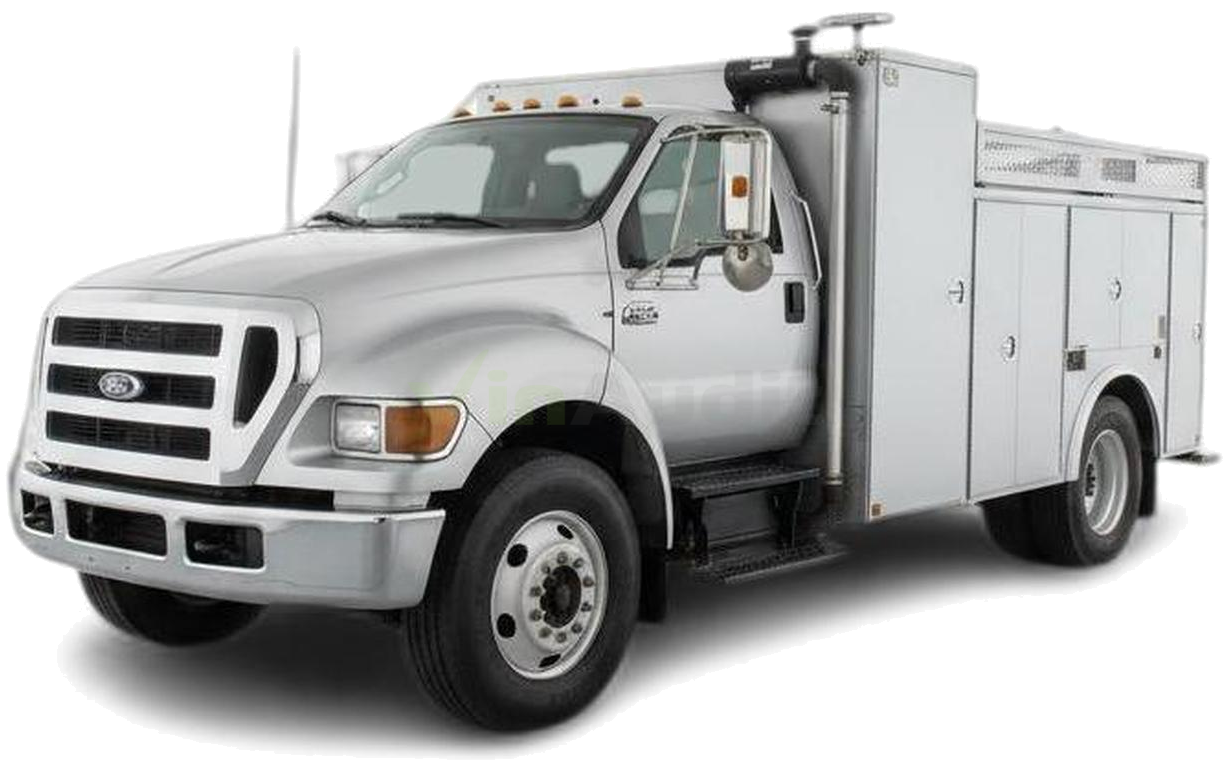
The Good
The 2004 Ford F-750 excels in raw power and unwavering reliability for heavy-duty work. Its robust design inspires confidence, while its straightforward functionality offers practical value for businesses. For the owner-operator, it represents a dependable partner capable of tackling any challenge, fostering a sense of accomplishment and security.
The Bad
Potential buyers should be aware of the F-750's inherent thirst for fuel due to its powerful engines and substantial size. Interior amenities might be basic compared to modern trucks, and maintenance can be more specialized and costly. Rust in chassis components and exhaust systems can also be an issue in certain climates.
2004 Ford F-750: Quick Overview
- Engine Options: The 2004 Ford F-750 was offered with a selection of robust diesel engines, catering to heavy-duty applications.
- Power Stroke 7.3L V8 Turbo Diesel: This was a common and highly regarded engine option.
- Horsepower: Typically ranged from 215 to 275 horsepower, depending on the specific tuning and application.
- Torque: Significant torque output, crucial for towing and hauling, often exceeding 500 lb-ft.
- Horsepower: Typically ranged from 215 to 275 horsepower, depending on the specific tuning and application.
- Cummins 5.9L ISB Inline-6 Turbo Diesel: Another popular choice known for its durability and performance.
- Horsepower: Varied, generally in a similar range to the Power Stroke, often around 215 to 275 horsepower.
- Torque: Strong torque figures, vital for its intended purpose.
- Horsepower: Varied, generally in a similar range to the Power Stroke, often around 215 to 275 horsepower.
- Caterpillar C7 ACERT Inline-6 Turbo Diesel: For the most demanding applications.
- Horsepower: Capable of higher outputs, potentially ranging from 300 to 330 horsepower.
- Torque: Very high torque ratings, designed for extreme hauling.
- Horsepower: Capable of higher outputs, potentially ranging from 300 to 330 horsepower.
- Power Stroke 7.3L V8 Turbo Diesel: This was a common and highly regarded engine option.
- Fuel Economy: Not a primary concern for this class of vehicle. Expect very low MPG figures, typically in the single digits (e.g., 5-10 MPG), highly dependent on load, terrain, and driving style.
- 0-60 Times: Inapplicable for this vehicle class. These trucks are not designed for acceleration testing but for work and load capacity.
- Towing and Hauling Capacity: This is where the F-750 shines. It is built for extreme loads.
- Gross Vehicle Weight Rating (GVWR): Ranges typically from 26,000 lbs to 37,000 lbs, depending on configuration.
- Towing Capacity: Varies significantly based on the chassis, axle ratings, and any trailer brakes. Can tow well over 20,000 lbs, often much more, with appropriate fifth-wheel or gooseneck setups.
- Payload Capacity: Extremely high, designed to carry substantial weight in the bed or on the chassis.
- Gross Vehicle Weight Rating (GVWR): Ranges typically from 26,000 lbs to 37,000 lbs, depending on configuration.
- Trim-Level Features: The concept of traditional trim levels (like XL, XLT, Lariat) is less applicable to commercial trucks. The F-750 is primarily a chassis cab, and features are dictated by the intended upfit and optional packages. Standard features would include robust construction, heavy-duty axles, commercial-grade suspension, and basic driver controls. Optional features could encompass air brakes, upgraded instrument clusters, limited comfort options like air conditioning, and power steering. The focus is on functionality and durability rather than luxury.
2004 Ford F-750 Specifications
Vehicle Information
| Year | 2004 |
| Make | Ford |
| Model | F-750 |
| Trim | - |
| Style | 2WD |
| Type | Pickup Truck |
| Category | Medium Truck |
Manufacturing Details
| Made In | Mexico |
| Manufacturing City | - |
Dimensions
| Doors | 4-Door |
| Curb Weight | - |
| Gross Vehicle Weight Rating | - |
| Overall Height | - |
| Overall Length | - |
| Overall Width | - |
| Wheelbase Length | - |
| Standard Seating | - |
Engine & Performance
| Engine | 7.2L I6 |
| Engine Size | 7.2L |
| Engine Cylinders | 6 |
| Transmission | - |
| Transmission Type | - |
| Transmission Speeds | - |
| Drivetrain | Rear-Wheel Drive |
Additional Features
| Anti-Brake System | - |
| Steering Type | - |
Pricing
| Manufacturer Suggested Retail Price (MSRP) | - |
| Invoice Price | - |
| Delivery Charges | - |
Vehicle History Report
Specifications
History
Events
History Check
Check
Check
Check
Check
Listings
Recalls
Check
Analysis
What Problems Does the 2004 Ford F-750 Have?
For transmissions, the heavy-duty automatic and manual transmissions can experience wear over time. Issues might include hard shifting, slipping gears, or hydraulic problems. Regular fluid changes are critical for longevity. The exhaust system, especially the catalytic converter and DPF (Diesel Particulate Filter) if equipped with later emission systems, can become clogged or fail.
On the chassis and suspension side, rust is a significant concern, particularly in areas with heavy road salt usage. Frame corrosion, brake line degradation, and suspension component wear (like leaf springs and bushings) can all lead to costly repairs. Electrical gremlins, though less frequent than mechanical issues, can manifest as intermittent gauge failures, lighting problems, or issues with the starter and alternator.
Recalls for the 2004 F-750 model year would typically be focused on safety-related components. Specific recalls would need to be checked against the vehicle's VIN. Long-term reliability hinges heavily on how the truck was used and maintained. A truck that has been constantly overloaded or neglected in terms of preventative maintenance will likely encounter more problems sooner than one that has been treated with care. Regular oil changes with the correct diesel-specific oil, fuel filter replacements, and proper cooling system maintenance are paramount for maximizing the lifespan of the engine and other critical components.
How long will the 2004 Ford F-750 last?
What Technology & Safety Features are Included?
Driver-assistance features are virtually non-existent by today's standards. Systems like cruise control might have been available as an option, but advanced aids such as lane departure warning, blind-spot monitoring, or adaptive cruise control were not offered. The primary focus for driver assistance was on the robust braking system (often air brakes on higher GVWR models) and responsive steering for its size.
Safety features are more utilitarian. The F-750 would have basic safety equipment like seatbelts and a sturdy frame designed to withstand significant forces. Depending on the specific configuration and GVWR, anti-lock braking systems (ABS) would have been standard or optional for improved stopping control, especially under load. Airbags were typically driver and passenger side.
Crash-test ratings for commercial trucks like the F-750 are not typically conducted or published by organizations like the NHTSA or IIHS in the same manner as passenger vehicles. The design intent is to withstand the rigors of commercial use and to protect occupants in the event of an accident, but formal crash test scores are not readily available. The sheer mass and robust construction of the F-750 inherently provide a significant level of passive safety.
What Colors Options are Available?
2004 Ford F-750 Prices and Market Value
On the used market, a 2004 Ford F-750 can be found for prices ranging widely from $10,000 to $30,000 or more, heavily influenced by mileage, condition, engine type, and the quality of its vocational body or equipment. Trucks in excellent condition with lower mileage and desirable powertrains will command higher prices. Depreciation is relatively moderate for work trucks compared to personal vehicles, as their utility and durability contribute to sustained value. Factors affecting resale value include the overall condition of the chassis, engine and transmission health, presence of rust, and the functionality and desirability of any mounted equipment.
2004 Ford F-750 Cost of Ownership
2004 Ford F-750 Fuel Efficiency
2004 Ford F-750 Recalls & Defects
Equipment:other:labels
Service Brakes, AIR
2004 Ford F-750 Warranty
Basic
Powertrain
Rust
2004 Ford F-750 Insurance
reasonable repair costs.
How Does the 2004 Ford F-750 Compare to Other Pickup Truck?
Features on the 2004 F-750 are utilitarian. It focuses on core functionality and durability rather than creature comforts or advanced technology. Competitors like Freightliner and International might offer slightly more refined interiors or a broader range of factory options for specific vocational needs, though the F-750's chassis provides a highly adaptable platform. Price-wise, the F-750 typically presented a competitive value proposition, offering robust Ford engineering at a price point that was often attractive to businesses looking for a workhorse without the premium cost of some European or highly specialized manufacturers.
Alternatives:
- Freightliner M2 Business Class: Often considered a benchmark, offering excellent visibility, a comfortable cab for its class, and a wide array of configurations. Performance and reliability are comparable, with a strong dealer network.
- International 4300/Durastar: Known for their strong diesel engines and durable construction. They often provided a good balance of performance and cost-effectiveness.
- Peterbilt 330/335: While typically positioned slightly higher in the market, these offer exceptional build quality and durability, though at a potentially higher price point.
Final Verdict: Is the 2004 Ford F-750 a Good Pickup Truck?
When considering a purchase, buying used is the only realistic option. Focus on models with well-maintained diesel engines (7.3L Power Stroke or Cummins 5.9L are preferred), and meticulously inspect the chassis for rust and structural integrity. A truck that has been regularly serviced and has a documented maintenance history will offer better long-term value. Avoid trucks that appear neglected or have excessive mileage without evidence of proper upkeep. Specific trims are less relevant than the engine, transmission, and overall condition of the chassis and any mounted equipment.

Simon A
Simon is a contributor to VinCheck, where he provides articles and reviews on various automotive topics. His work focuses on delivering accurate and up-to-date information about used cars, helping readers make informed decisions.