by VIN, Year, Make, Model by License Plate

1986 Honda Civic Overview, Reviews, Ratings & Specs

Rating: 0.00
Based on 0 Owner Reviews
Drew B | October 30, 2025
The 1986 Honda Civic belongs to the third generation (1983-1987), a pivotal era for Honda's compact car. Available as a 3-door hatchback, 4-door sedan, 4-door wagon (Wagovan/Shuttle), and the sporty CRX 2-door coupe, it offered versatility. Key trims included DX, S, and the performance-oriented Si. New pricing ranged roughly from $6,000 to $10,000. It stood out for its exceptional fuel efficiency, surprising reliability, and nimble handling, making it a beloved choice for economical transportation with a touch of fun.
The Good

The 1986 Civic boasts legendary reliability and exceptional fuel efficiency, appealing to practical buyers seeking low running costs. Its compact design and spirited performance, especially in Si trim, offer an engaging driving experience for emotional buyers. Comfortable for its class, it provides great value, blending practicality with a "fun-to-drive" factor that few rivals matched.

The Bad

Key weaknesses for the 1986 Civic include susceptibility to rust, particularly in wheel wells, rocker panels, and around windows. Carburetor issues can plague non-Si models. Basic interior materials show wear quickly, and finding rust-free examples or those without electrical gremlins can be challenging. Old rubber seals and suspension components often require attention.

1986 Honda Civic: Quick Overview

  • Engine Options:
    • 1.3L SOHC 8-valve inline-4 (EV series): Primarily for earlier models or base trims, typically carbureted.
    • 1.5L SOHC 12-valve inline-4 (EW1/EW3/EW4 series): The most common engine, also typically carbureted in DX/S trims. The EW4 found in the Si models featured multi-point fuel injection, a significant upgrade.
  • Horsepower:
    • 1.3L: Approximately 60-65 hp.
    • 1.5L (carbureted): Around 76 hp.
    • 1.5L Si (fuel-injected EW4): Approximately 91 hp.
  • Fuel Economy (EPA estimates, highly variable by engine/transmission):
    • Expect combined figures generally in the high 20s to low 40s MPG. For instance, an Si model might achieve around 28-32 MPG combined, while a base manual could hit 35-40+ MPG. CRX HF models pushed this even further, sometimes exceeding 50 MPG highway.
  • 0-60 mph Times:
    • Base models (1.3L/1.5L carbureted): Generally in the 10-12 second range.
    • Si models (1.5L fuel-injected): Closer to 9 seconds, making them quite peppy for their time.
  • Towing Capacity:
    • Not officially rated for significant towing in the U.S. market. While small utility trailers might be technically feasible, it's not a recommended application due to the vehicle's lightweight construction and powertrain design.
  • Trim-Level Features:
    • Base: Very spartan, manual steering, minimal amenities, often 1.3L or base 1.5L engine.
    • DX: Added comforts like a rear wiper, better upholstery, maybe a clock, and typically the 1.5L engine.
    • S: Sportier suspension tuning, perhaps a tachometer, body-colored bumpers, often manual transmission only, more supportive seats.
    • Si: Top-tier performance trim. Featured the 91 hp fuel-injected 1.5L engine, sport-tuned suspension, alloy wheels, more aggressive styling cues, front and rear anti-roll bars, power steering (optional), and improved interior seating with bolsters. The CRX Si was particularly notable for its lightweight and agile handling.
    • Wagovan/Shuttle: Unique tall-roof wagon body style, often available in DX or S trims, emphasizing practicality and cargo space. Some later wagons featured Real Time 4WD, though this was more prevalent in later model years of the generation.

1986 Honda Civic Specifications

Vehicle Information
Year 1986
Make Honda
Model Civic
Trim -
Style 4-Door Sedan
Type Sedan
Category Compact Car
Manufacturing Details
Made In United States
Manufacturing City MARYVILLE
Dimensions
Doors 4-Door
Curb Weight -
Gross Vehicle Weight Rating -
Overall Height -
Overall Length -
Overall Width -
Wheelbase Length -
Standard Seating -
Engine & Performance
Engine 1.5-L L-4 SOHC 16V
Engine Size 1.5L
Engine Cylinders 4
Transmission 4-Speed Automatic
Transmission Type Automatic
Transmission Speeds 4-Speed
Drivetrain Front-Wheel Drive
Additional Features
Anti-Brake System -
Steering Type -
Pricing
Manufacturer Suggested Retail Price (MSRP) -
Invoice Price -
Delivery Charges -

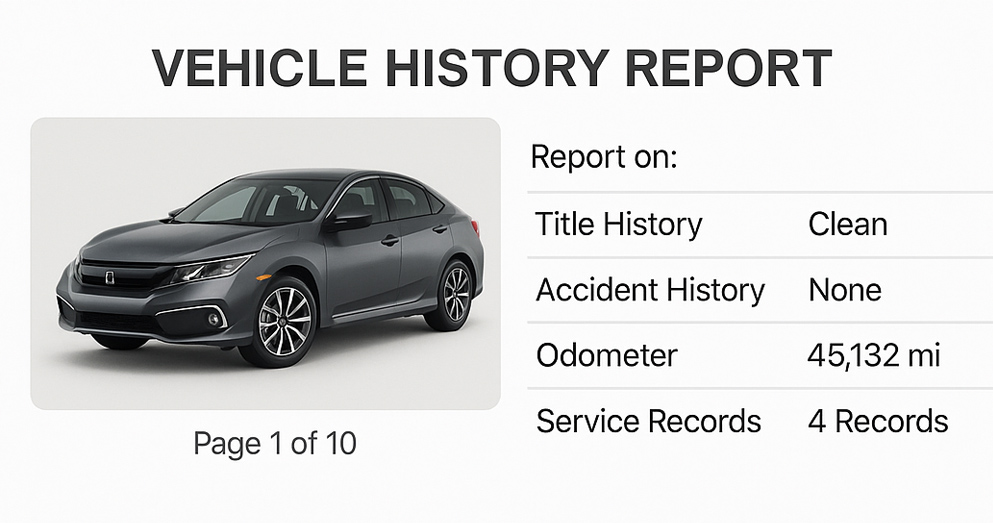
Vehicle History Report

Vehicle
Specifications
Ownership
History
All History
Events
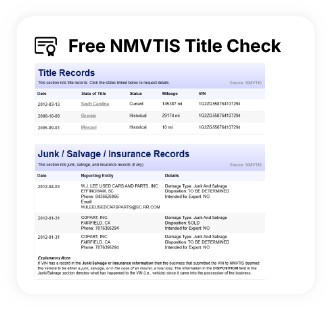
NMVTIS Title
History Check
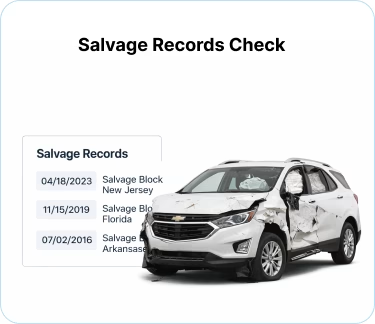
Salvage/Rebuilt
Check
Accident
Check
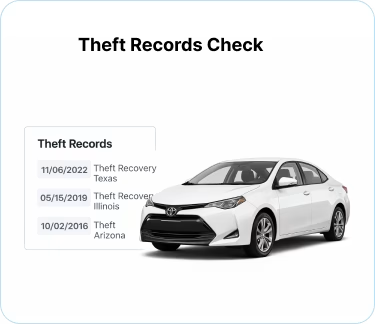
Theft
Check
Open Lien
Check
Past Sale
Listings
Safety
Recalls
Odometer
Check
Market Price
Analysis

What Problems Does the 1986 Honda Civic Have?

The 1986 Honda Civic, while renowned for its fundamental reliability, does exhibit several frequently reported problems and long-term concerns characteristic of vehicles from its era.

Rust: This is arguably the most pervasive long-term issue. Owners frequently report rust on the rear wheel arches, rocker panels, lower door sills, shock towers, and around the windshield and rear hatch. Honda's rust protection wasn't as advanced as it is today, making these areas prime targets, especially in regions with road salt or high humidity. Inspection for rust is paramount when considering a purchase.

Carburetor Issues: For non-Si models that came with carburetors (which was most of them), issues like rough idling, stalling, poor fuel economy, and difficulty starting when cold are common. Over time, vacuum lines degrade, jets clog, and wear on internal components can make precise tuning difficult. Many owners opt for a carburetor rebuild or even a swap to a more modern, aftermarket carburetor or basic EFI system.

Electrical Gremlins: While not widespread, intermittent electrical problems, such as flickering dash lights, faulty gauges, or non-functional power accessories (if equipped), can arise from aged wiring harnesses, corroded connectors, or failing grounds. The main relay, a common Honda weak point, can also cause intermittent starting issues.

Suspension Wear: After nearly four decades, original suspension components like bushings, ball joints, and shocks/struts are likely worn. This can lead to clunking noises, poor handling, and uneven tire wear. While replacements are generally affordable and available, it's a common maintenance item.

Oil Leaks: Old engine seals (cam, crank, distributor O-rings) and valve cover gaskets are prone to hardening and leaking oil over time. These are generally minor but require attention to prevent oil loss and keep the engine bay clean.

Exhaust System Corrosion: The original exhaust system is prone to rust and can develop leaks or breaks, especially the muffler and catalytic converter pipes.

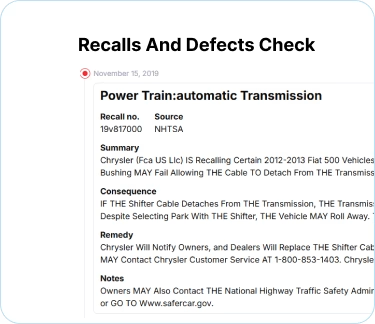
Recalls: For such an old vehicle, specific recall data is harder to track or less impactful today. Any recalls issued in the 1980s would have likely been addressed decades ago. Generic recalls related to potential brake light switches or minor electrical components might have existed, but there aren't any widely known, persistent, unaddressed critical recalls for the 1986 model year that affect its fundamental operation today beyond common wear and tear.

In summary, while the core mechanicals (engine and transmission) are robust, aging components and rust are the primary long-term reliability concerns. Many of these issues are addressable with typical classic car maintenance.

How long will the 1986 Honda Civic last?

Based on owner data and typical maintenance habits, a 1986 Honda Civic can easily achieve 200,000 to 300,000 miles, with many examples exceeding this, especially with diligent upkeep. The robust SOHC engines and manual transmissions are exceptionally durable. Longevity is more often limited by body rust than mechanical failure. Weaknesses over time primarily involve the aforementioned rust spreading through critical structural areas, deterioration of rubber components (bushings, hoses, seals), and carburetor wear on non-Si models. Electrical issues, while less common, can also surface. Regular oil changes, cooling system flushes, and proactive rust prevention are key to maximizing years of service. A well-maintained Civic from this era is a testament to Honda's engineering, capable of remarkable endurance.

What Technology & Safety Features are Included?

The 1986 Honda Civic reflects the automotive technology of its time, meaning its built-in tech, entertainment, driver-assistance, and safety features are rudimentary by modern standards. However, for its era, it offered a pragmatic approach.

Built-in Tech & Entertainment:
  • Audio System: Base models typically came with an AM/FM radio, often a simple unit with two speakers. Higher trims, like the DX or Si, could feature an AM/FM stereo cassette player. There were no CD players or digital audio inputs.
  • Instrumentation: A basic analog gauge cluster provided speed, fuel level, and engine temperature. A tachometer was standard on Si and S trims, and optional or unavailable on others. Warning lights for oil pressure, battery, and check engine light (on Si) were present.
  • Climate Control: A manual heating and ventilation system was standard. Air conditioning was an optional feature, often dealer-installed, and could be found on higher trims.
  • Other Conveniences: Intermittent wipers were available, along with a rear window defroster and, on hatchbacks/wagons, a rear wiper. Some models offered a digital clock. Power steering was optional, predominantly on Si models.

Driver-Assistance & Safety Features:
  • Passive Safety: The primary safety features were the vehicle's unibody construction, front and rear crumple zones (designed to absorb impact), and three-point seatbelts for front occupants (lap belts for rear middle). There were no airbags, anti-lock brakes (ABS), or traction control systems.
  • Visibility: Large glass areas provided good outward visibility, a passive safety benefit.
  • Brakes: Most models featured front disc brakes and rear drum brakes. The Si trim often had slightly larger or ventilated front discs for improved stopping power.

Optional Features:
Options were limited but included air conditioning, power steering (mostly on Si), alloy wheels (Si), and upgraded stereo systems.

Crash-Test Ratings:
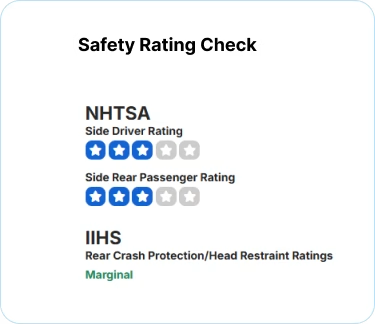
Formal, standardized crash-test ratings like those from NHTSA or IIHS (with star ratings) did not exist in the same comprehensive way in 1986. Automotive safety evaluations of that period focused more on regulatory compliance. Therefore, direct "crash-test ratings" as understood today are not available for the 1986 Honda Civic. Its safety was considered typical for small cars of its era, emphasizing occupant restraint via seatbelts and structural integrity against basic impacts. Modern safety expectations are vastly different, meaning the 1986 Civic would perform poorly by today's standards.

What Colors Options are Available?

We’re working on this section!
In the meantime, feel free to explore the other sections for more content.

1986 Honda Civic Prices and Market Value

When new in 1986, the Honda Civic ranged from approximately $6,000 for a base hatchback to around $9,000-$10,000 for a well-equipped Si or CRX Si. Like most mass-market vehicles, it experienced rapid depreciation in its initial years. However, its reputation for reliability and economy meant it held its value better than many domestic rivals.

Currently, the used market prices are highly varied. A non-running or very rough example might be under $1,000. Clean, well-maintained DX or standard hatchback/sedan models can fetch $3,000-$6,000. The true outliers are the Si and CRX Si models, which have appreciated significantly due to their "classic" status and enthusiast demand. Pristine, low-mileage examples of these sportier trims can command $10,000 to $20,000+, and even higher for exceptional, original condition CRX Si. Factors affecting resale value today include condition (especially rust-free bodywork), originality, mileage, and desirability of the specific trim (Si/CRX models being most valuable).

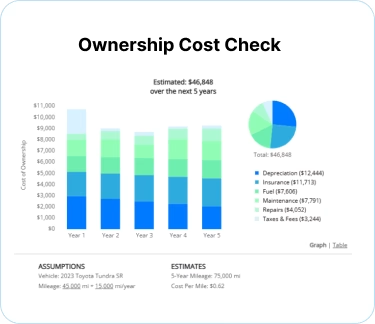
1986 Honda Civic Cost of Ownership

The 1986 Honda Civic is overwhelmingly economical to own. Insurance costs are typically very low due to its age and lack of complex features; however, collectors insurance might be needed for high-value Si/CRX models. Fuel costs are minimal thanks to excellent MPG. Maintenance is straightforward, with parts generally inexpensive and readily available, often performable by DIY enthusiasts. Repairs are also budget-friendly, as the mechanicals are simple and robust. Major issues are rare if maintained, though rust repair can be costly. Long-term, beyond initial restoration for neglected examples, it's one of the most cost-effective classic cars to run. It's a testament to simple, durable engineering.

1986 Honda Civic Fuel Efficiency

Fuel Type Gasoline
Fuel Capacity -
City Mileage -
Highway Mileage -

1986 Honda Civic Warranty

Basic
Original warranty 0 months / No data
Estimated remaining Expired
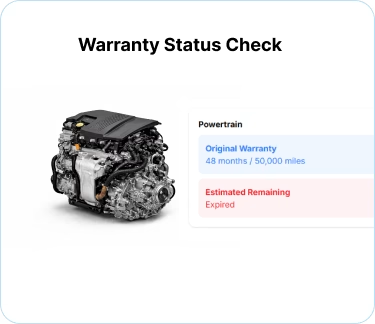
Powertrain
Original warranty 0 months / No data
Estimated remaining Expired
Rust
Original warranty 0 months / No data
Estimated remaining Expired

1986 Honda Civic Insurance

Insurance for a 1986 Honda Civic is moderately priced, reflecting its status as a Sedan with strong safety ratings and
reasonable repair costs.

How Does the 1986 Honda Civic Compare to Other Sedan?

The 1986 Honda Civic competed fiercely in the compact car segment against rivals like the Toyota Corolla, Nissan Sentra, Volkswagen Golf/Rabbit, and the Ford Escort.

Performance: The Civic, especially in Si trim, generally offered a more spirited and engaging driving experience than most competitors. While the base 1.5L was competitive with Corolla and Sentra's equivalent engines, the Civic Si's 91 hp 1.5L fuel-injected engine delivered notably better acceleration and handling dynamics than the vast majority of its direct rivals, except perhaps the Volkswagen GTI. The Corolla, Sentra, and Escort were generally less athletic and more comfort-oriented, with less engine output. The Golf GTI was its closest performance peer.

Features: Feature-wise, the Civic was on par with its Japanese competitors (Corolla, Sentra), offering basic amenities. It didn't boast revolutionary features but focused on functional design. The European rivals like the Golf might have offered a slightly more refined interior or different optional packages, while American cars like the Escort often felt less substantial in build quality and materials. No car in this segment offered significant driver-assistance or advanced infotainment in 1986.

Reliability: This is where the Civic truly shone, often surpassing most rivals. Honda's reputation for bulletproof engines and transmissions, coupled with good build quality, made it more reliable than the Ford Escort and often marginally better than the VW Golf (which could suffer from more electrical gremlins). Toyota Corolla and Nissan Sentra were strong contenders in reliability, often matching the Civic's longevity.

Price: New, the Civic was competitively priced within its segment, often offering better value for money than some European rivals while being slightly more premium than basic domestic offerings. Today, its used price for standard models is similar to equivalent Corollas and Sentras, but the Si and CRX Si models command significantly higher prices, reflecting their enthusiast appeal and rarity, unlike most of their direct competitors.

Recommendations for Alternatives:
  • For similar reliability and economy: The 1986 Toyota Corolla (especially the AE86 for RWD enthusiasts, though less common) or Nissan Sentra are excellent alternatives. They offer comparable dependability and ease of ownership.
  • For better performance (similar era): The Volkswagen Golf GTI (Mk2) is the most direct and formidable rival to the Civic Si/CRX Si, offering similar "hot hatch" thrills, though potentially with higher maintenance costs.
  • For a different "fun factor": Consider the Subaru GL/Loyale wagon with its optional 4WD, offering unique utility for the era, though not as sporty as the Civic.

In summary, the 1986 Honda Civic stood out for its balanced blend of reliability, efficiency, and surprising driving dynamics, especially in its sportier iterations.

Final Verdict: Is the 1986 Honda Civic a Good Sedan?

The 1986 Honda Civic is an excellent choice for a variety of buyers, particularly those appreciating classic Japanese reliability and engaging driving. It's ideal for first-time classic car owners, economy-minded drivers seeking a vintage daily, or enthusiasts looking for a project with strong aftermarket support. For a practical, low-cost "runabout", a well-preserved DX or S hatchback is definitely worth buying. If you seek a "driver's car" and value sporty handling, the Si or CRX Si trims are highly recommended and are absolutely worth buying, but expect to pay a premium. Condition is paramount, with rust-free examples being the holy grail. Buy used, as new is obviously not an option, and prioritize examples with documented maintenance and minimal body rust. Avoid heavily modified or neglected vehicles unless you're prepared for extensive restoration. Overall, it's a truly iconic and rewarding ownership experience.

1986 Honda Civic Owner Reviews

0.00
Consumer Rating, Based on 0 Consumer Reviews
Overall rating
Cancel
Thank You for Your Review!

We truly appreciate the time and effort you took to share your experience with us.

Uh oh!

Something went wrong, please try again later.

Author Image
Drew B

Drew is a seasoned automotive expert and contributor to VinCheck.info. With nearly 15 years of experience as a former Porsche technician, he brings a wealth of hands-on knowledge to his writing. Born in North Carolina, a region renowned for its deep-rooted NASCAR culture, Drew developed a passion for cars early in life, often building and working on vehicles from a young age. At VINCheck, Drew leverages his extensive technical background to provide in-depth analyses of various vehicles. His articles often focus on engine performance, reliability, and maintenance insights, offering readers practical information grounded in real-world experience. Some of his notable contributions include reviews on the Mazda CX-5's longevity and detailed examinations of engine options for models like the 2011 Toyota Camry and Tacoma