
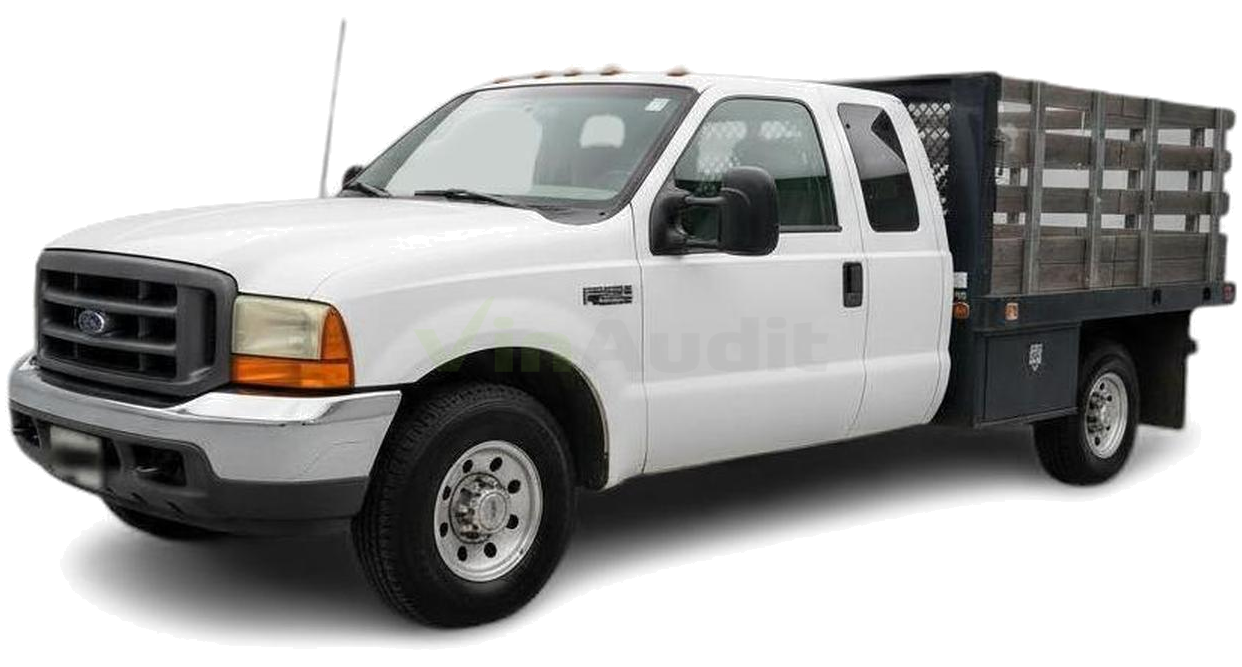
The Good
The 2000 Ford F-350 Super Duty boasts exceptional performance for heavy tasks, thanks to its powerful engine options, particularly the highly reliable 7.3L Power Stroke diesel. Its commanding design evokes a sense of strength and capability, appealing emotionally to those who value raw power and dependability. Practically, it offers excellent long-term value due to its durable construction, impressive towing/hauling capacity, and the enduring demand for its robust mechanicals, making it a truly indispensable work truck.
The Bad
Potential weaknesses for the 2000 Ford F-350 Super Duty include rust, particularly on the frame, cab corners, and bed. Watch out for aging steering components like ball joints and steering boxes, which often require replacement. The 7.3L Power Stroke can have Camshaft Position Sensor (CPS) and fuel system issues. The 4R100 transmission also requires careful maintenance to avoid common wear-related problems.
2000 Ford F-350 Super Duty: Quick Overview
- Engine Options:
- 5.4L "Triton" SOHC V8 Gasoline Engine
- 6.8L "Triton" SOHC V10 Gasoline Engine
- 7.3L "Power Stroke" OHV V8 Turbodiesel Engine
- Horsepower & Torque:
- 5.4L V8: Approx. 260 hp @ 4500 rpm, 350 lb-ft torque @ 2500 rpm
- 6.8L V10: Approx. 275 hp @ 4250 rpm, 410 lb-ft torque @ 2750 rpm
- 7.3L Power Stroke V8 Diesel: Approx. 235 hp @ 2600 rpm, 500 lb-ft torque @ 1600 rpm (earlier versions), later versions could reach 275 hp / 520 lb-ft (with automatic transmission)
- Fuel Economy:
Heavy-duty trucks like the F-350 were not rated by EPA for fuel economy in 2000. Real-world estimates vary greatly based on load, driving style, and engine:- Gas Engines: Typically 8-12 MPG.
- 7.3L Power Stroke Diesel: Generally 12-18 MPG, with some owners reporting higher on the highway unloaded.
- 0-60 Times:
Not a performance-oriented vehicle. 0-60 times are slow by modern standards, typically in the 10-14 second range depending on engine, transmission, and load. - Towing Capacity:
Varied significantly by configuration (engine, transmission, cab, 2WD/4WD, single/dual rear wheel).- Conventional Towing: Roughly 10,000 to 12,500 lbs.
- 5th-Wheel/Gooseneck Towing: Up to approximately 14,500 lbs for the 7.3L diesel with dual rear wheels.
- Payload Capacity: Up to 5,000+ lbs for DRW models.
- Trim-Level Features:
- XL: Basic work truck. Manual windows/locks, vinyl seating, AM/FM radio, steel wheels. Focus on utility and durability.
- XLT: Mid-range trim. Cloth seating, power windows/locks/mirrors, keyless entry, CD player, cruise control, chrome bumpers/grille, alloy wheels optional. Offered a balance of work capability and comfort.
- Lariat: Top-tier luxury. Leather upholstery, power driver's seat, automatic headlights, upgraded audio system, wood grain interior accents, climate control, fog lights, more extensive chrome trim. Aimed at buyers wanting a comfortable and well-equipped heavy-duty truck.
2000 Ford F-350 Super Duty Specifications
Vehicle Information
| Year | 2000 |
| Make | Ford |
| Model | F-350 Super Duty |
| Trim | - |
| Style | - |
| Type | Pickup Truck |
| Category | Standard Pickup Truck |
Manufacturing Details
| Made In | United States |
| Manufacturing City | JEFFERSON COUNTY |
Dimensions
| Doors | 4-Door |
| Curb Weight | 6304 pounds |
| Gross Vehicle Weight Rating | 11200 pounds |
| Overall Height | 77.80 inches |
| Overall Length | 262.00 inches |
| Overall Width | 95.50 inches |
| Wheelbase Length | 172.40 inches |
| Standard Seating | 6 |
Engine & Performance
| Engine | 7.3L V8 |
| Engine Size | 7.3L |
| Engine Cylinders | 8 |
| Transmission | 6-Speed Manual |
| Transmission Type | Manual |
| Transmission Speeds | 6-Speed |
| Drivetrain | Rear-Wheel Drive |
Additional Features
| Anti-Brake System | 2-Wheel ABS 4-Wheel ABS |
| Steering Type | Recirculating |
Pricing
| Manufacturer Suggested Retail Price (MSRP) | $30,875 |
| Invoice Price | $26,849 |
| Delivery Charges | - |
Vehicle History Report
Specifications
History
Events
History Check
Check
Check
Check
Check
Listings
Recalls
Check
Analysis
What Problems Does the 2000 Ford F-350 Super Duty Have?
Gasoline engines, particularly the 5.4L V8 and 6.8L V10, can experience spark plug ejection issues, especially if plugs are not torqued correctly or if threads are damaged. Exhaust manifold studs are also prone to breaking, leading to exhaust leaks.
The 4R100 automatic transmission, used across all engine options, is a known weak point. It can suffer from overheating, converter clutch issues, and solenoid failures, especially if regularly pushed to its towing limits without proper cooling and maintenance.
Chassis and suspension components are another area of concern. Ball joints, tie rods, and steering box wear are very common, necessitating regular replacement. Leaf springs can sag over time, and rust on the frame, brake lines, and fuel tank straps is a significant issue, particularly in regions with road salt. Body rust on cab corners, rocker panels, and wheel arches is also prevalent.
Electrically, dash cluster issues, blend door actuators failing for HVAC, and general wiring harness deterioration can occur. Brake systems may experience warped rotors and seizing calipers due to age and heavy use.
Regarding recalls, a significant one affected many Ford trucks of this era, including the Super Duty: the Speed Control Deactivation Switch recall. This switch, if faulty, could overheat and cause a fire, even when the vehicle was turned off. Another notable recall involved the parking brake cable, which could corrode and prevent the parking brake from fully engaging or releasing.
How long will the 2000 Ford F-350 Super Duty last?
Over time, weaknesses emerge as expected: rust becomes a major concern for the frame and body, especially in northern climates. Suspension and steering components like ball joints, tie rods, and steering boxes will wear out multiple times. The 4R100 transmission can fail if neglected or overloaded. While the engine "cores" are incredibly durable, ancillary components (sensors, fuel lines, wiring harnesses) will eventually degrade, requiring attention. Owners committed to preventative care and willing to perform repairs will find these trucks immensely satisfying and long-lasting.
What Technology & Safety Features are Included?
Built-in Tech & Entertainment: Standard features on lower trims typically included an AM/FM radio. Higher trims like the XLT and Lariat offered an AM/FM stereo with a cassette player, and a CD player was an available option. Climate control was manual, and dashboards featured analog gauges for speed, RPM, fuel, and vital engine temperatures. There were no integrated navigation systems, touchscreens, or USB connectivity. Interior controls were primarily physical buttons and knobs, designed for durability and ease of use, even with work gloves.
Driver-Assistance Features: Modern driver-assistance technologies like adaptive cruise control, lane-keeping assist, or blind-spot monitoring were non-existent. The most advanced driver-assistance feature available was likely cruise control, which was standard on higher trims and optional on others.
Safety Features: Standard safety equipment included dual front airbags for the driver and front passenger. Four-wheel anti-lock brakes (ABS) were either optional or standard on certain configurations and trims. The truck's sheer size and heavy-duty frame provided a significant degree of passive safety. Seat belts for all occupants were standard. Unlike modern vehicles, there were no advanced stability control systems, traction control, or sophisticated crumple zones beyond basic engineering.
Optional Features: Beyond the previously mentioned CD player and ABS, optional features that enhanced convenience and safety included power windows, power door locks, remote keyless entry, power-adjustable mirrors, and an optional power-adjustable driver's seat on higher trims. Fog lights were also an available option. An integrated trailer brake controller was not commonly factory-installed in this era, with aftermarket units being the prevalent choice.
Crash-Test Ratings: Heavy-duty trucks like the F-350 Super Duty were not typically subjected to the same standardized crash-test ratings by organizations like the NHTSA or IIHS that passenger vehicles received. Their mass and construction were generally assumed to offer substantial protection in collisions, but specific numerical ratings for frontal, side, or rollover impacts are generally not available for this model year.
What Colors Options are Available?
2000 Ford F-350 Super Duty Prices and Market Value
In today's used market, prices are highly variable. A rough, high-mileage gas model might fetch $5,000-$8,000. Well-maintained 7.3L Power Stroke diesel models, especially Crew Cab 4x4s, command a significant premium, often selling for $15,000-$25,000, with exceptionally clean, low-mileage examples sometimes exceeding $30,000.
Depreciation insights reveal that while initial depreciation was steep, the 7.3L Power Stroke models have experienced an unusual phenomenon: appreciation or stable value in recent years due to their reputation for reliability and simplicity compared to newer, more complex diesels. Factors affecting current resale value include engine type (7.3L diesel is king), mileage, overall condition (rust is a major detractor), maintenance history, 4x4 capability, and cab configuration. A clean, well-documented 7.3L F-350 is highly sought after and holds its value exceptionally well.
2000 Ford F-350 Super Duty Cost of Ownership
2000 Ford F-350 Super Duty Fuel Efficiency
2000 Ford F-350 Super Duty Safety Rating
NHTSA
IIHS
2000 Ford F-350 Super Duty Recalls & Defects
Fuel System, Gasoline:storage:tank Assembly
Fuel System, Gasoline:storage:tank Assembly
Visibility:windshield Wiper/Washer:motor
Vehicle Speed Control
Equipment:electrical
2000 Ford F-350 Super Duty Warranty
Basic
Powertrain
Rust
2000 Ford F-350 Super Duty Insurance
reasonable repair costs.
How Does the 2000 Ford F-350 Super Duty Compare to Other Pickup Truck?
In terms of performance, all three offered serious towing and hauling capabilities. The Ford's 7.3L Power Stroke diesel was renowned for its robust torque and durability, easily matching or exceeding its rivals. The Dodge Ram 3500, however, was a formidable competitor, offering the legendary 5.9L Cummins diesel, known for even greater longevity and torque output. GM's offering around this time typically included a 6.5L Detroit Diesel (less favored for power and reliability) or large gas engines, which generally couldn't match the diesel torque of Ford or Dodge.
Features were quite similar across the board, focusing on utilitarian aspects with available upgrades like power accessories, AC, and basic audio. Ford's Lariat trim often felt slightly more upscale than comparable GM and Dodge offerings of the era, though all offered comfortable interiors for work trucks.
Reliability is where the Ford 7.3L Power Stroke and Dodge 5.9L Cummins truly shined, both considered among the most reliable diesel engines ever produced, easily capable of 300,000+ miles. GM's 6.5L diesel was generally considered less reliable and powerful than its competitors. Gas engines across all brands were reasonably reliable but naturally didn't offer the same work-life.
Price when new was comparable across the manufacturers for similar configurations. In the current used market, the 7.3L Power Stroke F-350s and 5.9L Cummins Ram 3500s often command higher prices than their GM counterparts due to their enduring reputation for reliability and strong aftermarket support.
Alternatives: For someone prioritizing ultimate engine longevity and torque, a well-maintained Dodge Ram 3500 with the 5.9L Cummins diesel (2nd gen, '94-'02) is a strong alternative, often considered the gold standard for mechanical simplicity. If modern amenities and safety features are a concern, a newer generation F-350 (2008+) or a GM Duramax-equipped HD truck (2007.5+) would be "better" but at a significantly higher cost. For a budget-friendly, highly capable work truck from this era, the 2000 F-350 7.3L is still a top contender, alongside the Cummins-powered Ram.
Final Verdict: Is the 2000 Ford F-350 Super Duty a Good Pickup Truck?
It is absolutely worth buying under the right conditions. Since it's a vintage vehicle, "new" is not an option. Focus on a used model with a well-documented maintenance history and minimal rust. The 7.3L Power Stroke diesel in XLT or Lariat trim (for comfort) is the most sought-after configuration. Avoid neglected examples or those with significant frame rust. It's not ideal as a primary daily driver for urban commuting due to its size and fuel economy, but excels as a dedicated workhorse or weekend hauler, offering tremendous capability and reliability for its price point.

Simon A
Simon is a contributor to VinCheck, where he provides articles and reviews on various automotive topics. His work focuses on delivering accurate and up-to-date information about used cars, helping readers make informed decisions.