
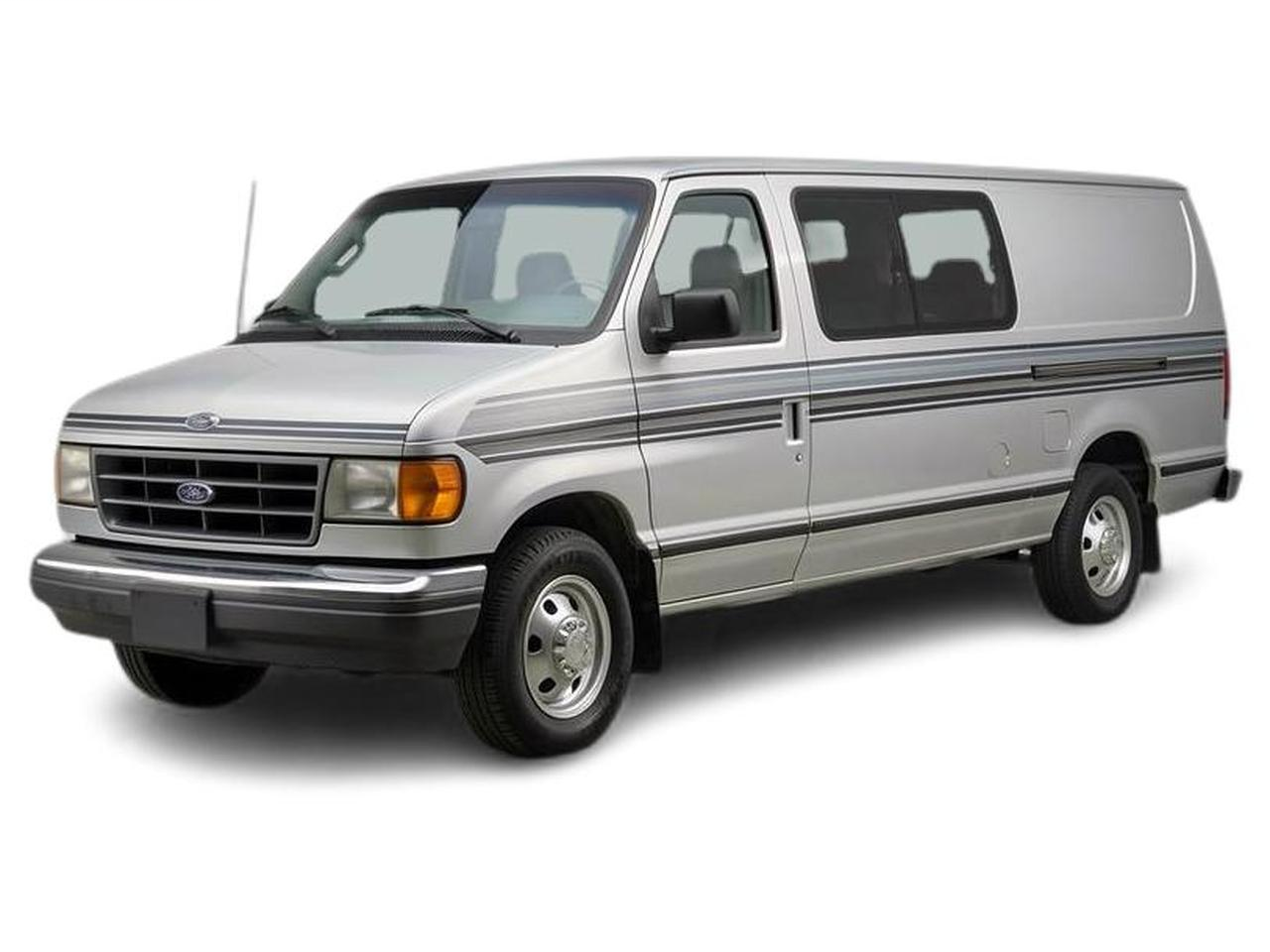
The Good
The 1993 E-350 offers exceptional utility and unwavering reliability, appealing to the practical need for dependable transportation. Its spacious interior and robust build evoke a sense of security and capability, while its straightforward design ensures ease of maintenance for long-term value.
The Bad
Common areas to watch for on the 1993 E-350 include potential rust, especially in the body panels and frame. The aging of electrical components, interior wear and tear, and the condition of suspension and brake systems are also important considerations due to its age.
1993 Ford E-350: Quick Overview
- Engine Options: The 1993 Ford E-350 offered a choice of gasoline engines. The standard engine was typically a 4.9L inline-six, while a more powerful 5.8L V8 was also available. Some heavy-duty configurations might have offered a 7.5L V8. Diesel options were less common for this specific model year in the US market, but could be found in some export or specialized configurations.
- Horsepower: Horsepower varied by engine. The 4.9L inline-six generally produced around 145-150 horsepower. The 5.8L V8 offered approximately 185-190 horsepower, and the larger 7.5L V8 would have delivered closer to 230 horsepower.
- Fuel Economy: As expected for a heavy-duty van of this era, fuel economy was not a strong suit. Official EPA estimates are often not available for such vehicles, but owners typically reported figures in the range of 10-15 MPG combined, heavily dependent on engine choice, load, and driving conditions.
- 0-60 Times: 0-60 MPH times were not a performance metric typically advertised or focused on for the E-350. Given its size and weight, acceleration was leisurely, especially when loaded. Expect times well over 10 seconds, likely in the 12-15 second range for unloaded models with the V8 engines, and significantly longer for the inline-six or when towing.
- Towing Capacity: Towing capacity varied significantly based on the specific configuration (e.g., axle ratios, engine, chassis package). Properly equipped E-350 models could tow substantial loads, often in the range of 7,000 to 10,000 pounds or more, making it suitable for heavy-duty towing applications.
- Trim-Level Features: Trim levels primarily differentiated passenger comfort and convenience. Base models were spartan, focused on utility with vinyl seats and minimal amenities. Higher trims, especially in passenger configurations (like the Chateau), could include features such as upgraded upholstery, captain's chairs, interior trim packages, air conditioning, and more robust sound systems. Cargo van trims focused on durability and functionality with heavy-duty flooring and cargo tie-downs.
1993 Ford E-350 Specifications
Vehicle Information
| Year | 1993 |
| Make | Ford |
| Model | E-350 |
| Trim | - |
| Style | Econoline Van RWD 4AT 7.5L V8 |
| Type | Van |
| Category | commercial |
Manufacturing Details
| Made In | United States |
| Manufacturing City | LORAIN |
Dimensions
| Doors | 4-Door |
| Curb Weight | 5000 pounds |
| Gross Vehicle Weight Rating | - |
| Overall Height | 81 inches |
| Overall Length | 210 inches |
| Overall Width | 79 inches |
| Wheelbase Length | 138 inches |
| Standard Seating | 8 |
Engine & Performance
| Engine | 7.5L V8 |
| Engine Size | 7.5L |
| Engine Cylinders | 8 |
| Transmission | 4-Speed Automatic |
| Transmission Type | Automatic |
| Transmission Speeds | 4-Speed |
| Drivetrain | Rear-Wheel Drive |
Additional Features
| Anti-Brake System | - |
| Steering Type | Recirculating Ball |
Pricing
| Manufacturer Suggested Retail Price (MSRP) | $25,000 |
| Invoice Price | $23,000 |
| Delivery Charges | $800 |
Vehicle History Report
Specifications
History
Events
History Check
Check
Check
Check
Check
Listings
Recalls
Check
Analysis
What Problems Does the 1993 Ford E-350 Have?
Mechanically, the powertrain is generally robust, but maintenance is key. Spark plug blowouts on the Triton V8 engines (though less common on the 1993 model year 5.8L compared to later versions) could occur if not properly torqued. Transmission issues, especially with automatic transmissions like the E4OD, could arise if fluid changes were neglected or if the transmission was overworked. Overheating can be an issue if the cooling system is not maintained.
Electrical gremlins are also a possibility with age. Fraying wiring harnesses, failing sensors, and issues with the alternator or starter can develop. The interior components, such as upholstery, dashboard materials, and seals, may show wear and tear. Door locks, window regulators, and hinges can also become problematic over time.
Regarding recalls, specific to the 1993 model year, it is always advisable to check with the National Highway Traffic Safety Administration (NHTSA) for any outstanding or past recalls. However, general long-term reliability concerns for this era of E-350 are primarily tied to its age and the need for consistent maintenance. With regular fluid changes, addressing minor issues promptly, and mitigating rust, these vans can be very durable. Weaknesses tend to be exacerbated by heavy use, lack of maintenance, or exposure to corrosive environments. Model year specific issues are less pronounced for the E-350 compared to some passenger cars, as the platform was very consistent over several years.
How long will the 1993 Ford E-350 last?
What Technology & Safety Features are Included?
Driver-assistance features were virtually non-existent in the modern sense. There were no advanced cruise control systems, lane keeping assists, or parking sensors. The focus was on providing the driver with basic controls and visibility. Features like power windows and power door locks were often optional, especially on base cargo models.
Safety features were limited but standard for the era. This included seat belts (lap and shoulder belts for front occupants), front airbags (driver-side became standard around this time for Ford vehicles, but passenger airbags were not common in vans), and basic safety glass. Anti-lock braking system (ABS) was likely an optional feature on some models, particularly for heavier duty configurations.
Crash-test ratings for commercial vans like the 1993 E-350 are not as widely publicized or as comprehensive as those for passenger cars. Ford's focus at the time was on structural integrity and occupant protection within the robust van framework. However, older vehicles generally do not perform as well in modern crash tests compared to contemporary vehicles due to advancements in safety cell design, crumple zones, and restraint systems. Optional features would have primarily revolved around comfort and utility rather than technology or advanced safety.
What Colors Options are Available?
1993 Ford E-350 Prices and Market Value
1993 Ford E-350 Cost of Ownership
1993 Ford E-350 Fuel Efficiency
1993 Ford E-350 Insurance
reasonable repair costs.
How Does the 1993 Ford E-350 Compare to Other Van?
Performance: In terms of raw power and towing, the E-350 with its optional V8 engines was competitive. The Chevrolet/GMC vans offered similar engine choices, with V8s providing comparable torque and hauling capability. Fuel economy across all these heavy-duty vans of this era was generally poor, in the 10-15 MPG range, with little to distinguish them.
Features: Features in 1993 were utilitarian. All three offered basic amenities like radios, heating, and optional A/C. Higher trims might add power accessories or better upholstery. None offered the advanced technology or driver aids seen in modern vehicles. The interior space and configuration versatility were similar across the board, catering to cargo or passenger transport.
Reliability: Ford's E-Series, including the E-350, has a reputation for robust, simple mechanicals, leading to strong long-term reliability, especially if maintained. Chevrolet/GMC vans of this era also offered good reliability, though some transmissions might have had specific concerns depending on the year and model. Overall, the E-350 was a solid contender.
Price: New prices were competitive. On the used market, the 1993 E-350 often presents excellent value, frequently being priced similarly to or slightly below its Chevy/GMC counterparts of the same vintage, especially considering its robust build.
Alternatives: For similar capability, the Chevrolet G-Series vans (like the G20/G30) from the same era are direct competitors. If looking for something newer with potentially more modern (though still basic) features and improved safety, a later model Ford Econoline or Chevrolet Express/GMC Savana from the late 1990s or early 2000s could be considered, though they would likely command higher prices. For those prioritizing efficiency in a van format, modern options are scarce, but if the need is more for a large SUV with towing capacity, vehicles like the Chevrolet Suburban or Ford Expedition offer passenger comfort with significant hauling ability, albeit less cargo volume.
Final Verdict: Is the 1993 Ford E-350 a Good Van?

Drew B
Drew is a seasoned automotive expert and contributor to VinCheck.info. With nearly 15 years of experience as a former Porsche technician, he brings a wealth of hands-on knowledge to his writing. Born in North Carolina, a region renowned for its deep-rooted NASCAR culture, Drew developed a passion for cars early in life, often building and working on vehicles from a young age. At VINCheck, Drew leverages his extensive technical background to provide in-depth analyses of various vehicles. His articles often focus on engine performance, reliability, and maintenance insights, offering readers practical information grounded in real-world experience. Some of his notable contributions include reviews on the Mazda CX-5's longevity and detailed examinations of engine options for models like the 2011 Toyota Camry and Tacoma